Tons of dead sardines scooped from Calif. harbor
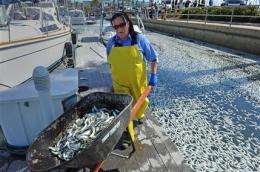
In this Tuesday, March 8, 2011 file photo, Annette Burch gathers up dead fish in the King Harbor area of Redondo Beach, south of Los Angeles. Cleaning crews on Sunday, March 13 finished removing millions of fish found floating dead in a Southern California marina, five days after the slimy, stinking mass of sardines was discovered. (AP Photo/The Daily Breeze, Brad Graverson, File)
(AP) -- Cleaning crews on Sunday finished removing millions of fish found floating dead in a Southern California marina, five days after the slimy, stinking mass of sardines was discovered.
Crews from several coastal cities and more than 700 volunteers removed about 140 tons of dead sardines from King Harbor in Redondo Beach, city officials said in a statement.
The fish were taken to a composting center where they will be turned into fertilizer.
The city said that while the fish were gone, local crews will continue cleaning up the aftermath of the die-off in the harbor for another week.
Biologists from the University of Southern California and the California Department of Fish and Game have said critically low oxygen levels in the water caused the sardines to suffocate.
But the USC scientists said high levels of domoic acid were found in the sardines, which may have distressed them off the Los Angeles coastline and caused them to swim into the Redondo Beach marina.
Fish and game officials also were testing fish for toxins at its animal forensics laboratory. Results were expected this week.
Domoic acid is often found in the stomach of fish that have been feeding on plankton during toxic algae blooms, one of which was spotted off Redondo Beach on Wednesday.
The toxin has been linked to neurological disorders, illnesses and deaths in seabirds, sea lions, sea otters and whales, spurring concerns for the gulls, pelicans and other sea life that have been feasting on the dead fish in King Harbor.
The sardines died late Monday and caked the water's surface the next morning, stacking up to 2 feet deep in some spots.
©2010 The Associated Press. All rights reserved. This material may not be published, broadcast, rewritten or redistributed.
-
From lemons to lemonade: Reaction uses carbon dioxide to make carbon-based semiconductor,
32 comments
-
Thioridazine kills cancer stem cells in human while avoiding toxic side-effects of conventional cancer treatments,
3 comments
-
SpaceX private rocket blasts off for space station (Update),
42 comments
-
Climate scientists say they have solved riddle of rising sea,
30 comments
-
Research team claims to have found evidence Lake Cheko is impact crater for Tunguska Event,
18 comments
-
What would stain as translucent on light-coloured fabric?
9 hours ago
-
How do I identify different bacteria on culture plates?
19 hours ago
-
Why Do Dogs do Strange things...
May 25, 2012
-
What does exophillic and endophillic mean in terms of mosquito and their control?
May 24, 2012
-
Semen stains glows under black lights (uv light)?
May 23, 2012
-
Question on Human Chromosome 2
May 23, 2012
- More from Physics Forums - Biology
More news stories
Scientist: Evolution debate will soon be history
(AP) -- Richard Leakey predicts skepticism over evolution will soon be history. Not that the avowed atheist has any doubts himself.
8 hours ago |
3.4 / 5 (8) |
21
Thousands of shellfish found dead in Peru
Thousands of crustaceans were found dead off the coast of Lima following the mystery mass death of dolphins and pelicans, the Peruvian Navy said Friday.
18 hours ago |
4.8 / 5 (4) |
6
More plant species responding to global warming than previously thought
(Phys.org) -- Far more wild plant species may be responding to global warming than previous large-scale estimates have suggested.
May 22, 2012 |
4.6 / 5 (14) |
18
|
Totally rad: Scientists create rewritable digital data storage in DNA
(Phys.org) -- Scientists from Stanford's Department of Bioengineering have devised a method for repeatedly encoding, storing and erasing digital data within the DNA of living cells.
May 21, 2012 |
4.9 / 5 (17) |
11
|
For monogamous sparrows, it doesn't pay to stray (but they do it anyway)
It's quite common for a female song sparrow to stray from her breeding partner and mate with the male next door, but a new study shows that sleeping around can be costly.
May 22, 2012 |
5 / 5 (1) |
7
|
Dell tablet leak: 10.1-inch display, two-battery choice
(Phys.org) -- Headline after headline talks about vendors tablets in the wings as likely number-one contenders for the iPad. Such claims have justifiably been taken with a grain of salt, considering ...
SpotterRF debuts Radar Backpack Kit (w/ Video)
(Phys.org) -- SpotterRF has announced a special radar backpack kit designed to enhance situational awareness for soldiers on the ground. The company says its special radar is designed for warfighters as part ...
SpaceX capsule has 'new car' smell, astronauts say (Update)
SpaceX's Dragon cargo vessel smells like a new car, said astronauts at the International Space Station after opening the hatches Saturday following the spacecraft's landmark mission to the orbiting lab.
Astronomers seize last chance in lifetime for Venus Transit
Astronomers are gearing for one the rarest events in the Solar System: an alignment of Earth, Venus and the Sun that will not be seen for another 105 years.
Keep food safety in mind this memorial day weekend
(HealthDay) -- Picnics, parades and cookouts are as much a part of Memorial Day weekend as tributes to the United States' war veterans.
Australia hails surprise super-telescope decision
Australia has hailed a surprise decision giving it a role in a radio telescope project aimed at revolutionising astronomy, vowing to draw on its decades of experience in space science.