Seeing in stereo: Engineers invent lens for 3-D microscope
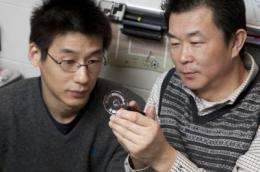
Two Ohio State University engineers inspect a lens that enables microscopes to capture 3-D images. Shown from left to right are inventors Lei Li, a postdoctoral researcher, and Allen Yi, associate professor of integrated systems engineering. Credit: Photo by Kevin Fitzsimons, courtesy of Ohio State University.
Engineers at Ohio State University have invented a lens that enables microscopic objects to be seen from nine different angles at once to create a 3D image.
Other 3D microscopes use multiple lenses or cameras that move around an object; the new lens is the first single, stationary lens to create microscopic 3D images by itself.
Allen Yi, associate professor of integrated systems engineering at Ohio State, and postdoctoral researcher Lei Li described the lens in a recent issue of the Journal of the Optical Society of America A.
Yi called the lens a proof of concept for manufacturers of microelectronics and medical devices, who currently use very complex machinery to view the tiny components that they assemble.
Though the engineers milled their prototype thermoplastic lens on a precision cutting machine, the same lens could be manufactured less expensively through traditional molding techniques, Yi said.
"Ultimately, we hope to help manufacturers reduce the number and sizes of equipment they need to miniaturize products," he added.
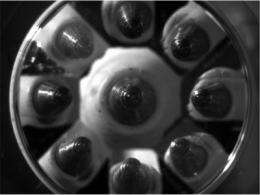
Researchers at Ohio State University have invented a 3-D microscope lens that gathers images of tiny objects from nine different angles at once. Here the lens captures a ballpoint pen tip that measures about 1 millimeter across. Credit: Image courtesy of Ohio State University.
The prototype lens, which is about the size of a fingernail, looks at first glance like a gem cut for a ring, with a flat top surrounded by eight facets. But while gemstones are cut for symmetry, this lens is not symmetric. The sizes and angles of the facets vary in minute ways that are hard to see with the naked eye."No matter which direction you look at this lens, you see a different shape," Yi explained. Such a lens is called a "freeform lens," a type of freeform optics.
Freeform optics have been in use for more than a decade. But Lei Li was able to write a computer program to design a freeform lens capable of imaging microscopic objects.
Then Yi and Li used a commercially available milling tool with a diamond blade to cut the shape from a piece of the common thermoplastic material polymethyl methacrylate, a transparent plastic that is sometimes called acrylic glass. The machine shaved bits of plastic from the lens in increments of 10 nanometers, or 10 billionths of a meter a distance about 5,000 times smaller than the diameter of a human hair.
The final lens resembled a rhinestone, with a faceted top and a wide, flat bottom. They installed the lens on a microscope with a camera looking down through the faceted side, and centered tiny objects beneath the flat side.
Each facet captured an image of the objects from a different angle, which can be combined on a computer into a 3D image.
The engineers successfully recorded 3D images of the tip of a ballpoint pen which has a diameter of about 1 millimeter and a mini drill bit with a diameter of 0.2 millimeters.
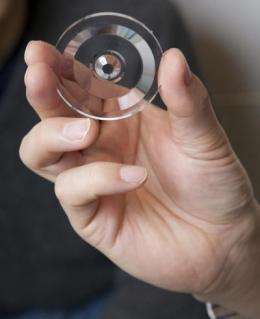
A lens invented at Ohio State University enables microscopes to capture 3-D images of tiny objects. Credit: Photo by Kevin Fitzsimons, courtesy of Ohio State University.
"Using our lens is basically like putting several microscopes into one microscope," said Li. "For us, the most attractive part of this project is we will be able to see the real shape of micro-samples instead of just a two-dimensional projection."In the future, Yi would like to develop the technology for manufacturers. He pointed to the medical testing industry, which is working to shrink devices that analyze fluid samples. Cutting tiny reservoirs and channels in plastic requires a clear view, and the depths must be carved with precision.
Computer-controlled machines rather than humans do the carving, and Yi says that the new lens can be placed in front of equipment that is already in use. It can also simplify the design of future machine vision equipment, since multiple lenses or moving cameras would no longer be necessary.
Other devices could use the tiny lens, and he and Li have since produced a grid-shaped array of lenses made to fit an optical sensor. Another dome-shaped lens is actually made of more than 1,000 tiny lenses, similar in appearance to an insect's eye.
Provided by
The Ohio State University
-
From lemons to lemonade: Reaction uses carbon dioxide to make carbon-based semiconductor,
32 comments
-
Thioridazine kills cancer stem cells in human while avoiding toxic side-effects of conventional cancer treatments,
3 comments
-
SpaceX private rocket blasts off for space station (Update),
42 comments
-
Climate scientists say they have solved riddle of rising sea,
30 comments
-
Research team claims to have found evidence Lake Cheko is impact crater for Tunguska Event,
18 comments
-
Writing a book so im learning about things, i have some general questions please read
2 hours ago
-
Question about induced E field.
3 hours ago
-
Charging a capacitor in a tesla coil
3 hours ago
-
Water Rocket
6 hours ago
-
why do trucks have bigger brakes?
11 hours ago
-
Solar Sail Physics - Do they work on a large scale?
12 hours ago
- More from Physics Forums - General Physics
More news stories
Landmark calculation clears the way to answering how matter is formed
(Phys.org) -- An international collaboration of scientists, including Thomas Blum, associate professor of physics, is reporting in landmark detail the decay process of a subatomic particle called a kaon ...
May 25, 2012 |
4.2 / 5 (21) |
47
|
Is a classical electrodynamics law incompatible with special relativity?
(Phys.org) -- The laws of classical electromagnetism that were developed in the 19th century are the same laws that scientists use today. They include Maxwell’s four equations along with the Lorentz la ...
Lying in wait for WIMPs: Researchers seek to dramatically increase sensitivity of Large Underground Xenon detector
Although it's invisible, dark matter accounts for at least 80 percent of the matter in the universe. No one knows what it is, but most scientists would bet on weakly interacting massive particles, or WIMPs.
May 23, 2012 |
4 / 5 (7) |
15
|
Hall effect at the speed of light: How can you demonstrate relativistic effects with your mobile phone?
The relativistic Hall effect describing objects rotating at speeds comparable with the speed of light has been reported.
May 21, 2012 |
4.3 / 5 (3) |
8
Cloak of invisibility: Engineers use plasmonics to create an invisible photodetector
A team of engineers at Stanford and the University of Pennsylvania has for the first time used "plasmonic cloaking" to create a device that can see without being seen - an invisible machine that detects light. It is the first ...
May 21, 2012 |
4.8 / 5 (16) |
7
|
Scientist: Evolution debate will soon be history
(AP) -- Richard Leakey predicts skepticism over evolution will soon be history. Not that the avowed atheist has any doubts himself.
Dell tablet leak: 10.1-inch display, two-battery choice
(Phys.org) -- Headline after headline talks about vendors tablets in the wings as likely number-one contenders for the iPad. Such claims have justifiably been taken with a grain of salt, considering ...
SpotterRF debuts Radar Backpack Kit (w/ Video)
(Phys.org) -- SpotterRF has announced a special radar backpack kit designed to enhance situational awareness for soldiers on the ground. The company says its special radar is designed for warfighters as part ...
SpaceX capsule has 'new car' smell, astronauts say (Update)
SpaceX's Dragon cargo vessel smells like a new car, said astronauts at the International Space Station after opening the hatches Saturday following the spacecraft's landmark mission to the orbiting lab.
Thousands of shellfish found dead in Peru
Thousands of crustaceans were found dead off the coast of Lima following the mystery mass death of dolphins and pelicans, the Peruvian Navy said Friday.
Astronomers seize last chance in lifetime for Venus Transit
Astronomers are gearing for one the rarest events in the Solar System: an alignment of Earth, Venus and the Sun that will not be seen for another 105 years.

