Turn to space tech when under pressure
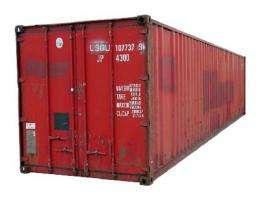
When engineers come up with a super-strong new material for building shipping containers, trucking trailers and aircraft parts, it is a major challenge to simulate its strength and reliability accurately. So a Belgian company turned to ESA.
A super-strong new material presents engineers with tricky challenges. The good news? They have a super-strong new building material. The bad news? If it is brand new and high-tech, there is no design or production experience, and it can be difficult to calculate the final strength through computer modeling.
This was the situation Belgian composite materials company Acrosoma found itself in a few years ago.
ESA’s Technology Transfer Program stepped in to suggest sophisticated software from space research and development that could reduce the weight of the containers so that each lorry could carry 10% more cargo.
This reduces the number of vehicles on the road, lowering both costs and carbon dioxide emission – which is good for the environment.
The problem was that it was not possible to test the panels physically because of their size, so computer simulations were needed.
“If you used a standard programme,” said Jan Verhaeghe, Acrosoma’s CEO, of the quandary his company faced at the time, “it showed that our panels were weak.”
The company was sure that the panels were strong enough, but “we needed to see how strong the panels actually would be,” said Mr. Verhaeghe.
“And we needed to convince the customers, as well.”
Space simulation software proved the strength
“We use the ESAComp software in preliminary design phases for space structures to analyse the composite materials’ performance and strength,” explained Andreas Obst, an engineer in ESA’s Structures and Mechanisms Division.
“We use it to determine the best material and the lightest structure, but it is still strong enough. It helps us save weight, which is very important for anything to go into space.”
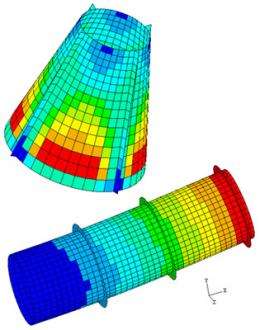
The link between Acrocoma’s problem and the space software ESAComp was established by Creation, a company, working with ESA's Technology Transfer Program Office as part of its National Technology Transfer Initiative in Belgium. Creation facilitates the spin-off of technology developed for space into terrestrial applications.
ESAComp was developed by ESA for the express purpose of designing and analysing composite materials used in, say, spacecraft and satellite launchers. The first issue was developed by Helsinki University of Technology and released in 1998.
Although it originated in aerospace, ESAComp was developed as a general tool for dealing with composites in industry and research.
In 2000 the Finnish company Componeering was set up to take ESAComp to the non-space market to solve problems like Acrosoma's.
Mr. Verhaeghe recalled, “ESA came to us and said, ‘Can you do something with that program?’”
“In the beginning, we didn’t believe it would work. But we thought, if ESA believes in it, who are we not to?”
Composite stronger than steel
While a panel made of a traditional material, like steel, will be consistently strong throughout, composite materials allow engineers to embed the fibres in different configurations.
This in turn makes it possible to exert a high degree of control over how strong the panel is under very specific conditions. A load-bearing lorry panel, for example, will be subject to very different kinds of pressures, loads and weight than a panel in the wall of a satellite launcher.
Thanks to fibre-enhanced plastic technology, each can be built specifically for the type of stress they will encounter.
By producing strength only where it is needed, you can cut down on material. “Eventually, one can create much lighter structures,” explained Markku Palanterä, general manager of Componeering.
Testing began, and it worked: Componeering’s ESAComp software could handle the new materials.
The ability to test the panels accurately streamlined Acrosoma’s design phase. But most important was the newfound ability to show potential customers just what they were getting.
“ESAComp simulation software is used by European space industry. The software has been used to solve problems for different industries in non-space fields, when it comes to the use of composite materials,” added Andreas Obst.
In the future, Acrosoma hopes to adapt their materials to make parts for everything from aircraft fuselages to wind turbines. For moving into new fields like these, Componeering’s software simulations are indispensable.
“It’s a very powerful commercial tool,” said Mr. Verhaeghe. “But more and more, it’s a basis for Acrosoma’s technological development.”
Provided by European Space Agency


