Space robot's debut being moved up after clamor
March 4, 2011 By MARCIA DUNN , AP Aerospace Writer
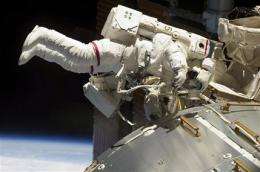
In this image provided by NASA astronaut Steve Bowen participates in the mission's second spacewalk Wednesday March 2, 2011 as construction and maintenance continue on the International Space Station. During the six-hour, 14-minute spacewalk, Bowen and astronaut Alvin Drew (out of frame), tackled a variety of tasks, including venting into space some remaining ammonia from a failed pump module they moved during the mission's first spacewalk. (AP Photo/NASA)
The 220-mile-high unveiling of R2, the first humanoid robot in space, is being moved up at the urging of the president of the United States.
Astronaut Catherine Coleman said Friday that she and the 11 other humans aboard the shuttle-station complex want to get R2 out of its packing material as soon as possible.
"We've all been voting to move up getting him out of his box," she said during a crew news conference. "In fact, we're all pretty sure that we hear scratching from the inside there."
Robonaut 2, better known as R2, flew to the International Space Station aboard Discovery. In a phone call to the two crews Thursday, President Barack Obama teased the astronauts for waiting to unpack the robot.
NASA managers initially were going to wait a couple of months before getting R2 out. But the fact that Discovery is spending two extra days at the orbiting outpost, so its crew can help unpack a newly installed storage unit, has sped everything up.
Coleman said she's not sure if the astronauts will be able to get R2 out before Discovery leaves Monday.
In any event, Coleman, both a scientist and engineer, said she can't wait to test Robonaut during the remainder of her space station stay. As robots travel into space, it's important to learn how they operate in weightlessness, she said. Better to learn those lessons inside the space station, before a robot ventures out on a spacewalk or roams other planets, she added.
It will take both humans and robots "to get us further out into the universe, and Robonaut is a good first step," Coleman said.
R2 - lacking legs and built from the waist up - will undergo a series of tests before tackling simple space station chores at its permanent home.
This is Discovery's final voyage. It's being retired once it returns to Earth on Wednesday, 13 days after blasting off, and will be sent to the Smithsonian Institution for display.
NASA Administrator Charles Bolden will announce the final resting places for the two other space shuttles on April 12, the 30th anniversary of the first shuttle flight. More than 20 museums and educational institutions across the country, including the Kennedy Space Center Visitor Complex, are vying for display rights. Enterprise, a test vehicle that never made it to space, is also up for dibs.
As for Discovery - NASA's oldest and most traveled shuttle - commander Steven Lindsey said he and his crew have been too busy to focus on the historic aspect. But every so often, he reflects on the fact that Discovery will never fly again.
"What a great vehicle it's been, 39 missions, nearly one year on orbit," Lindsey said. "It's just really inspiring to me and kind of bittersweet and quite frankly sad, knowing that when we land, that will be it for this vehicle."
Astronaut Alvin Drew said it was poignant to see the shuttle filling his entire visor during his two spacewalks.
"It's just a magnificent ship ... to be out there working on, around and near it, is just a privilege to be part of the legacy of Discovery. Seems like a blessing," Drew said.
The astronaut who went spacewalking with Drew earlier this week, Stephen Bowen, said he's still pinching himself to see if he's dreaming. He joined Discovery's last crew last month, replacing astronaut Timothy Kopra, who injured himself in a bicycle accident.
"There's no possible way I can make it up to Tim," Bowen said with a smile. "If there's anything I can do for him, I'm willing to discuss it."
More information: NASA: http://www.nasa.gov/mission-pages/shuttle/main/index.html
©2010 The Associated Press. All rights reserved. This material may not be published, broadcast, rewritten or redistributed.
-
From lemons to lemonade: Reaction uses carbon dioxide to make carbon-based semiconductor,
32 comments
-
Thioridazine kills cancer stem cells in human while avoiding toxic side-effects of conventional cancer treatments,
3 comments
-
SpaceX private rocket blasts off for space station (Update),
42 comments
-
Climate scientists say they have solved riddle of rising sea,
30 comments
-
Research team claims to have found evidence Lake Cheko is impact crater for Tunguska Event,
18 comments
-
revamping general concept and cosmological principle
May 25, 2012
-
Transiting Exoplanet Light Curve
May 25, 2012
-
Math behind Theoretical Physics
May 24, 2012
-
Do we know whats at the center of galaxies yet?
May 23, 2012
-
Structure of the Milky Way?
May 20, 2012
-
What would it take to terraform Pluto and Charon?
May 19, 2012
- More from Physics Forums - General Astronomy
More news stories
SpaceX capsule has 'new car' smell, astronauts say (Update)
SpaceX's Dragon cargo vessel smells like a new car, said astronauts at the International Space Station after opening the hatches Saturday following the spacecraft's landmark mission to the orbiting lab.
Space & Earth / Space Exploration
18 hours ago |
4.5 / 5 (20) |
0
Astronomers seize last chance in lifetime for Venus Transit
Astronomers are gearing for one the rarest events in the Solar System: an alignment of Earth, Venus and the Sun that will not be seen for another 105 years.
18 hours ago |
5 / 5 (3) |
2
Australia hails surprise super-telescope decision
Australia has hailed a surprise decision giving it a role in a radio telescope project aimed at revolutionising astronomy, vowing to draw on its decades of experience in space science.
18 hours ago |
5 / 5 (4) |
1
Astronauts enter world's 1st private supply ship
(AP) -- Space station astronauts floated into the Dragon on Saturday, a day after its heralded arrival as the world's first commercial supply ship.
Space & Earth / Space Exploration
18 hours ago |
5 / 5 (5) |
0
Sophisticated simulations predict future warming
The chances of our planet being hit by a global warming of 3 degrees Celsius by 2050 is as likely as it being hit by an increase of 1.4 degrees, new research shows. Presented in the journal Nature Geoscience, the British study ...
Space & Earth / Earth Sciences
May 22, 2012 |
4.4 / 5 (9) |
51
Scientist: Evolution debate will soon be history
(AP) -- Richard Leakey predicts skepticism over evolution will soon be history. Not that the avowed atheist has any doubts himself.
Dell tablet leak: 10.1-inch display, two-battery choice
(Phys.org) -- Headline after headline talks about vendors tablets in the wings as likely number-one contenders for the iPad. Such claims have justifiably been taken with a grain of salt, considering ...
SpotterRF debuts Radar Backpack Kit (w/ Video)
(Phys.org) -- SpotterRF has announced a special radar backpack kit designed to enhance situational awareness for soldiers on the ground. The company says its special radar is designed for warfighters as part ...
Thousands of shellfish found dead in Peru
Thousands of crustaceans were found dead off the coast of Lima following the mystery mass death of dolphins and pelicans, the Peruvian Navy said Friday.
Keep food safety in mind this memorial day weekend
(HealthDay) -- Picnics, parades and cookouts are as much a part of Memorial Day weekend as tributes to the United States' war veterans.
Family history of Alzheimer's affects functional connectivity
(HealthDay) -- Cognitively normal individuals with a family history of late-onset Alzheimer's disease (AD) may display lower resting state functional connectivity in the default mode network (DMN) of the brain, ...