South Carolina bill targets prisoners on Facebook
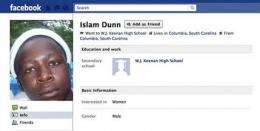
(AP) -- Islam Dunn updates his Facebook page with a phone like so many other 19-year-olds, only he must hide the device so the prison guards don't notice.
The proliferation of cell phones smuggled into prisons has some inmates routinely updating their status from the inside, and South Carolina is considering becoming the first state to make that a crime.
The measure would add 30 days to a prisoner's sentence if he is caught interacting on social networking sites via cell phone. The bill goes a step further, too, making it illegal for anyone to set up a page for a prisoner, which legal experts say violates inmates' free speech rights even if they are using contraband cell phones.
Rep. Wendell Gilliard, a Democrat from Charleston who proposed the law, said crime victims shouldn't have to worry about seeing or being threatened by a prisoner online. There's also a fear convicts are coordinating criminal activity.
"We now know that the criminals behind bars are using this as a method of intimidation. People's lives are threatened. They're sending out coded messages through social networking," Gilliard said. "How can we as a society stand by and do nothing?"
Tarangie Tyler's family was terrorized nearly two years ago by Dunn and a group of men who were trying to rob their home. Her 34-year-old husband, Jerry, was shot to death in the attack after four men, including Dunn, kicked in the door of their home.
Tyler moved her five children to a safer neighborhood, but now fears they could be intimidated by simply logging on to the computer that sits on their kitchen counter.
"To hear that one of them has a Facebook, it's scary," said Tyler, 35. "I don't think they should have Facebook, because of the crime that they did. ... If they want to communicate, that's what a pencil and paper are for."
Prisoners are free to exchange letters with people on the outside, but their mail is monitored. Inmates in federal prison and a handful of other jurisdictions also have limited access to e-mail, and typically can only send it to people who have previously agreed to it.
Yet smart phones provide easy access to social networking sites, and it's difficult for corrections officials to keep up. Some inmate pages are obvious, with photos of themselves in prison. Others are set up and run by relatives or friends.
Facebook already prohibits third-party profiles and takes them down when they find out. The company also deactivates prisoner pages when they become aware of them, regardless of who set up the pages.
In Oklahoma, a man serving 30 years for the murder of a sheriff was moved to solitary confinement after he used a smuggled cell phone to post pictures and comments on Facebook.
Officials in California, having seized nearly 11,000 mobile phones from prisoners last year, started setting up system that would capture every cell phone signal from a prison and block unauthorized calls, a program already used in Mississippi and in the works in South Carolina.
"I don't doubt that there are inmates who use contraband cell phones and social media to connect with their families," said Terry Thornton, a spokeswoman for the California Department of Corrections and Rehabilitation. "But we also have evidence that they're using contraband cell phones ... to harass victims to threaten other people and to engage in all other sorts of criminal activity."
On Dunn's page, he wrote that was tired of being in prison and asked friends to put money on his prepaid debit card.
"All i want is my life bac," Dunn updated January 29 from Facebook's mobile web application. In an update on his birthday, Dunn said: "got SO high." A few weeks later he wrote: "its really hard 2 find luv n jail.lol."
Corrections officials were unaware of Dunn's Facebook page, and department spokesman John Barkley said an investigator would search the inmate's cell.
Some of Dunn's 200 friends have written messages on his wall, many telling him to stay positive during his 20-year stint for attempted armed robbery. Andrea Watson, a friend of Dunn's family, said she received a Facebook friend request from him several months ago. She didn't understand exactly how Dunn was going online from prison and she really didn't care.
"Islam is a very intelligent young man," said Watson, a 39-year-old nurse in Columbia. "I feel like it's very important to keep giving Islam some encouraging messages because Islam feels like he has nothing and nobody."
The South Carolina bill has support from a dozen lawmakers, including the Republican House speaker, but it's not clear whether it will pass. If it becomes law, prisoners who use cell phones to interact online would be fined $500 and detained up to 30 more days. Those who set up profiles would face similar punishment.
The American Civil Liberties Union opposes the South Carolina measure and successfully fought a similar law in Arizona in 2003, before the boom in smuggled phones behind bars.
That law was different than the one being proposed in South Carolina, though, because it prohibited people from helping inmates access the Internet indirectly using telephone, letters or a network of family, friends or activists on the outside. The law was passed after a murder victim's family complained about an ad posted on the Internet that solicited pen pals for the convict.
A federal judge struck down the law, ruling it was one thing to stop inmates from using the Internet in jail but quite another to hinder their access to it through intermediaries.
"Efforts of this kind are just an attempt to beat up on prisoners because we don't like them," said David Fathi, director of the ACLU's National Prison Project. "The First Amendment protects speech, even if it's speech that some people don't want to see. The response to seeing something that you don't like on the Internet is, don't look at it."
Acknowledging that inmates should not be allowed unfettered access to cell phones, Fathi said that once they get them, their online use shouldn't be restricted.
"There is no First Amendment objection to prison officials saying prisoners can't have cell phones, and doing the appropriate searches to make sure that rule is followed," Fathi said. "But that's completely different than something like this bill that tries to regulate prisoners' speech in the outside world."
Despite the Arizona ruling, Gilliard - who is sponsoring at least four other tough-on-crime bills this session - said he considers it necessary to criminalize the profiles themselves to show inmates how seriously South Carolina views their online activity.
Kay Harrison thought she had seen the last of the man who gunned down her niece and another woman outside a South Carolina courthouse during a heated custody dispute. She resettled into life as a single mom in suburban Atlanta, and about two years ago, the 53-year-old Harrison set up a Facebook account to keep up with friends.
On a whim, she searched for her niece's killer, Michael Godfrey.
"And there he was," Harrison said. "There was no disclaimer saying, 'Oh, by the way, I'm a felon, I murdered two people.' ... I didn't sleep a wink that night."
©2010 The Associated Press. All rights reserved. This material may not be published, broadcast, rewritten or redistributed.


