Missing sunspots: Solar mystery solved
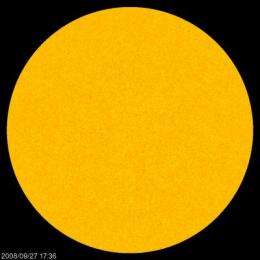
This visible-light photograph, taken in 2008 by NASA's Solar and Heliospheric Observatory (SOHO) spacecraft, shows the sun's face free of sunspots. The sun experienced 780 spotless days during the unusually long solar minimum that just ended. New computer simulations imply that the sun's long quiet spell resulted from changing flows of hot plasma within it. Credit: NASA/SOHO
The Sun has been in the news a lot lately because it's beginning to send out more flares and solar storms. Its recent turmoil is particularly newsworthy because the Sun was very quiet for an unusually long time. Astronomers had a tough time explaining the extended solar minimum. New computer simulations imply that the Sun's long quiet spell resulted from changing flows of hot plasma within it.
"The Sun contains huge rivers of plasma similar to Earth's ocean currents," says Andres Munoz-Jaramillo, a visiting research fellow at the Harvard-Smithsonian Center for Astrophysics (CfA). "Those plasma rivers affect solar activity in ways we're just beginning to understand."
The Sun is made of a fourth state of matter - plasma, in which negative electrons and positive ions flow freely. Flowing plasma creates magnetic fields, which lie at the core of solar activity like flares, eruptions, and sunspots.
Astronomers have known for decades that the Sun's activity rises and falls in a cycle that lasts 11 years on average. At its most active, called solar maximum, dark sunspots dot the Sun's surface and frequent eruptions send billions of tons of hot plasma into space. If the plasma hits Earth, it can disrupt communications and electrical grids and short out satellites.
During solar minimum, the Sun calms down and both sunspots and eruptions are rare. The effects on Earth, while less dramatic, are still significant. For example, Earth's outer atmosphere shrinks closer to the surface, meaning there is less drag on orbiting space junk. Also, the solar wind that blows through the solar system (and its associated magnetic field) weakens, allowing more cosmic rays to reach us from interstellar space.
The most recent solar minimum had an unusually long number of spotless days: 780 days during 2008-2010. In a typical solar minimum, the Sun goes spot-free for about 300 days, making the last minimum the longest since 1913.
"The last solar minimum had two key characteristics: a long period of no sunspots and a weak polar magnetic field," explains Munoz-Jaramillo. (A polar magnetic field is the magnetic field at the Sun's north and south poles.) "We have to explain both factors if we want to understand the solar minimum."
To study the problem, Munoz-Jaramillo used computer simulations to model the Sun's behavior over 210 activity cycles spanning some 2,000 years. He specifically looked at the role of the plasma rivers that circulate from the Sun's equator to higher latitudes. These currents flow much like Earth's ocean currents: rising at the equator, streaming toward the poles, then sinking and flowing back to the equator. At a typical speed of 40 miles per hour, it takes about 11 years to make one loop.
This video is not supported by your browser at this time.
A simulation of solar magnetic fields.
Munoz-Jaramillo and his colleagues discovered that the Sun's plasma rivers speed up and slow down like a malfunctioning conveyor belt. They find that a faster flow during the first half of the solar cycle, followed by a slower flow in the second half of the cycle, can lead to an extended solar minimum. The cause of the speed-up and slowdown likely involves a complicated feedback between the plasma flow and solar magnetic fields."It's like a production line - a slowdown puts 'distance' between the end of the last solar cycle and the start of the new one," says Munoz-Jaramillo.
The ultimate goal of studies like this is to predict upcoming solar maxima and minima - both their strength and timing. The team focused on simulating solar minima, and say that they can't forecast the next solar minimum (which is expected to occur in 2019) just yet.
"We can't predict how the flow of these plasma rivers will change," explains lead author Dibyendu Nandy (Indian Institute of Science Education and Research, Kolkata). "Instead, once we see how the flow is changing, we can predict the consequences."
Provided by
Harvard-Smithsonian Center for Astrophysics
-
From lemons to lemonade: Reaction uses carbon dioxide to make carbon-based semiconductor,
32 comments
-
Thioridazine kills cancer stem cells in human while avoiding toxic side-effects of conventional cancer treatments,
3 comments
-
SpaceX private rocket blasts off for space station (Update),
42 comments
-
Climate scientists say they have solved riddle of rising sea,
30 comments
-
Research team claims to have found evidence Lake Cheko is impact crater for Tunguska Event,
18 comments
-
revamping general concept and cosmological principle
May 25, 2012
-
Transiting Exoplanet Light Curve
May 25, 2012
-
Math behind Theoretical Physics
May 24, 2012
-
Do we know whats at the center of galaxies yet?
May 23, 2012
-
Structure of the Milky Way?
May 20, 2012
-
What would it take to terraform Pluto and Charon?
May 19, 2012
- More from Physics Forums - General Astronomy
More news stories
SpaceX capsule has 'new car' smell, astronauts say (Update)
SpaceX's Dragon cargo vessel smells like a new car, said astronauts at the International Space Station after opening the hatches Saturday following the spacecraft's landmark mission to the orbiting lab.
Space & Earth / Space Exploration
17 hours ago |
4.5 / 5 (20) |
0
Astronomers seize last chance in lifetime for Venus Transit
Astronomers are gearing for one the rarest events in the Solar System: an alignment of Earth, Venus and the Sun that will not be seen for another 105 years.
17 hours ago |
5 / 5 (3) |
2
Australia hails surprise super-telescope decision
Australia has hailed a surprise decision giving it a role in a radio telescope project aimed at revolutionising astronomy, vowing to draw on its decades of experience in space science.
17 hours ago |
5 / 5 (4) |
1
Astronauts enter world's 1st private supply ship
(AP) -- Space station astronauts floated into the Dragon on Saturday, a day after its heralded arrival as the world's first commercial supply ship.
Space & Earth / Space Exploration
17 hours ago |
5 / 5 (5) |
0
Sophisticated simulations predict future warming
The chances of our planet being hit by a global warming of 3 degrees Celsius by 2050 is as likely as it being hit by an increase of 1.4 degrees, new research shows. Presented in the journal Nature Geoscience, the British study ...
Space & Earth / Earth Sciences
May 22, 2012 |
4.4 / 5 (9) |
51
Scientist: Evolution debate will soon be history
(AP) -- Richard Leakey predicts skepticism over evolution will soon be history. Not that the avowed atheist has any doubts himself.
Dell tablet leak: 10.1-inch display, two-battery choice
(Phys.org) -- Headline after headline talks about vendors tablets in the wings as likely number-one contenders for the iPad. Such claims have justifiably been taken with a grain of salt, considering ...
SpotterRF debuts Radar Backpack Kit (w/ Video)
(Phys.org) -- SpotterRF has announced a special radar backpack kit designed to enhance situational awareness for soldiers on the ground. The company says its special radar is designed for warfighters as part ...
Thousands of shellfish found dead in Peru
Thousands of crustaceans were found dead off the coast of Lima following the mystery mass death of dolphins and pelicans, the Peruvian Navy said Friday.
Keep food safety in mind this memorial day weekend
(HealthDay) -- Picnics, parades and cookouts are as much a part of Memorial Day weekend as tributes to the United States' war veterans.
Family history of Alzheimer's affects functional connectivity
(HealthDay) -- Cognitively normal individuals with a family history of late-onset Alzheimer's disease (AD) may display lower resting state functional connectivity in the default mode network (DMN) of the brain, ...
Mar 02, 2011
Rank: 2.1 / 5 (11)
See: B. W. Ninham (1963) "Charged Bose gas in astrophysics", Physics Letters 4, 278-279.
and "Super-fluidity in the solar interior: Implications for solar eruptions and climate" [Journal of Fusion Energy, vol. 21 (Dec 2002) pp. 193-198]
arxiv.org/pdf/astro-ph/0501441v1
With kind regards,
Oliver K. Manuel
Former NASA Principal
Investigator for Apollo
Mar 02, 2011
Rank: 1.7 / 5 (11)
The APEIRON Journal
in press (2011), 19 pages
arxiv.org/pdf/1102.1499v1
Mar 02, 2011
Rank: 1.8 / 5 (5)
Mar 02, 2011
Rank: 5 / 5 (5)
OT:{Sigh} Surely a compact core would be evident from the helioseismology findings ??
Mar 02, 2011
Rank: 3 / 5 (10)
Mar 02, 2011
Rank: 2.6 / 5 (7)
Guys, please stop with the undeservingly definitive headlines...
No. Electric currents create magnetic fields, they're the only things that ever can and do.
We could grant the article partial credit on this point if it bothered to explain that plasma flowing in a circuit = charged particles moving in a circuit = an electric current, so had they included such details or a qualifier then they'd be correct. But this is like saying "cars weaving randomly across the road create a traffic hazard" (well, yeah...) when the point is that drunk drivers create a traffic hazard.
They don't actually know.
The headline is misleading in the extreme. NOT "solved".
Mar 02, 2011
Rank: 5 / 5 (3)
Mar 02, 2011
Rank: 2 / 5 (8)
It was reported in Nature: "Is the Sun a pulsar?" by Peter Toth, Nature 270, 159 - 160 (10 November 1977); doi:10.1038/270159a0
nature.com/nature/journal/v270/n5633/abs/270159a0.html
Mar 02, 2011
Rank: 4.3 / 5 (6)
I'm veering the tiniest bit off-topic here, but don't forget permanent magnets.
Mar 02, 2011
Rank: 5 / 5 (1)
Mar 02, 2011
Rank: 5 / 5 (6)
It took me a long time to wrap my brain around it too, but apparently even the magnetic fields around permanent magnets are created by electric currents. And I mean like ongoing active atomic-level electric currents. Though I wouldn't normally consider Wikipedia reliably authoritative, I think it's OK to recommend you look up their article on "Magnet", and scroll down to the bit on "Ampère model". I'd post a link but physorg tends to freeze on me when I do. Here's a small excerpt:
Mar 02, 2011
Rank: 1.5 / 5 (8)
Astro, you have revealed the IPCC agenda too earlier!
C'mon, everyone knows we have caused (we the dirty Earthling producers of CO2!) the Solar Minimum....but please, do not use Solar Minimum, use Solar Changing....:)
We have to be consistent!
Mar 02, 2011
Rank: 3.7 / 5 (3)
Thanks, I'll check it out.
If you want to post a link, just insert "DELETE" into the string, or a couple of spaces -anyway, something obvious, that can then be easily removed, and the link then cut/pasted into browser.
Mar 02, 2011
Rank: 1 / 5 (6)
Mar 03, 2011
Rank: 3 / 5 (5)
OK, got one. They were on sale.
Now what?
Mar 03, 2011
Rank: 5 / 5 (1)
Mar 03, 2011
Rank: 5 / 5 (2)
Mar 03, 2011
Rank: 2.3 / 5 (6)
Mmmmkay.
Sounds like another theory that computer models have supposedly "settled"...
Mar 03, 2011
Rank: 1.8 / 5 (5)
Disappearance of the sunspots is interrelated to minimal intensities of the summary magnetic field. At the equality stage, the changeable magnetic field of the core indicates almost equality intensity to the opposite and almost permanent value, which is formed by the turbulent convection streams in the shell.
At the equality stage the triply alpha processes and their streams from the core magnetic poles are ceased. Thus desapearence of the magnetic confinement is interrelated to the finish of the triply alpha processes. The core magnetic poles can produce only thermonuclear reactions. Thus Sun explodes the spot remains and eventually we can not observe temporarily the spot activity process.
Kakha.
Mar 03, 2011
Rank: 1 / 5 (5)