Making skinny worms fat, fat worms skinny
Mar 24, 2011 by Jason Bardi
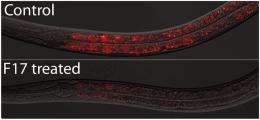
The UCSF team identifed chemical compounds that reduced the accumulation of fat (highlighted in red) in worms, as seen in the treated worms. Credit: Kaveh Ashrafi/UCSF

(PhysOrg.com) -- Researchers exploring human metabolism at the University of California, San Francisco (UCSF) have uncovered a handful of chemical compounds that regulate fat storage in worms, offering a new tool for understanding obesity and finding future treatments for diseases associated with obesity.

As described in a paper published this month in the journal Nature Chemical Biology, the UCSF team took armies of microscopic called C.elegans and exposed them to thousands of different . Giving these compounds to the worms, they discovered, basically made them skinnier or fatter without affecting how they eat, grow, or reproduce.

This video is not supported by your browser at this time.

The discovery gives scientists new ways to investigate metabolism and could eventually lead to the development of new drugs to regulate excessive fat accumulation and address the metabolic issues that underlie a number of major human health problems, including, , and some forms of cancer.

The work also demonstrates the value of “worm screening” as a way of finding new targets for human diseases, according to the UCSF scientists, whose work was spearheaded by postdoctoral fellow George Lemieux, PhD, in the laboratory of Professor Zena Werb, PhD, vice chair of the Department of Anatomy at UCSF.

The work was a collaboration involving Kaveh Ashrafi, PhD, an associate professor in the UCSF Department of Physiology, and Roland Bainton, MD, PhD, an associate professor in residence in the UCSF Department of Anesthesia & Perioperative Care.

Why Worms Are Fat

The UCSF team’s interest in how worms deal with fat began with a more fundamental interest in human metabolism. Worms make molecules of fat for the same reasons humans do – they are useful for storing energy and are a basic building block for body tissues. Many of the genes and mechanisms worms use to regulate fat accumulation have similar systems in humans, and not all of them are completely understood.

Starting with 3,200 different chemical compounds and 3,200 pools of tiny worms, the UCSF team used a red dye that sticks to fat molecules to pinpoint under the microscope which of the chemicals made the worms fatter (more red) or skinnier (less red). They identified a few dozen, and performing additional tests, narrowed in on about 10 compounds they believe regulate fat metabolism. Those compounds not only altered storage in the worms but in in insect and human cells grown in test tubes, leading Lemieux to comment that they “may be useful for understanding in other organisms.”

One of these compounds modulates a molecular complex called an AMP-activated kinase, which senses the availability of cellular energy. Versions of kinase complexes exist both in worms and humans, and some already are key targets for drug design by pharmaceutical companies.

“The compound that we get from our worm screen can act on this kinase complex as well if not better than anything else that is out there,” said Ashrafi.

The real strength of the work, he added, is that it demonstrates the value of the new worm screen over existing screening tools for identifying the genes, proteins and other molecular players involved in human health.

A large part of drug discovery involves identifying these players and designing ways to treat diseases that emerge when they don’t work correctly. But identifying the targets is only the beginning. Designing a drug involves overcoming a long list of other hurdles, Ashrafi said, and the bottom line is that most of the potential drugs that seem to work well in the test tube fail to work in people.

The value of the worm screen, he said, is that it allows scientists to select compounds for further study that already work effectively in a whole organism.

“A lot of the drugs that are in clinical use or development today were discovered basically by chance,” Ashrafi said. “If we understood everything about everything, we could probably design the right compounds. But the reality is our understanding of many of the biological principles and chemical principles are still in their infancy.”

Explore further: Attacking MRSA with metals from antibacterial clays

More information: dx.doi.org/10.1038/nchembio.534

Provided by University of California San Francisco

5 /5 (2 votes)

Related Stories

Study connects obesity with nervous system

Jan 23, 2008

A discovery by Queen’s biologists and their students sheds new light on the genetic roots of obesity – a condition that is increasing dramatically in North America and has been linked to heart disease, diabetes and some ...

Researchers use banned herbicide to prolong worms' life

Dec 08, 2010

It sounds like science fiction – Dr. Siegfried Hekimi and his student Dr. Wen Yang, researchers at McGill's Department of Biology, tested the current "free radical theory of aging" by creating mutant worms that had increased ...

Worms control lifespan at high temperatures

Apr 16, 2009

The common research worm, C. elegans, is able to use heat-sensing nerve cells to not only regulate its response to hotter environments, but also to control the pace of its aging as a result of that heat, according to new ...

Xenacoelomorpha -- a new phylum in the animal kingdom

Feb 16, 2011

An international team of scientists including Albert Poustka from the Max Planck Institute for Molecular Genetics in Berlin has discovered that Xenoturbellida and the acoelomorph worms, both simple marine ...

Recommended for you

Attacking MRSA with metals from antibacterial clays

20 hours ago

In the race to protect society from infectious microbes, the bugs are outrunning us. The need for new therapeutic agents is acute, given the emergence of novel pathogens as well as old foes bearing heightened antibiotic resistance.

Keeping fruit, vegetables and cut flowers fresh longer

May 15, 2013

New technology offers the promise of reducing billions of dollars of losses that occur each year from the silent, invisible killer of fruits, vegetables and cut flowers—a gas whose effects are familiar to everyone who has ...

Why don't beetles freeze in the winter?

May 14, 2013

For 37 years, Queen's University Biochemistry professor Peter Davies has been unraveling the mystery of why some organisms including insects and fish don't freeze in the winter. His research into insect antifreeze protein ...

The molecular basis of strawberry aroma

May 13, 2013

You know that summer is here when juicy red strawberries start to appear on the shelves. In Germany, this seasonal fruit has never been more popular: on average 3.5 kilos per head were consumed in 2012—a ...

A new dimension for 3-D protein structures

May 13, 2013

(Phys.org) —3D structures of biological molecules like proteins directly affect the way they behave in our bodies. EPFL scientists have developed a new infrared-UV laser method to more accurately determine ...

User comments : 2

Adjust slider to filter visible comments by rank

Display comments: newest first

plasticpower
not rated yet Mar 25, 2011
Maybe one day we can take a pill along with our vitamins that keeps us skinny despite our terrible eating habits...
Beard
not rated yet Mar 26, 2011
Not everyone has terrible eating habits, I'd love to stay lean while eating more to gain muscle. Same goes for any athlete.

More news stories

Attacking MRSA with metals from antibacterial clays

In the race to protect society from infectious microbes, the bugs are outrunning us. The need for new therapeutic agents is acute, given the emergence of novel pathogens as well as old foes bearing heightened antibiotic resistance.

Beautiful 'flowers' self-assemble in a beaker

By simply manipulating chemical gradients in a beaker of fluid, materials scientists at Harvard have found that they can control the growth behavior of crystals to create precisely tailored structures—such ...

Making gold green: New non-toxic method for mining gold

Northwestern University scientists have struck gold in the laboratory. They have discovered an inexpensive and environmentally benign method that uses simple cornstarch—instead of cyanide—to isolate gold from raw materials ...

Morocco to harness the wind in energy hunt

Morocco is ploughing ahead with a programme to boost wind energy production, particularly in the southern Tarfaya region, where Africa's largest wind farm is set to open in 2014.

New case of SARS-like virus in Saudi: ministry

A new case of the deadly coronavirus has been detected in Saudi Arabia where 15 people have already died after contracting it, the health ministry announced on Saturday on its Internet website.