Researchers define a new type of secretory cell in the intestine
Mar 07, 2011
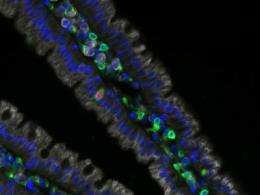
Gerbe et al. define tuft cells as a new secretory lineage in the intestine. These rare cells can be distinguished from the four other main cell types of the intestinal epithelium by their co-expression of SOX9 (red) and COX1 (green). Microtubules are shown in white. Credit: François Gerbe

The intestinal epithelium consists of four main specialized cell lineages: absorptive enterocytes and three secretory cell types known as enteroendocrine, Paneth, and goblet cells. But a rare, fifth type of intestinal cell called tuft cells also exists. Defined by the thick brush of long microvilli that project from their apical surface, tuft cells are seen in several epithelial tissues, yet little is known about their function due to a lack of tuft cell–specific markers.

In the March 7 issue of The Journal of Cell Biology, a team of French researchers led by Philippe Jay identified a unique "signature" of proteins expressed by tuft cells. Like other intestinal cell types, tuft cells turned over rapidly and were replaced by the differentiation of proliferative stem cells' progeny in the intestinal crypts. This differentiation was blocked in the absence of ATOH1—a transcription factor required for the development of all intestinal secretory lineages. Yet tuft cell differentiation didn't require other transcription factors that specify enteroendocrine, Paneth, and goblet cells, suggesting that tuft cells represent a distinct lineage of intestinal secretory cells.

The team found that tuft cells secrete opioids and produce enzymes that synthesize prostaglandins. The latter observation suggests that tuft cells may promote inflammation and tumorigenesis. Indeed, the researchers identified tuft cell–like cells in several early stage intestinal tumors. To really understand tuft cells' function, however, Jay hopes to identify transcription factors uniquely required for their development in order to generate mice that specifically lack tuft cells from their intestinal epithelium.

Explore further: New computer simulations help scientists understand how—and why—viruses spread

More information: Gerbe, F., et al. 2011. J. Cell Biol. doi:10.1083/jcb.201010127

add to favorites email to friend print save as pdf

Related Stories

The making of an intestinal stem cell

Mar 05, 2009

Researchers have found the factor that makes the difference between a stem cell in the intestine and any other cell. The discovery reported in the March 6th issue of the journal Cell, a Cell Press publication, is an essent ...

'Scrawny' gene keeps stem cells healthy

Jan 07, 2009

(PhysOrg.com) -- Stem cells are the body's primal cells, retaining the youthful ability to develop into more specialized types of cells over many cycles of cell division. How do they do it? Scientists at the ...

Recommended for you

A feline fungus joins the new species list

23 hours ago

(Phys.org) —A new species of fungus that causes life-threatening infections in humans and cats has been discovered by a University of Sydney researcher.

New way to improve antibiotic production

Jun 17, 2013

An antibiotic has been found to stimulate its own production. The findings, to be published in PNAS, could make it easier to scale up antibiotic production for commercialisation.

User comments : 0

More news stories

Origins of 'The Hoff' crab revealed (w/ Video)

The history of a new type of crab, nicknamed 'The Hoff' because of its hairy chest, which lives around hydrothermal vents deep beneath the Southern Ocean and Indian Ocean, has been revealed for the first ...

Cape Wind gets $200M investment from Danish fund

The Cape Wind offshore wind project has secured a $200 million investment from a Danish pension fund in what the wind farm's president said Tuesday is a milestone for the long-delayed project.