Scientists create cell assembly line
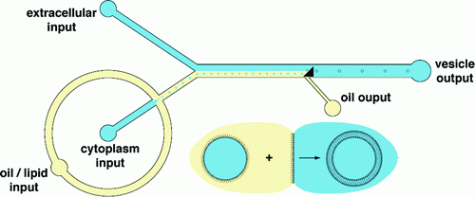
Borrowing a page from modern manufacturing, scientists from the Florida campus of The Scripps Research Institute have built a microscopic assembly line that mass produces synthetic cell-like compartments.
The new computer-controlled system represents a technological leap forward in the race to create the complex membrane structures of biological cells from simple chemical starting materials.
"Biology is full of synthetic targets that have inspired chemists for more than a century," said Brian Paegel, Scripps Research assistant professor and lead author of a new study published in the Journal of the American Chemical Society. "The lipid membrane assemblies of cells and their organelles pose a daunting challenge to the chemist who wants to synthesize these structures with the same rational approaches used in the preparation of small molecules."
While most cellular components such as genes or proteins are easily prepared in the laboratory, little has been done to develop a method of synthesizing cell membranes in a uniform, automated way. Current approaches are capricious in nature, yielding complex mixtures of products and inefficient cargo loading into the resultant cell-like structures.
The new technology transforms the previously difficult synthesis of cell membranes into a controlled process, customizable over a range of cell sizes, and highly efficient in terms of cargo encapsulation.
The membrane that surrounds all cells, organelles and vesicles – small subcellular compartments – consists of a phospholipid bilayer that serves as a barrier, separating an internal space from the external medium.
The new process creates a laboratory version of this bilayer that is formed into small, cell-sized compartments.
How It Works
"The assembly-line process is simple and, from a chemistry standpoint, mechanistically clear," said Sandro Matosevic, research associate and co-author of the study.
A microfluidic circuit generates water droplets in lipid-containing oil. The lipid-coated droplets travel down one branch of a Y-shaped circuit and merge with a second water stream at the Y-junction. The combined flows of droplets in oil and water travel in parallel streams toward a triangular guidepost.
Then, the triangular guide diverts the lipid-coated droplets into the parallel water stream as a wing dam might divert a line of small boats into another part of a river. As the droplets cross the oil-water interface, a second layer of lipids deposits on the droplet, forming a bilayer.
The end result is a continuous stream of uniformly shaped cell-like compartments.
The newly created vesicles range from 20 to 70 micrometers in diameter—from about the size of a skin cell to that of a human hair. The entire circuit fits on a glass chip roughly the size of a poker chip.
The researchers also tested the synthetic bilayers for their ability to house a prototypical membrane protein. The proteins correctly inserted into the synthetic membrane, proving that they resemble membranes found in biological cells.
"Membranes and compartmentalization are ubiquitous themes in biology," noted Paegel. "We are constructing these synthetic systems to understand why compartmentalized chemistry is a hallmark of life, and how it might be leveraged in therapeutic delivery."
More information: "Stepwise Synthesis of Giant Unilamellar Vesicles on a Microfluidic Assembly Line," was published February 10, 2011. For more information, see pubs.acs.org/doi/abs/10.1021/ja109137s
Provided by The Scripps Research Institute


