Rapid, high-definition chemistry with new imaging technique
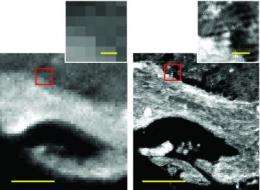
With intensity a million times brighter than sunlight, a new synchrotron-based imaging technique offers high-resolution pictures of the molecular composition of tissues with unprecedented speed and quality. Carol Hirschmugl, a physicist at the University of Wisconsin-Milwaukee (UWM), led a team of researchers from UWM, the University of Illinois at Urbana-Champaign and University of Illinois at Chicago (UIC) to demonstrate these new capabilities.
Hirschmugl and UWM scientist Michael Nasse have built a facility called "Infrared Environmental Imaging (IRENI)," to perform the technique at the Synchrotron Radiation Center (SRC) at UW-Madison. The new technique employs multiple beams of synchrotron light to illuminate a state-of-the-art camera, instead of just one beam.
IRENI cuts the amount of time needed to image a sample from hours to minutes, while quadrupling the range of the sample size and producing high-resolution images of samples that do not have to be tagged or stained as they would for imaging with an optical microscope.
"Since IRENI reveals the molecular composition of a tissue sample, you can choose to look at the distribution of functional groups, such as proteins, carbohydrates and lipids," says Hirschmugl, "so you concurrently get detailed structure and chemistry."
The technique could have broad applications not only in medicine, but also in pharmaceutical drug analysis, art conservation, forensics, biofuel production, and advanced materials, such as graphene, she says.
Funded by $1 million grant from the National Science Foundation's Major Research Instrumentation Program, the development of the facility has quickly attracted other projects supported by the NSF and the National Institutes of Health. It is published online today in Nature Methods.
The work is a collaboration with the labs of Rohit Bhargava, assistant professor of bioengineering at the University of Illinois at Urbana-Champaign and pathologists Dr. Virgilia Macias and Dr. André Kajdacsy-Balla at UIC. "It has taken three years to establish IRENI as a national user facility located at the SRC," says Nasse. "It is the only facility of its kind worldwide."
Chemical fingerprints
The unique features of the synchrotron make it a highly versatile light source in spectroscopy. Streams of speeding electrons emit continuous light across the entire electromagnetic spectrum so that researchers can access whatever wavelength is best absorbed for a particular purpose.
Although not visible to the human eye, the mid-infrared range of light used by the team documents the light absorbed at thousands of locations on the sample, forming graphic "fingerprints" of biochemically important molecules.
Using 12 beams of synchrotron light in this range allows researchers to collect thousands of these chemical fingerprints simultaneously, producing an image that is 100 times less-pixelated than in conventional infrared imaging.
"We did not realize until now the improvement in detail and quality that sampling at this pixel size would bring," says Bhargava. "The quality of the chemical images is now quite similar to that of optical microscopy and the approach presents exciting new possibilities."
Testing for future applications
The team tested the technique on breast and prostate tissue samples to determine its capabilities for potential use in diagnostics for cancer and other diseases. The researchers were able to detect features that distinguished the epithelial cells, in which cancers begin, from the stromal cells, which are the type found in deeper tissues, with unprecedented detail.
Separating the two layers of cells is a "basement membrane" which prevents malignant cells from spreading from the epithelial cells into the stromal cells. Early-stage cancers are concentrated in the epithelial cells, but metastasis occurs when the basement membrane is breached. Using a prostate cancer sample, the team had encouraging results in locating spectra of the basement membrane, but more work needs to be done.
"IRENI provides us a new opportunity to study tissues and provides lessons for the development of the next generation of IR imaging instruments," says Michael Walsh, a Carle Foundation Hospital-Beckman Institute post-doctoral fellow at the University of Illinois at Urbana-Champaign and co-author on the paper.
It opens the door for development of synchrotron-based imaging that can monitor cellular processes, from simple metabolism to stem cell specialization.
Provided by University of Wisconsin - Milwaukee


