Researchers show increased risk of predators can evoke adaptive response in birds
March 28, 2011 by Bob Yirka report

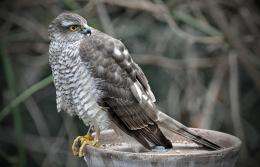
Accipiter nisus

Enlarge

A juvenile Eurasian Sparrowhawk in Betuwe, Netherlands. Image credit: Wikipedia.

(PhysOrg.com) -- Evolutionary ecologists Michael Coslovsky and Heinz Richner of the University of Bern in Switzerland, have published a study in Functional Ecology where they show that when a female bird is exposed to more stress from predators, such as hawks, when ovulating, they tend to produce offspring that are smaller, which isn't a surprise as stressed offspring in many species wind up smaller than average; the surprise is that the smaller offspring also grew their wings both faster and longer than what would be considered normal for their species.

To get these results, Coslovsy and Richner went out into Bremgartenwald forest, near Bern and chose a group of great tits to use as a study group. They then exposed part of the group of mothers (during ) to stuffed sparrow hawks and audio recordings of their calls; the control group was exposed to song thrushes. Two days after the nestlings hatched, they (both groups) were captured, tagged and carted off to another part of the forest to be raised by adoptive parents. As they grew, they were all monitored and it was then the researchers discovered that the offspring of stressed mothers were in fact smaller, as expected, but they also grew their wings at an unusually brisk pace, and grew them longer (1.8 millimeters on average) than other from the control group.

Prior to this research, it’s been assumed that smaller growth in bird offspring is generally a negative effect brought about by a buildup of the hormone corticosterone. Now, with the news that smaller also produce wings at an earlier age, and grow them longer, it might be argued that all three changes are nature’s way of helping the survive in a more hostile than normal environment; less weight, combined with longer wings at an earlier age, would seem to increase the nestling’s ability to fly away at a younger age, and to do so more speedily to ward off attacks.

Of course, the results shown by Coslovsy and Richner are just one study, and have only been done on one species of bird; many more field trials will have to be made before any definitive conclusions can be drawn.

More information: Predation risk affects offspring growth via maternal effects, Michael Coslovsky, Heinz Richner, Functional Ecology, Article first published online: 1 March 2011. DOI: 10.1111/j.1365-2435.2011.01834.x
via Nature.

© 2010 PhysOrg.com


Rank not rated yet
Relevant PhysicsForums posts

More news stories

Scientist: Evolution debate will soon be history

(AP) -- Richard Leakey predicts skepticism over evolution will soon be history. Not that the avowed atheist has any doubts himself.

Biology / Evolution

created 6 hours ago | popularity 3.1 / 5 (7) | comments 21

Thousands of shellfish found dead in Peru

Thousands of crustaceans were found dead off the coast of Lima following the mystery mass death of dolphins and pelicans, the Peruvian Navy said Friday.

Biology / Ecology

created 16 hours ago | popularity 4.8 / 5 (4) | comments 6

More plant species responding to global warming than previously thought

(Phys.org) -- Far more wild plant species may be responding to global warming than previous large-scale estimates have suggested.

Biology / Ecology

created May 22, 2012 | popularity 4.6 / 5 (14) | comments 18 | with audio podcast

Totally rad: Scientists create rewritable digital data storage in DNA

(Phys.org) -- Scientists from Stanford's Department of Bioengineering have devised a method for repeatedly encoding, storing and erasing digital data within the DNA of living cells.

Biology / Biotechnology

created May 21, 2012 | popularity 4.9 / 5 (17) | comments 11 | with audio podcast

For monogamous sparrows, it doesn't pay to stray (but they do it anyway)

It's quite common for a female song sparrow to stray from her breeding partner and mate with the male next door, but a new study shows that sleeping around can be costly.

Biology / Plants & Animals

created May 22, 2012 | popularity 5 / 5 (1) | comments 7 | with audio podcast


Dell tablet leak: 10.1-inch display, two-battery choice

(Phys.org) -- Headline after headline talks about vendors’ tablets in the wings as likely number-one contenders for the iPad. Such claims have justifiably been taken with a grain of salt, considering ...

SpotterRF debuts Radar Backpack Kit (w/ Video)

(Phys.org) -- SpotterRF has announced a special radar backpack kit designed to enhance situational awareness for soldiers on the ground. The company says its special radar is designed for warfighters as part ...

SpaceX capsule has 'new car' smell, astronauts say (Update)

SpaceX's Dragon cargo vessel smells like a new car, said astronauts at the International Space Station after opening the hatches Saturday following the spacecraft's landmark mission to the orbiting lab.

Keep food safety in mind this memorial day weekend

(HealthDay) -- Picnics, parades and cookouts are as much a part of Memorial Day weekend as tributes to the United States' war veterans.

Astronomers seize last chance in lifetime for Venus Transit

Astronomers are gearing for one the rarest events in the Solar System: an alignment of Earth, Venus and the Sun that will not be seen for another 105 years.

Australia hails surprise super-telescope decision

Australia has hailed a surprise decision giving it a role in a radio telescope project aimed at revolutionising astronomy, vowing to draw on its decades of experience in space science.