Offspring of clones in food chain leaves EU in bind
March 17, 2011

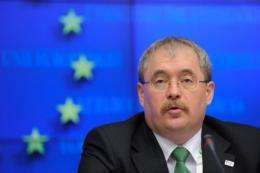
Hungarian Minister of Agriculture Rural Development Sandor Fazekas

Enlarge

Hungarian Minister of Agriculture Rural Development Sandor Fazekas gives a press conference during the European environment ministers council meeting in Brussels on March 14. A new law regulating access for the first time for offspring of cloned animals to meat markets in Europe is heading for the dustbin, the European Union's current chair said Thursday.

A new law regulating access for the first time for offspring of cloned animals to meat markets in Europe is heading for the dustbin, the European Union's current chair said Thursday.

A string of "Frankenfood" scares following the emergence of "non-traceable offspring" in the food chain in Britain and elsewhere lies behind an unusually hard line from the -- but leaves gaps in legal provisions that pre-dated 1996 trailblazer wide open.

Negotiations going back three years among the 27 states, the executive European Commission and the elected parliament that together must craft EU policy collapsed in acrimony after nine-hour overnight talks, incurring the anger of farm ministers meeting in Brussels.

Parliament's rejection of legislation as drafted "would require drawing a family tree for each slice of cheese or salami, which is practically impossible," said Hungarian rural development minister Sandor Fazekas, chairing the talks.

Negotiators for the MEPs "did not have the flexibility to discuss the possibility of allowing foodstuffs from naturally conceived animals with clones among their ancestors."

He said states had agreed "the maximum possible protection of consumers with a system that is practically and legally feasible."

Anything more "would be misleading consumers and create horrendous extra cost for farmers," Fazekas added.

The states and the EU's executive maintain that a ban on the sale of naturally born offspring of cloned animals, which the parliament wants, "would result in a trade ban on beef, pork and dairy product."

They argue this would increase prices and risk retaliation by trading partners, hitting rural agricultural exports.

for research is not covered in the legislative proposals, which must be wrapped up by the end of March or go back to the drawing board.

"Last-chance conciliation" is set for March 28.

The parliament's negotiators said it was "incredible" that states were "exclusively tied to commercial trade interests" and "willing to turn a blind eye to public opinion, as well as the ethical and animal welfare problems associated with cloning."

(c) 2011 AFP


Rank 5 /5 (1 vote)
Relevant PhysicsForums posts

More news stories

Scientist: Evolution debate will soon be history

(AP) -- Richard Leakey predicts skepticism over evolution will soon be history. Not that the avowed atheist has any doubts himself.

Biology / Evolution

created 6 hours ago | popularity 3.1 / 5 (7) | comments 21

Thousands of shellfish found dead in Peru

Thousands of crustaceans were found dead off the coast of Lima following the mystery mass death of dolphins and pelicans, the Peruvian Navy said Friday.

Biology / Ecology

created 16 hours ago | popularity 4.8 / 5 (4) | comments 6

More plant species responding to global warming than previously thought

(Phys.org) -- Far more wild plant species may be responding to global warming than previous large-scale estimates have suggested.

Biology / Ecology

created May 22, 2012 | popularity 4.6 / 5 (14) | comments 18 | with audio podcast

Totally rad: Scientists create rewritable digital data storage in DNA

(Phys.org) -- Scientists from Stanford's Department of Bioengineering have devised a method for repeatedly encoding, storing and erasing digital data within the DNA of living cells.

Biology / Biotechnology

created May 21, 2012 | popularity 4.9 / 5 (17) | comments 11 | with audio podcast

For monogamous sparrows, it doesn't pay to stray (but they do it anyway)

It's quite common for a female song sparrow to stray from her breeding partner and mate with the male next door, but a new study shows that sleeping around can be costly.

Biology / Plants & Animals

created May 22, 2012 | popularity 5 / 5 (1) | comments 7 | with audio podcast


Dell tablet leak: 10.1-inch display, two-battery choice

(Phys.org) -- Headline after headline talks about vendors’ tablets in the wings as likely number-one contenders for the iPad. Such claims have justifiably been taken with a grain of salt, considering ...

SpotterRF debuts Radar Backpack Kit (w/ Video)

(Phys.org) -- SpotterRF has announced a special radar backpack kit designed to enhance situational awareness for soldiers on the ground. The company says its special radar is designed for warfighters as part ...

SpaceX capsule has 'new car' smell, astronauts say (Update)

SpaceX's Dragon cargo vessel smells like a new car, said astronauts at the International Space Station after opening the hatches Saturday following the spacecraft's landmark mission to the orbiting lab.

Keep food safety in mind this memorial day weekend

(HealthDay) -- Picnics, parades and cookouts are as much a part of Memorial Day weekend as tributes to the United States' war veterans.

Astronomers seize last chance in lifetime for Venus Transit

Astronomers are gearing for one the rarest events in the Solar System: an alignment of Earth, Venus and the Sun that will not be seen for another 105 years.

Australia hails surprise super-telescope decision

Australia has hailed a surprise decision giving it a role in a radio telescope project aimed at revolutionising astronomy, vowing to draw on its decades of experience in space science.