Nuke crisis reignites debate on protective pills
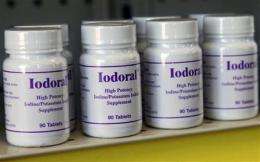
(AP) -- The Japanese nuclear crisis has reignited a debate in the U.S. over the government's role in distributing a cheap anti-cancer drug to people living around nuclear power plants.
The Nuclear Regulatory Commission currently makes the drug, potassium iodide, available to states for distribution within a 10-mile radius of nuclear power plants. Some House members from both parties want that expanded to 20 miles. And the American Thyroid Association, whose mission is to promote thyroid health, wants to go further - urging that potassium iodide be made available within 200 miles of a nuclear plant.
Potassium iodide, if taken within a few of hours of radiation exposure, helps reduce the risk of thyroid cancer by preventing the body from absorbing radioactive iodine. It's especially important for children, whose thyroid glands are more susceptible to radioactive iodine.
A 2002 bioterrorism law called for expanding the distribution radius to 20 miles, but the Bush administration in 2007 waived that requirement, invoking a provision in the law that allows the president to do so if he determined that a more effective method was available to prevent cancer. Bush's White House science adviser, John Marburger, concluded that a better route was evacuation and interdiction of contaminated food.
Potassium iodide, a salt also known as KI, doesn't block any other radiation besides radioactive iodine.
"It is possible that public misunderstanding of KI and its limits may lead to a dangerous sense of false confidence that KI provides inoculation against all forms of radiation," Marburger wrote in his decision.
President Barack Obama has not reversed that decision. Health and Human Services spokeswoman Dori Salcido said the government is studying lessons from the Japanese disaster, including potassium iodide distribution. But she added, "Experts agree that the best approach is always to avoid harmful levels of radiation by evacuating people nearby and monitoring food and water sources for harmful radiation levels."
Reps. Ed Markey, D-Mass., and Bill Young, R-Fla., have written separate letters to HHS Secretary Kathleen Sebelius urging her to fully implement the 2002 law's potassium distribution provision.
"The catastrophe in Japan should be a wake-up call to this administration," Young wrote in a letter co-signed by Florida Republican Gus Bilirakis.
Markey, who authored the 2002 KI provision, told Sebelius, "The exercise of presidential power to distribute KI is now long overdue, leaving many Americans living near these plants needlessly at risk, as sadly evidenced by the disaster in Japan."
In this country, 23 of 32 eligible states receive either the tablet or liquid KI or both from the federal government, according to the Nuclear Regulatory Commission.
The American Academy of Pediatrics also supports expanding the zone to 20 miles, said Dr. Steve Krug, who chairs the group's disaster preparedness advisory council. "It's really the children who need the protection the most, and our stockpile and strategies have not thoroughly considered the needs of children," he said.
He said the federal government should ensure that state plans call for KI to be stored in places where kids congregate, particularly schools, and preferably in a liquid form, which he said is more easily given to younger children.
Fourteen states have chosen to receive the liquid form from the federal government, according to Patricia Milligan, senior technical adviser for preparedness and response at the NRC. She said tablets store better and last longer than the liquid form, and can be mashed up in applesauce or fruit juice to make them more palatable to kids.
Milligan added that each state comes up with a plan that works for it, and the federal government can't dictate how potassium iodide is to be distributed.
"Some states pre-distribute, some stockpile, some states do a combination thereof," she said. "Some schools and school districts have chosen not to receive KI, because they don't want to be responsible for administering potassium iodide; they'd rather the kids get on the bus and leave."
She said that the NRC is "absolutely confident" that the 10-mile radius is sufficient. The nuclear energy industry also says stockpiling beyond that is unnecessary.
Dr. Fred Mettler, a University of New Mexico radiologist who led an international study of health effects after the 1986 Chernobyl nuclear disaster, said having potassium iodide around plants is of fairly limited use.
"I think the focus is wrong on potassium iodide," he said. "I think the focus clearly needs to be on the food chain."
Thousands of cases of thyroid cancer after Chernobyl are blamed on the Soviet Union's failure to stop children in the region from drinking milk contaminated with radioactive iodine. But KI proponents also cite the Chernobyl experience, noting studies have shown potassium iodide reduced incidents of thyroid cancer to children exposed to radiation.
The Japanese nuclear crisis has sparked a big demand for KI in the U.S., even though public health officials said the risk was confined to Japan. Anbex Inc., a leading supplier of the tablets, sold out the day of the tsunami, said company president Alan Morris. The company began shipping again this week.
©2010 The Associated Press. All rights reserved. This material may not be published, broadcast, rewritten or redistributed.


