Researchers invent next-gen device to track world's air quality
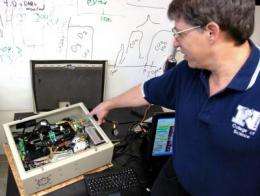
Physics professor Pat Arnott of the University of Nevada, Reno explains the new technology for photoacoustic air particle monitoring recently licensed by the University to Droplet Measurement Technologies. The device is used to measure air quality, including black carbon, in a number of applications. Credit: Photo by Mike Wolterbeek, University of Nevada, Reno.
A new air-quality measuring instrument invented by Pat Arnott and Ian Arnold of the University of Nevada, Reno that is more economical, more portable and more accurate than older technologies has been licensed for commercial development by Droplet Measurement Technologies of Boulder, Colo.
Arnott, a physics professor in the University's College of Science, had perhaps lugged his heavy pieces of equipment one too many times through airports to faraway places to examine airborne particles. Now, his and Arnold's latest invention has reduced the laser-equipped air-monitoring equipment to suitcase size, while enhancing its measurement capabilities.
This latest, compact version of the photoacoustic particle measuring machine with its lasers, mirrors, flexible tubes, wires and relays is also cheaper and faster and should be an attractive alternative for users.
"This machine will be much more ubiquitous for measuring air quality, or more precisely, black carbon in the air, or a number of other uses," Arnott said. "Key component cost and instrument weight have dropped from $2,000 and 180 pounds to $40 and 20 pounds. This will make it more accessible to researchers, businesses and government agencies; and much easier when traveling around the world to gather data."
Over the past 12 years, Arnott, along with collaborators from the Desert Research Institute, have mapped air pollution on Los Angeles freeways, as well as in Mexico City, the rain forests of Brazil, Vancouver, B.C., and Big Bend National Park, to name a few locations. They have also worked 1,600 feet underground in an active Nevada gold mine to monitor air quality.
Arnott's invention is an improvement on earlier technology he developed with partners. Arnott, John Walker and Hans Moosmüller, all at the time with DRI, commercialized the first version of the instrument with Droplet Measurement Technologies in 2005.
The University of Nevada, Reno's Tech Transfer Office, worked out the deal with DMT to commercialize the technology.
"The new device is a smaller, less expensive photoacoustic instrument for measuring airborne particles related to air quality that makes it affordable for a broader range of uses and it promises to lead to much wider market adoption of photoacoustic technology," said Ryan Heck, director of the University's Tech Transfer Office. "Pat and DMT have worked together for years, and we were pleased to help facilitate a new product based on their collaboration."
Arnott and DMT have already built beta-versions of the device that are in use by researchers at the Lawrence Berkeley Labs and the Bay Area Air Quality District, at the Max Planck Institute for Chemistry in Europe and in locations in Mexico City. Droplet is working to produce many more that will be a fraction of the cost to users.
"We're pleased to have entered into the licensing agreement," John Lovett, CEO of Droplet said. "Pat is a leading scientist in applying photo-acoustic technology to aerosols and has partnered with DMT on developing research-grade scientific instruments for air quality assessment.
"Our new instrument, the Photoacoustic Extinctiometer PAX, is a next generation monitoring tool to help scientists and air quality engineers accurately assess the optical properties of aerosols that are relevant for climate change and visibility. By measuring the aerosol in its natural state (photoacoustically), without requiring filter collection, the PAX improves measurement accuracy over older competing technologies."
Arnott and Arnold, an undergraduate student in Physics at the University when he assisted Arnott with instrument development, are also working on developing a truly miniature device that may find use as an on-board sensor for real-time black carbon air pollution emission control.
Provided by University of Nevada, Reno
-
From lemons to lemonade: Reaction uses carbon dioxide to make carbon-based semiconductor,
32 comments
-
Thioridazine kills cancer stem cells in human while avoiding toxic side-effects of conventional cancer treatments,
3 comments
-
SpaceX private rocket blasts off for space station (Update),
42 comments
-
Climate scientists say they have solved riddle of rising sea,
30 comments
-
Research team claims to have found evidence Lake Cheko is impact crater for Tunguska Event,
18 comments
-
Hypothetical desert earth
2 hours ago
-
More human population = greater mass?
May 25, 2012
-
Conversion from aircraft bearing to normal degrees
May 23, 2012
-
Interpretation/Analysis of the Lab results(HEPA filter)
May 22, 2012
-
Has anyone here attended the The Urbino Summer School in Paleoclimatology?
May 22, 2012
-
Earthquakes: Mag 6 N. Italy and Mag 5.6 W. Bulgaria
May 21, 2012
- More from Physics Forums - Earth
More news stories
SpaceX capsule has 'new car' smell, astronauts say (Update)
SpaceX's Dragon cargo vessel smells like a new car, said astronauts at the International Space Station after opening the hatches Saturday following the spacecraft's landmark mission to the orbiting lab.
Space & Earth / Space Exploration
16 hours ago |
4.5 / 5 (19) |
0
Astronomers seize last chance in lifetime for Venus Transit
Astronomers are gearing for one the rarest events in the Solar System: an alignment of Earth, Venus and the Sun that will not be seen for another 105 years.
16 hours ago |
5 / 5 (2) |
2
Australia hails surprise super-telescope decision
Australia has hailed a surprise decision giving it a role in a radio telescope project aimed at revolutionising astronomy, vowing to draw on its decades of experience in space science.
16 hours ago |
5 / 5 (4) |
1
Astronauts enter world's 1st private supply ship
(AP) -- Space station astronauts floated into the Dragon on Saturday, a day after its heralded arrival as the world's first commercial supply ship.
Space & Earth / Space Exploration
16 hours ago |
5 / 5 (5) |
0
Dragon arrives at space station in historic 1st (Update 2)
The privately bankrolled Dragon capsule made a historic arrival at the International Space Station on Friday, triumphantly captured by astronauts wielding a giant robot arm.
Space & Earth / Space Exploration
May 25, 2012 |
5 / 5 (10) |
19
Dell tablet leak: 10.1-inch display, two-battery choice
(Phys.org) -- Headline after headline talks about vendors tablets in the wings as likely number-one contenders for the iPad. Such claims have justifiably been taken with a grain of salt, considering ...
Scientist: Evolution debate will soon be history
(AP) -- Richard Leakey predicts skepticism over evolution will soon be history. Not that the avowed atheist has any doubts himself.
SpotterRF debuts Radar Backpack Kit (w/ Video)
(Phys.org) -- SpotterRF has announced a special radar backpack kit designed to enhance situational awareness for soldiers on the ground. The company says its special radar is designed for warfighters as part ...
Keep food safety in mind this memorial day weekend
(HealthDay) -- Picnics, parades and cookouts are as much a part of Memorial Day weekend as tributes to the United States' war veterans.
Thousands of shellfish found dead in Peru
Thousands of crustaceans were found dead off the coast of Lima following the mystery mass death of dolphins and pelicans, the Peruvian Navy said Friday.
Family history of Alzheimer's affects functional connectivity
(HealthDay) -- Cognitively normal individuals with a family history of late-onset Alzheimer's disease (AD) may display lower resting state functional connectivity in the default mode network (DMN) of the brain, ...