NASA spacecraft now circling Mercury -- a first
Mar 18, 2011
Image: NASA

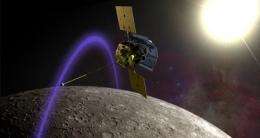
For the first time, Earth has a regular orbiting eye-in-the-sky spying on the solar system's smallest and strangest planet, Mercury.

NASA's spacecraft called Messenger successfully veered into a pinpoint orbit Thursday night after a 6 1/2-year trip and 4.9 billion miles and tricky maneuvering to fend off the of the sun. It is the fifth planet in our solar system that NASA has orbited, in addition to the Earth and the moon.

"It was right on the money," Messenger's chief engineer, Eric Finnegan, said. Messenger is in orbit that brings it as close as 120 miles above the planet's surface. "This is as close you can possibly get to being perfect."

"Everybody was whooping and hollering; we are elated," Finnegan said. "There's a lot of work left to be done, but we are there."

is not only difficult to get to, but it's has some of the most extremes in the solar system. Temperatures there swing wildly by 1,100 degrees. While it gets up to 800 degrees on the planet closest to the sun, it also is so cold and dark in some craters that the temperatures don't get above 300 degrees below zero. Radar even shows that there is likely frozen ice in those craters, something Messenger will try to confirm.

In the 1970s, NASA sent a spacecraft, Mariner, whizzing by Mercury, but only got pictures of less than half of the tiny rock. Robert Strom of the University of Arizona was a scientist on the Mariner and current Messenger missions and he said for a while he thought he wouldn't get a second peek at the eccentric Mercury.

"I am just so thrilled it isn't funny," Strom said by telephone minutes after NASA confirmed that Messenger was in orbit. "Thirty-six years waiting for this day. It's just unbelievable."

Strom said he and all his colleagues were nervous as the desk-sized spacecraft automatically shifted into an egg-shaped orbit, with controllers on Earth unable to change commands because it took eight minutes for signals to travel the approximately 100 million miles from Mercury to Earth.

"This was not easy. This was a very, very difficult maneuver to get into orbit," Strom told The Associated Press.

A NASA Twitter account under Messenger's name gave play-by-play accounts as it arrived at the small planet. This "Messenger" "exchanged tweets" with Voyager 2, one of NASA's oldest and most-distant spacecraft. Voyager 2, launched in 1977 and now at the edge of the solar system, tweeted good luck and Messenger "answered" with a tweet: "Many thanks! Cold out there? Kinda warm where I am."

Messenger, which cost $446 million, was launched in 2004. Next month it should start transmitting pictures and investigate Mercury's mysterious magnetic field and unusual density.

"This is when the real mission begins," Messenger chief scientist Sean Solomon said an hour after Messenger was safely in Mercury's . "We are really ready to learn about one of Earth's nearest neighbors for the first time."

For example, Solomon said Mercury, Venus, Earth and Mars formed at the same time, but Mercury "came out very different."

"Mercury is a planet where there are many things going on," Solomon said.

Explore further: Collisions of coronal mass ejections can be super-elastic

More information: Messenger spacecraft: http://bit.ly/eqUYR8

4.8 /5 (16 votes)
add to favorites email to friend print save as pdf

Related Stories

Messenger spacecraft on way to Mercury

Aug 03, 2005

NASA's Messenger spacecraft swung by Earth for a Tuesday gravity assist that propelled it deeper into space on its long journey toward Mercury.

MESSENGER Returns Images from Oct. 6 Mercury Fly-By

Oct 07, 2008

MESSENGER is the first mission sent to orbit the planet closest to the sun. On Oct. 6, 2008, at roughly 4:40 a.m. ET, MESSENGER flew by Mercury for the second time this year. During the encounter, the probe ...

MESSENGER On Its Way

Aug 04, 2004

The MESSENGER spacecraft lifted off on-time aboard a Boeing Delta II rocket from pad 17-B at Cape Canaveral Air Force Station, Fla., at 2:15:56.537 a.m. EDT. MESSENGER has successfully begun its mission to u ...

NASA rescheduled MESSENGER start to Mercury to August 3

Aug 02, 2004

Today's launch of the MESSENGER spacecraft has been canceled due to weather constraints. The launch team will try again tomorrow, August 3, at 2:15:56 a.m. MESSENGER is a scientific investigation of the planet ...

Recommended for you

NASA head views progress on asteroid lasso mission

5 hours ago

Surrounded by engineers, NASA chief Charles Bolden inspected a prototype spacecraft engine that could power an audacious mission to lasso an asteroid and tow it closer to Earth for astronauts to explore.

Ecuador satellite collides with Russian space junk

5 hours ago

A small Ecuadoran satellite collided in orbit with the remains of a Russian rocket, but it is too soon to know how much damage it might have sustained, Quito's space agency said Thursday.

Forecast for Titan: Wild weather could be ahead

May 22, 2013

(Phys.org) —Saturn's moon Titan might be in for some wild weather as it heads into its spring and summer, if two new models are correct. Scientists think that as the seasons change in Titan's northern hemisphere, ...

SDO observes mid-level solar flare

May 22, 2013

UPDATE 16:30 p.m. EDT: The M7-class flare was also associated with a coronal mass ejection or CME, another solar phenomenon that can send billions of tons of particles into space. While this CME was not Ea ...

User comments : 5

Adjust slider to filter visible comments by rank

Display comments: newest first

Parsec
5 / 5 (6) Mar 18, 2011
COOL!
CreepyD
5 / 5 (5) Mar 18, 2011
I'm always amazed when scientist acheive something such as this, such perfection over such vast distances.
I look forward to seeing some interesting data.
GSwift7
5 / 5 (4) Mar 18, 2011
Congratulation to them. I'm so relieved that it made it. Every big win like this helps to keep Washington interested in funding the next one.
StarDust21
not rated yet Mar 19, 2011
quick upload the first images for us NASA! :)
omatumr
4 / 5 (1) Mar 19, 2011
Congratulations on this great engineer feat!

More news stories

Hubble reveals the ring nebula's true shape

(Phys.org) —The Ring Nebula's distinctive shape makes it a popular illustration for astronomy books. But new observations by NASA's Hubble Space Telescope of the glowing gas shroud around an old, dying, ...

A hidden population of exotic neutron stars

(Phys.org) —Magnetars – the dense remains of dead stars that erupt sporadically with bursts of high-energy radiation - are some of the most extreme objects known in the Universe. A major campaign using ...

NASA head views progress on asteroid lasso mission

Surrounded by engineers, NASA chief Charles Bolden inspected a prototype spacecraft engine that could power an audacious mission to lasso an asteroid and tow it closer to Earth for astronauts to explore.

Controlling mood through the motions of mitochondria

(Medical Xpress)—Regulating the distribution of power in neurons is done by a system that makes the national electric grid look simple by comparison. Each neuron has several thousand mitochondria confined ...

Google Drive sports new view and scan enhancements

(Phys.org) —Google Drive has a new look and functions. The makeover in Google Drive features scanning and interface enhancements that put the user into "card" mode. The enhancements make it easy for the ...