NASA satellites show towering thunderstorms in rare sub-tropical storm Arani
March 16, 2011

NASA satellites show towering thunderstorms in rare sub-tropical storm Arani

Enlarge

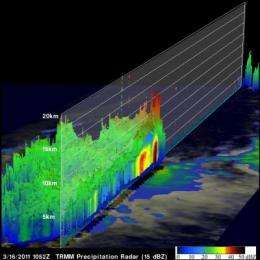
This 3-D view of Sub-tropical Storm Arani's clouds was created from data taken by NASA's TRMM satellite. It showed that there were very heavy thunderstorms (red) in the eastern half of the storm. TRMM's Precipitation Radar showed that some of these powerful storms were reaching to heights of over 14 km (~8.7 miles) above the surface of the Southern Atlantic Ocean. Credit: NASA/SSAI, Hal Pierce

NASA's Aqua and TRMM satellites are providing data to scientists about the Southern Atlantic Ocean Sub-tropical Storm Arani, a rare occurrence in the southern ocean. Rainfall data and cloud top temperatures revealed some heavy rain and strong thunderstorms exist in Arani as it continues to pull away from Brazil.

NOAA's Satellite and Information Service classified Arani as a T1 on the Dvorak intensity scale which would indicate an estimated wind speed of about 29 knots (~33 mph).

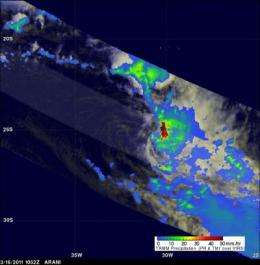
During the daytime on Tuesday, March 15 at 1820 UTC (2:20 p.m. EST) NASA's Measuring Mission (TRMM) satellite flew over Sub-Tropical Storm Arani. TRMM showed that the storm contained mostly moderate rainfall, falling at a rate between 20 and 40 millimeters (.89 to 1.57 inches) per hour. However, there were some areas of heavy rainfall in the north and eastern quadrants of the storm. The heavier rainfall was occurring at about 50 mm or 2 inches per hour. TRMM's Microwave Imager (TMI) and Precipitation Radar (PR) data were used in the image above to show rainfall near Arani.
NASA satellites show towering thunderstorms in rare sub-tropical storm Arani
Enlarge

The TRMM satellite had another very good view of Sub-tropical Cyclone Arani in the morning light on March 16, 2011, at 1052 UTC. This data showed that there were very heavy thunderstorms in the eastern half of the storm. TRMM's Precipitation Radar showed that some of these powerful storms were reaching to heights of over 14 km (~8.7 miles) above the surface of the Southern Atlantic Ocean. Credit: NASA/SSAI, Hal Pierce

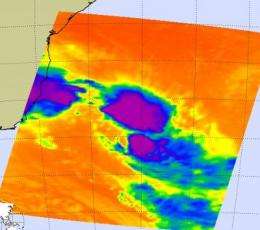
On Mar. 16 at 03:29 UTC (Mar. 15 at 11:29 p.m. EST) another of NASA's fleet of Earth science satellites flew over Sub-tropical Storm Arani and took its temperature. NASA's Aqua satellite captured an infrared image of Sub-Tropical Storm Arani's cold thunderstorm in two areas of the storm. The Atmospheric Infrared Sounder (AIRS) instrument that flies aboard Aqua provided infrared readings of those cloud tops and showed that they were as cold as or colder than -63F/-52 C, and were areas of heavy rainfall. The strongest thunderstorms wrapped from the north, eastward to the south of the center of circulation, confirming the data from the TRMM satellite.

Later on March 16, at 10:52 UTC (6:52 a.m. EST), the TRMM satellite again passed over Sub-Tropical Storm Arani and noticed it still had some strong thunderstorms and was producing heavy rainfall off the Brazilian coast.

TRMM data was used to create a 3-D view of Sub-tropical Storm Arani's clouds, and it showed that there were very heavy thunderstorms in the eastern half of the storm. TRMM's Precipitation Radar showed that some of these powerful storms were reaching to heights of over 14 km (~8.7 miles) above the surface of the Southern Atlantic Ocean.

Arani has the appearance of a tropical cyclone but has been classified as a subtropical cyclone. Subtropical cyclones are low pressure areas that develop with a cold core and transition to a warm core in the mid-levels of the troposphere, resembling a tropical cyclone. They more typically form outside of hurricane season (which is June 1 to Nov. 30 in the Northern Atlantic, for example). They also have broad wind patterns and that means that their maximum sustained winds are usually located farther from the center than a tropical cyclone. They also have no weather fronts linked to them, such as a typical low pressure area that brings summertime storms with an associated cold front. Subtropical cyclones can sometimes become tropical cyclones, and occasionally, tropical cyclones can become subtropical.
NASA satellites show towering thunderstorms in rare sub-tropical storm Arani
Enlarge

On March 16 at 03:29 UTC (Mar. 15 at 11:29 p.m. EST) NASA's Aqua satellite captured an infrared image of Sub-Tropical Storm Arani's cold thunderstorm cloud tops (purple) in two areas of the storm. Those cloud tops were as cold as or colder than -63F/-52 C, and were areas of heavy rainfall. The strongest thunderstorms appeared north and south of the center of circulation. Credit: NASA/JPL, Ed Olsen

Tropical cyclones are very rare in the Southern Atlantic Ocean. In 2004 a cyclone called Catarina formed in the South Atlantic and caused some controversy when it was classified as a hurricane by the United States' National Hurricane Center.

Arani is over the open waters of the Southern Atlantic and continues to move east-southeast and farther away from Brazil.

Provided by NASA's Goddard Space Flight Center search and more info website

Filter


Move the slider to adjust rank threshold, so that you can hide some of the comments.


Display comments: newest first

SincerelyTwo
Mar 16, 2011

Rank: not rated yet
I'm wondering if there's a term that describes the boundary where there is the transition from "cloud" to "rain"?
I'm also curious to know why that boundary exists, why aren't we drowning in clouds?

I suspect that this boundary varies from planet to planet depending on its mass, pressures at the surface of the planet, and also the chemical composition of the atmosphere?

By the way, it is amazing to me that clouds can be suspended like that... extending for miles outward from the surface, but then the last few hundred feet it condenses to form rain.

Now I want to learn everything I can about storm systems.
Rank not rated yet
Relevant PhysicsForums posts

More news stories

SpaceX capsule has 'new car' smell, astronauts say (Update)

SpaceX's Dragon cargo vessel smells like a new car, said astronauts at the International Space Station after opening the hatches Saturday following the spacecraft's landmark mission to the orbiting lab.

Space & Earth / Space Exploration

created 16 hours ago | popularity 4.5 / 5 (19) | comments 0

Astronomers seize last chance in lifetime for Venus Transit

Astronomers are gearing for one the rarest events in the Solar System: an alignment of Earth, Venus and the Sun that will not be seen for another 105 years.

Space & Earth / Astronomy

created 16 hours ago | popularity 5 / 5 (2) | comments 2

Australia hails surprise super-telescope decision

Australia has hailed a surprise decision giving it a role in a radio telescope project aimed at revolutionising astronomy, vowing to draw on its decades of experience in space science.

Space & Earth / Astronomy

created 16 hours ago | popularity 5 / 5 (4) | comments 1

Astronauts enter world's 1st private supply ship

(AP) -- Space station astronauts floated into the Dragon on Saturday, a day after its heralded arrival as the world's first commercial supply ship.

Space & Earth / Space Exploration

created 16 hours ago | popularity 5 / 5 (5) | comments 0

Dragon arrives at space station in historic 1st (Update 2)

The privately bankrolled Dragon capsule made a historic arrival at the International Space Station on Friday, triumphantly captured by astronauts wielding a giant robot arm.

Space & Earth / Space Exploration

created May 25, 2012 | popularity 5 / 5 (10) | comments 19


Dell tablet leak: 10.1-inch display, two-battery choice

(Phys.org) -- Headline after headline talks about vendors’ tablets in the wings as likely number-one contenders for the iPad. Such claims have justifiably been taken with a grain of salt, considering ...

Scientist: Evolution debate will soon be history

(AP) -- Richard Leakey predicts skepticism over evolution will soon be history. Not that the avowed atheist has any doubts himself.

SpotterRF debuts Radar Backpack Kit (w/ Video)

(Phys.org) -- SpotterRF has announced a special radar backpack kit designed to enhance situational awareness for soldiers on the ground. The company says its special radar is designed for warfighters as part ...

Keep food safety in mind this memorial day weekend

(HealthDay) -- Picnics, parades and cookouts are as much a part of Memorial Day weekend as tributes to the United States' war veterans.

Thousands of shellfish found dead in Peru

Thousands of crustaceans were found dead off the coast of Lima following the mystery mass death of dolphins and pelicans, the Peruvian Navy said Friday.

Family history of Alzheimer's affects functional connectivity

(HealthDay) -- Cognitively normal individuals with a family history of late-onset Alzheimer's disease (AD) may display lower resting state functional connectivity in the default mode network (DMN) of the brain, ...