Novel nanowires boost fuel cell efficiency
March 31, 2011

Novel nanowires boost fuel cell efficiency

Enlarge

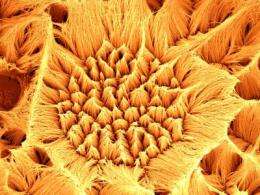
Taylor and Schroers engineered nanowires out of a novel material called bulk metallic glass in order to make fuel cell catalyst systems more durable and efficient. Credit: Golden Kumar and Miriam Schroers/Yale University

Fuel cells have been touted as a cleaner solution to tomorrow's energy needs, with potential applications in everything from cars to computers.

But one reason fuel cells aren't already more widespread is their lack of endurance. Over time, the catalysts used even in today's state-of-the-art fuels cells break down, inhibiting the chemical reaction that converts fuel into electricity. In addition, current technology relies on small coated with the catalyst; however, the particles' limited surface area means only a fraction of the catalyst is available at any given time.

Now a team of engineers at the Yale School of Engineering & Applied Science has created a new catalyst system using nanowires made of a novel material that boosts long-term performance by 2.4 times compared to today's technology. Their findings appear on the cover of the April issue of ACS Nano.

Yale engineers Jan Schroers and André Taylor have developed miniscule nanowires made of an innovative metal alloy known as a bulk metallic glass (BMG) that have high surface areas, thereby exposing more of the catalyst. They also maintain their activity longer than traditional fuel cell catalyst systems.

Current fuel cell technology uses carbon black, an inexpensive and electrically conductive carbon material, as a support for platinum particles. The carbon transports electricity, while the platinum is the catalyst that drives the production of electricity. The more platinum particles the fuel is exposed to, the more electricity is produced. Yet carbon black is porous, so the platinum inside the inner pores may not be exposed. Carbon black also tends to corrode over time.

"In order to produce more efficient fuel cells, you want to increase the active surface area of the catalyst, and you want your catalyst to last," Taylor said.

At 13 nanometers in scale (about 1/10,000 the width of a human hair), the BMG nanowires that Schroers and Taylor developed are about three times smaller than carbon black particles. The nanowires' long, thin shape gives them much more active surface area per mass compared to carbon black. In addition, rather than sticking platinum particles onto a support material, the Yale team incorporated the platinum into the nanowire alloy itself, ensuring that it continues to react with the fuel over time.

It's the nanowires' unique chemical composition that makes it possible to shape them into such small rods using a hot-press method, said Schroers, who has developed other BMG alloys that can also be blow molded into complicated shapes. The BMG also conduct electricity better than carbon black and carbon nanotubes, and are less expensive to process.

So far Taylor has tested their system for alcohol-based fuel cells (including those that use ethanol and methanol as fuel sources), but they say the system could be used in other types of fuel cells and could one day be used in portable electronic devices such as laptop computers and cell phones as well as in remote sensors.

"This is the introduction of a new class of materials that can be used as electrocatalysts," Taylor said. "It's a real step toward making fuel cells commercially viable and, ultimately, supplementing or replacing batteries in electronic devices."

More information: DOI: 10.1021/nn200033c

Provided by Yale University search and more info website

4.8 /5 (4 votes)  

Rank 4.8 /5 (4 votes)
Relevant PhysicsForums posts
  • Question about induced E field.
    created19 minutes ago
  • Charging a capacitor in a tesla coil
    created20 minutes ago
  • Water Rocket
    created3 hours ago
  • why do trucks have bigger brakes?
    created8 hours ago
  • Solar Sail Physics - Do they work on a large scale?
    created9 hours ago
  • How should I switch an air conditioner off?
    created9 hours ago
  • More from Physics Forums - General Physics

More news stories

Dopant gives graphene solar cells highest efficiency yet

(Phys.org) -- By taking advantage of graphene’s favorable electrical and optical properties, and then adding an organic dopant, researchers have achieved the highest power conversion efficiency yet for ...

Nanotechnology / Nanophysics

created May 21, 2012 | popularity 5 / 5 (10) | comments 14 | with audio podcast feature

Nanomedicine: Quantum dots appear safe in pioneering study on primates

A pioneering study to gauge the toxicity of quantum dots in primates has found the tiny crystals to be safe over a one-year period, a hopeful outcome for doctors and scientists seeking new ways to battle diseases ...

Nanotechnology / Bio & Medicine

created May 20, 2012 | popularity 4.3 / 5 (3) | comments 8 | with audio podcast

In nanorod crystal growth, nanoparticles seen as artificial atoms

In the growth of crystals, do nanoparticles act as "artificial atoms" forming molecular-type building blocks that can assemble into complex structures? This is the contention of a major but controversial theory ...

Nanotechnology / Nanophysics

created May 24, 2012 | popularity 4.8 / 5 (6) | comments 0 | with audio podcast

First direct observation of oriented attachment in nanocrystal growth

Berkeley Lab researchers have reported the first direct observation of nanoparticles undergoing oriented attachment, the critical step in biomineralization and the growth of nanocrystals. A better understanding ...

Nanotechnology / Nanophysics

created May 24, 2012 | popularity 4.7 / 5 (3) | comments 0 | with audio podcast

Synthetic nano-waste does not disappear

(Phys.org) -- Tiny particles of cerium oxide do not burn or change in the heat of a waste incineration plant. They remain intact on combustion residues or in the incineration system, as a new study by Swiss ...

Nanotechnology / Bio & Medicine

created May 25, 2012 | popularity 5 / 5 (2) | comments 1 | with audio podcast


Dell tablet leak: 10.1-inch display, two-battery choice

(Phys.org) -- Headline after headline talks about vendors’ tablets in the wings as likely number-one contenders for the iPad. Such claims have justifiably been taken with a grain of salt, considering ...

Scientist: Evolution debate will soon be history

(AP) -- Richard Leakey predicts skepticism over evolution will soon be history. Not that the avowed atheist has any doubts himself.

SpotterRF debuts Radar Backpack Kit (w/ Video)

(Phys.org) -- SpotterRF has announced a special radar backpack kit designed to enhance situational awareness for soldiers on the ground. The company says its special radar is designed for warfighters as part ...

SpaceX capsule has 'new car' smell, astronauts say (Update)

SpaceX's Dragon cargo vessel smells like a new car, said astronauts at the International Space Station after opening the hatches Saturday following the spacecraft's landmark mission to the orbiting lab.

Thousands of shellfish found dead in Peru

Thousands of crustaceans were found dead off the coast of Lima following the mystery mass death of dolphins and pelicans, the Peruvian Navy said Friday.

Astronomers seize last chance in lifetime for Venus Transit

Astronomers are gearing for one the rarest events in the Solar System: an alignment of Earth, Venus and the Sun that will not be seen for another 105 years.