Microscope could 'solve the cause of viruses'
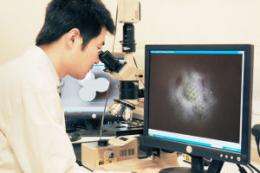
(PhysOrg.com) -- University of Manchester scientists have produced the worlds most powerful optical microscope, which could help understand the causes of many viruses and diseases.
Writing in the journal Nature Communications, the team have created a microscope which shatters the record for the smallest object the eye can see, beating the diffraction limit of light.
Previously, the standard optical microscope can only see items around one micrometre 0.001 millimetres clearly.
But now, by combining an optical microscope with a transparent microsphere, dubbed the 'microsphere nanoscope', the Manchester researchers can see 20 times smaller 50 nanometres (5 x 10⁻⁸m) under normal lights. This is beyond the theoretical limit of optical microscopy.
This hugely-increased capacity means the scientists, led by Professor Lin Li and Dr Zengbo Wang, could potentially examine the inside of human cells, and examine live viruses for the first time to potentially see what causes them.
The existing microscopes which have the capacity to examine tiny items electron microscopes can only see the surface of a cell rather than examining its structure and there is no tool to see a live virus visually.
The scientists, from the School of Mechanical, Aerospace and Civil Engineering, now believe they can use the microscope to detect far smaller images in the future. The new method has no theoretical limit in the size of feature that can be seen.
The new nano-imaging system is based on capturing optical, near-field virtual images, which are free from optical diffraction, and amplifying them using a microsphere, a tiny spherical particle which is further relayed and amplified by a standard optical microscope.
Professor Li, who initiated and led the research in collaboration with academics at the National University and Data Storage Institute of Singapore, believes their research could prove to be an important development.
He said: "This is a world record in terms of how small an optical microscope can go by direct imaging under a light source covering the whole range of optical spectrum.
"Not only have we been able to see items of 50 nanometres, we believe that is just the start and we will be able to see far smaller items.
"Theoretically, there is no limit on how small an object we will be able to see.
"The common way of seeing tiny items presently is with an electron microscope, and even then you cannot see inside a cell only the outside. Optical fluoresce microscopes can see inside the cells indirectly by dying them, but these dyes cannot penetrate viruses.
"Seeing inside a cell directly without dying and seeing living viruses directly could revolutionize the way cells are studied and allow us to examine closely viruses and biomedicine for the first time."
Among other tiny objects the scientists will be able to examine are anodized aluminum oxide nano-structures, and nano-patterns on Blue-Ray CVC disks, not previously visible with an optical microscope.
More information: Optical virtual imaging at 50 nm lateral resolution with a white light nanoscope, by Zengbo Wang: Nature Communications (2011)
Provided by
University of Manchester
-
From lemons to lemonade: Reaction uses carbon dioxide to make carbon-based semiconductor,
32 comments
-
Thioridazine kills cancer stem cells in human while avoiding toxic side-effects of conventional cancer treatments,
3 comments
-
SpaceX private rocket blasts off for space station (Update),
42 comments
-
Climate scientists say they have solved riddle of rising sea,
30 comments
-
Research team claims to have found evidence Lake Cheko is impact crater for Tunguska Event,
18 comments
-
Question about induced E field.
19 minutes ago
-
Charging a capacitor in a tesla coil
20 minutes ago
-
Water Rocket
3 hours ago
-
why do trucks have bigger brakes?
8 hours ago
-
Solar Sail Physics - Do they work on a large scale?
9 hours ago
-
How should I switch an air conditioner off?
9 hours ago
- More from Physics Forums - General Physics
More news stories
Dopant gives graphene solar cells highest efficiency yet
(Phys.org) -- By taking advantage of graphenes favorable electrical and optical properties, and then adding an organic dopant, researchers have achieved the highest power conversion efficiency yet for ...
Nanomedicine: Quantum dots appear safe in pioneering study on primates
A pioneering study to gauge the toxicity of quantum dots in primates has found the tiny crystals to be safe over a one-year period, a hopeful outcome for doctors and scientists seeking new ways to battle diseases ...
Nanotechnology / Bio & Medicine
May 20, 2012 |
4.3 / 5 (3) |
8
|
In nanorod crystal growth, nanoparticles seen as artificial atoms
In the growth of crystals, do nanoparticles act as "artificial atoms" forming molecular-type building blocks that can assemble into complex structures? This is the contention of a major but controversial theory ...
May 24, 2012 |
4.8 / 5 (6) |
0
|
First direct observation of oriented attachment in nanocrystal growth
Berkeley Lab researchers have reported the first direct observation of nanoparticles undergoing oriented attachment, the critical step in biomineralization and the growth of nanocrystals. A better understanding ...
May 24, 2012 |
4.7 / 5 (3) |
0
|
Synthetic nano-waste does not disappear
(Phys.org) -- Tiny particles of cerium oxide do not burn or change in the heat of a waste incineration plant. They remain intact on combustion residues or in the incineration system, as a new study by Swiss ...
Nanotechnology / Bio & Medicine
May 25, 2012 |
5 / 5 (2) |
1
|
Dell tablet leak: 10.1-inch display, two-battery choice
(Phys.org) -- Headline after headline talks about vendors tablets in the wings as likely number-one contenders for the iPad. Such claims have justifiably been taken with a grain of salt, considering ...
Scientist: Evolution debate will soon be history
(AP) -- Richard Leakey predicts skepticism over evolution will soon be history. Not that the avowed atheist has any doubts himself.
SpotterRF debuts Radar Backpack Kit (w/ Video)
(Phys.org) -- SpotterRF has announced a special radar backpack kit designed to enhance situational awareness for soldiers on the ground. The company says its special radar is designed for warfighters as part ...
SpaceX capsule has 'new car' smell, astronauts say (Update)
SpaceX's Dragon cargo vessel smells like a new car, said astronauts at the International Space Station after opening the hatches Saturday following the spacecraft's landmark mission to the orbiting lab.
Thousands of shellfish found dead in Peru
Thousands of crustaceans were found dead off the coast of Lima following the mystery mass death of dolphins and pelicans, the Peruvian Navy said Friday.
Astronomers seize last chance in lifetime for Venus Transit
Astronomers are gearing for one the rarest events in the Solar System: an alignment of Earth, Venus and the Sun that will not be seen for another 105 years.
Mar 01, 2011
Rank: 4.7 / 5 (3)
I think the researcher was much more articulate in his description: "Seeing inside a cell directly without dying and seeing living viruses directly could revolutionize the way cells are studied and allow us to examine closely viruses and biomedicine for the first time."
Mar 01, 2011
Rank: 4.5 / 5 (2)
Oh, really.
Mar 02, 2011
Rank: 4 / 5 (1)
Fantastic!
Mar 02, 2011
Rank: 4 / 5 (3)
I doubt that professor Li would ever say such a thing.
Mar 02, 2011
Rank: 4.5 / 5 (2)
Congratulations to University of Manchester!
Mar 02, 2011
Rank: not rated yet
Yes, of course! Direct, non-intrusive, observation at the "sub cellular" level does open up a possibility of a better understanding viral action and thus this is a significant breakthrough.
(Also, how is this different than the often panned Royal Rife microscopes of the 1930's?)
Mar 07, 2011
Rank: not rated yet
You have to truly admire the visual range here.