'Singing' mice -- the ongoing debate of nature vs. nurture
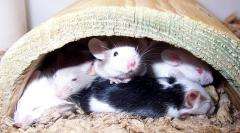
What happened to being "quiet as a mouse"? Researchers have recently shown that, rather than being the silent creatures of popular belief, mice emit ultrasonic calls in a variety of social contexts, and these calls have song-like characteristics. So if mice sing, where do they get their music? Are they born with the songs fully formed in their heads, or do they learn them from their peers? This question is of great interest to scientists as, while many organisms produce genetically regulated vocalizations, only a select few species (such as ourselves) can actually learn these vocalizations. If it turns out that mice can indeed learn new songs, it would provide a very convenient mammalian model of vocal learning.
Whether or not mouse song involves learning either through auditory imitation or behavioral feedback (e.g., from the mother), however, is a subject of hot debate, and the answer is proving elusive. To highlight the difficulties facing researchers, two studies published on March 9, 2011 in the open-access journal PLoS ONE have come to differing conclusions about whether mouse vocalization patterns are innate or learned.
In the first study, researchers from Northeastern Ohio Universities Colleges of Medicine and Pharmacy and the MRC Institute of Hearing Research conducted a study to understand developmental changes in mouse song that would allow parents to distinguish older mice from younger mice. They found that many features of mouse song changed with age. For example, the pattern of syllables within songs became more complex.
According to lead author Jasmine Grimsley, "We concluded that the increased complexity of song suggests that mice may be capable of vocal learning, but we also recognized that other factors besides learning, such as genetically controlled neuromuscular development, might explain the increased complexity. We conducted our study in normal hearing, CBA/CaJ mice, and we intend to use the results to understand how the brain codes the meaning of these sounds."
The second study, a collaboration among Azabu University, the RIKEN Brain Science Institute, and the Okanoya Emotional Information Project used a cross-fostering experiment to test whether the vocalization patterns were more strongly influenced by genetics or environment. The researchers used males from two mouse strains, C57BL/6 and BALB/c, which emit different vocalizations. Males from each strain were raised in litters of the opposite strain until weaning. Vocalization patterns were recorded at 10-20 weeks of age, and the researchers compared vocalizations of cross-fostered mice to control mice reared by genetic parents.
According to first author Takefumi Kikusui, "We first showed that two strains of mice, BALB and B6, sing strain-unique song types. We then showed that rearing BALB by B6 parents do not change the BALB characteristics of the song, and vise-versa. The fact that the cross-fostered animals sang songs similar to those of their genetic parents suggests that the structure of this courtship sound is under strong genetic control."
When asked about the results from the other study, corresponding author Dr. Kazuo Okanoya noted that, "they demonstrate substantial developmental changes in social vocalizations with age. They also characterized complex behavioral phenotypes of mice vocalizations. However, in our opinion, developmental and phonotypical complexities of mice vocalizations are not related with whether or not the vocalizations are learned."
Dr Grimsley said of the Japanese research, "while we believe that the study by Kikusui et al. indicates that some aspects of mouse songs are genetically driven, the conclusion that vocal learning does not occur in mice is too strong for the experiments that they performed. In our opinion, the jury is still out regarding whether mice do, or do not, exhibit vocal learning."
Which is it then, nature or nurture? It appears that it is still too early to say for sure, and we do not yet know whether the mating songs of mice are genetically determined or learned from their parents. What is certain, however, is that even carefully performed scientific research does not always produce straight-forward answers.
More information: Grimsley JMS, Monaghan JJM, Wenstrup JJ (2011) Development of Social Vocalizations in Mice. PLoS ONE 6(3): e17460. doi:10.1371/journal.pone.0017460
Provided by Public Library of Science


