Researcher develops medical technology to detect and treat disease
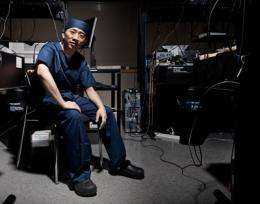
Cancer, heart disease and stroke are leading causes of death among Canadians. These are also the deadly diseases that Victor Yang's research team aims to alleviate.
Yang is a professor of electrical and computer engineering, and a Canada Research Chair in bioengineering and biophotonics. He's also a medical doctor with surgical training and works with neurosurgeons in several teaching hospitals. So Yang understands how the smallest, most precise tools can bring about huge changes in a patient's treatment and health.
To that end, Yang has two research interests: developing new techniques to image the human body, and devising novel tools for minimally invasive procedures. Both areas rely on Yang's expertise in an emerging type of medical imaging technology - Doppler optical coherence tomography (DOCT).
Using miniscule optical fibres, originally created for the telecommunications industry, DOCT creates detailed, 3-D images of the tiniest structures and movements within the body. When looking at delicate and small anatomical features, DOCT is more exact than ultrasound, more economical than MRI scans and safer than X-rays. Above all, DOCT can see things 10 to 100 times smaller than these traditional techniques.
Yang and his research team are enhancing DOCT for various medical applications. For example, he is exploring situations involving increased or decreased blood flow within the body. The former can be associated with cancer while the latter can be a sign of blockage in the brain or heart.
To feed their growth, cancerous masses spur the rapid development of extra blood vessels. Yang is using DOCT to detect and image those vessels - with an aim to destroy them. "The overall goal is to locate the tumour vasculature, treat it and then evaluate the results," he says.
Meanwhile, Yang has also developed flexible fibre-optic probes with artificial muscles for use in minimally invasive procedures such as endoscopy or angiography, with collaborators at University of British Columbia and University of Toronto. For instance, in a coronary angioplasty, a balloon-tipped catheter is used to open a narrowed or blocked artery in the heart. During such a delicate procedure, however, there is a risk of puncturing the arterial wall. Yang and his team have built a mini-probe that can look ahead and guide the catheter to form the right shape within the artery. One day, this device may aid the doctors to identify the location of small passageways within the blockage and prevent dangerous perforations. Potentially more patients could be candidates for angioplasty and avoid major surgeries such as a coronary-artery bypass.
But patients aren't the only ones potentially benefiting from Yang's expertise. Thanks to his lab's leading-edge work and collaborations, many of his graduate students conduct research not only on Ryerson campus, but also at Princess Margaret Hospital and Harvard Medical School. For example, Barry Vuong, Yang's PhD student, is currently doing experiments at Massachusetts General Hospital; and Darren Morofk, Yang's first master's student, is completing his PhD study at Oxford University. These prestigious learning opportunities help to transform the research culture at Ryerson. "Young Ryerson researchers are working with the best in the field, and I think they can compete on the world stage in the near future," says Yang.
Yang's current research program is funded by Canadian Institutes of Health Research, Natural Sciences and Engineering Research Council of Canada, and Canada Foundation for Innovation, among other sources. Working with researchers at the University Health Network, St. Michael's Hospital and Sunnybrook Health Science Center, Yang envisions technological leaps in multiple medical specialties: "These collaborations are out-of-the-box partnerships that lead to creative thinking and practical problem solving. They just reflect our university's history and traditional strength, in a new arena," adds Yang.


