Discovering mammoth undersea mountains
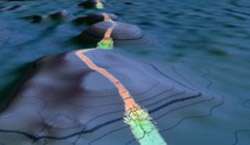
(PhysOrg.com) -- In the latest evidence of the vastness remaining to be explored in the world’s oceans, scientists aboard Scripps Institution of Oceanography at UC San Diego’s research vessel Melville are mapping a series of colossal and previously uncharted undersea mountains in remote areas of the South Atlantic Ocean.
With the largest seamount rising more than 14,700 feet from the seafloor—higher than California’s Mount Whitney, the tallest mountain in the contiguous United States—the mountains had been known from satellite data but never before charted at sea.
Because of the exploratory nature of the ship’s navigation, R/V Melville Captain Chris Curl and geophysicist J.J. Becker, who received his Ph.D. from Scripps in 2008, are working side-by-side to navigate over the gigantic mountains, the largest of which spans some 140 kilometers (87 miles) across (the approximate distance from San Diego to Long Beach, Calif.)
“These particular seamounts are so steep that it was nerve-wracking to go from 3,000 meters (9,840 feet) of water to less than 500 meters (1,640 feet) in 15 or 20 minutes!” said Becker.
David Sandwell, a Scripps professor of geophysics, has been providing guidance to the ship from his office on the Scripps campus as the vessel transits from South Africa to Chile. The researchers are employing a new survey tool based on Google Earth software called “Seamount Discovery Tool” to aid in the exploration.
“There are still 4,000-meter-tall undersea mountains that have never been charted by anyone,” said Sandwell, of Scripps’ Cecil H. and Ida M. Green Institute of Geophysics and Planetary Physics. “These are really huge seamounts that are somewhat known from satellite altimetry, so the ship data confirm their size and provide accurate measurements.”
The seamounts, mapped by Melville’s multibeam sonar, are located in the South Atlantic Ocean approximately 1,200 miles southwest of Cape Town, South Africa. (latitude 42°S, longitude 00°E).
Prior to Melville’s departure, Sandwell provided a proposed trackline where the ship might explore uncharted undersea features. Foul weather in the South Atlantic (persistent in the Southern Ocean) required the scientists to modify their exploration path almost immediately after leaving port. The alternate track, however, has revealed the presence of surprising numbers of large, flat-topped underwater mountains with extremely steep sides, called “guyots.”
“This is a great example of how serendipity and skill are involved in successful exploration and discovery,” said Bruce Appelgate, associate director for Ship Operations and Marine Technical Support at Scripps. “Dave Sandwell used the satellite data to create a great precruise plan, but the seas forced us to abandon that for a different path. Good oceanographers that they are, he and J.J. Becker were ready with contingency plans that have yielded spectacular results.”
Seamounts, especially massive seamounts like these, are important for many reasons, said Appelgate. The chemistry of the volcanic rock they are made from provides information about the underlying mantle where the seamounts formed.
“They are so big they actually deform the lithosphere they sit on, and they have a profound effect on the physical oceanography and biological ecosystems around them,” said Appelgate. “Satellite altimetry has detected about 13,000 seamounts, but the total number of seamounts taller than one kilometer probably exceeds 100,000. So clearly these are important, and you need ships like Melville, and scientists like Sandwell and Becker, to go find them.”
Becker and Sandwell noted that such discoveries can be made by diverting from the traditional “Great Circle” route of sea transit. The Great Circle is the shortest distance between two ports but significant discoveries can be made by increasing the path by just three percent. Considering uncertainties in weather, a longer path can save time and fuel so it is important for the ship’s captain to be involved in mapping decisions.
Scripps’ R/V Melville is currently being repositioned from the South Atlantic to the South Pacific in order to support major research programs funded by the National Science Foundation. Scripps’ policy is to use every opportunity at sea to collect meaningful data, so rather than simply transit across the ocean, Scripps provided funding through its UC Ship Funds Program to enable a diverse group of scientists to join the research vessel in Cape Town and acquire data. The cruise is led by Scripps Chief Scientist Robert Frouin, who along with his research team is making observations about the physics of the air-sea interface in areas of extreme wind. These data will be used to improve scientists’ ability to interpret data collected globally by satellites. Other Scripps scientists on board are deploying autonomous ocean drifters and building new software tools for shipboard data processing.
Melville will continue to cross the South Atlantic, pass through the Strait of Magellan and cruise up the west coast of Chile to its destination at Valparaiso, Chile. From there, Melville will continue its expedition of discovery by resuming an investigation of the deformation of the ocean floor caused by the magnitude-8.8 Chile earthquake of February 2010. Last year the ship performed the first-ever detailed seafloor mapping of a major subduction zone earthquake as part of the Scripps rapid scientific response to the Chilean earthquake. The additional data will shed new light on how the crust responds in the wake of giant earthquakes.
Owned by the U.S. Navy and operated by Scripps Oceanography, the 279-foot R/V Melville is a global-class ship that conducts long-duration science missions. Last year, the U.S. Office of Naval Research selected Scripps as the operator of a new Ocean Class scientific research vessel, which is currently being designed with input from Scripps oceanographers. The U.S. Navy is providing more than $88 million to construct the vessel, which is anticipated to be ready for Scripps to operate by 2015.
Provided by University of California - San Diego


