'Lost' samples from famous origin of life researcher could send search for first life in new direction
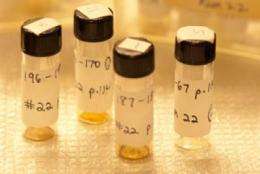
Preserved samples from a 1958 experiment done by "primordial soup" pioneer Stanley Miller contain amino acids created by the experiment. The samples had not undergone analysis until recently when Miller's former student Jeffrey Bada and colleagues discovered a wide range of amino acids. The find could be an important step toward understanding how life on Earth could have originated. The vials have been relabeled but the boxes are marked with Miller's original notes. Credit: Scripps Institution of Oceanography, UC San Diego
(PhysOrg.com) -- Stanley Miller gained fame with his 1953 experiment showing the synthesis of organic compounds thought to be important in setting the origin of life in motion. Five years later, he produced samples from a similar experiment, shelved them and, as far as friends and colleagues know, never returned to them in his lifetime.
More 50 years later, Jeffrey Bada, Miller's former student and a current Scripps Institution of Oceanography, UC San Diego professor of marine chemistry, discovered the samples in Miller's laboratory material and made a discovery that represents a potential breakthrough in the search for the processes that created Earth's first life forms.
Former Scripps undergraduate student Eric Parker, Bada and colleagues report on their reanalysis of the samples in the March 21 issue of Proceedings of the National Academy of Sciences. Miller's 1958 experiment in which the gas hydrogen sulfide was added to a mix of gases believed to be present in the atmosphere of early Earth resulted in the synthesis of sulfur amino acids as well as other amino acids. The analysis by Bada's lab using techniques not available to Miller suggests that a diversity of organic compounds existed on early planet Earth to an extent scientists had not previously realized.
"Much to our surprise the yield of amino acids is a lot richer than any experiment (Miller) had ever conducted," said Bada.
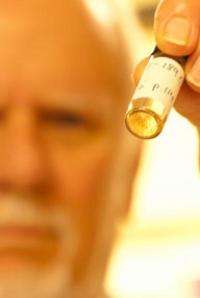
Scripps Oceanography professor of Marine Chemistry Jeffrey Bada holds a preserved sample from a 1958 experiment done by "primordial soup" pioneer Stanley Miller. The residue in the sample contains amino acids created by the experiment. The samples had not undergone analysis until recently when Bada and colleagues discovered a wide range of amino acids using modern detection methods. Credit: Scripps Institution of Oceanography, UC San Diego
The new findings support the case that volcanoes a major source of atmospheric hydrogen sulfide today accompanied by lightning converted simple gases into a wide array of amino acids, which are were in turn available for assembly into early proteins.Bada also found that the amino acids produced in Miller's experiment with hydrogen sulfide are similar to those found in meteorites. This supports a widely-held hypothesis that processes such as the ones in the laboratory experiments provide a model of how organic material needed for the origin of life are likely widespread in the universe and thus may provide the extraterrestrial seeds of life elsewhere.
Successful creation of the sulfur-rich amino acids would take place in the labs of several researchers, including Miller himself, but not until the 1970s.
"Unbeknownst to him, he'd already done it in 1958," said Bada.
Miller's initial experiments in the 1950s with colleague Harold Urey used a mixture of gases such as methane, ammonia, water vapor and hydrogen and electrically charged them as lightning would. The experiment, which took place in a closed chamber meant to simulate conditions on early Earth, generated several simple amino acids and other organic compounds in what became known as "primordial soup."
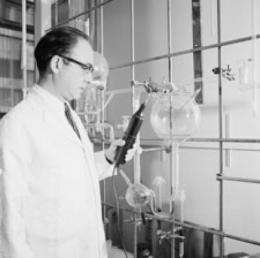
This is a photo of Stanley Miller in his UC San Diego lab in 1970. Credit: Scripps Institution of Oceanography Archives
With the gases and electrical energy they produce, many geoscientists believe the volcanoes on a young planet covered much more extensively by water than today's served as oases of raw materials that allowed prebiotic matter to accumulate in sufficient quantities to assemble into more complex material and eventually into primitive life itself. Bada had already begun reanalyzing Miller's preserved samples and drawing conclusions about the role of volcanoes in sparking early life when he came across the previously unknown samples. In a 2008 analysis of samples left from Miller's more famous experiment, Bada's team had been able to detect many more amino acids than his former mentor had thanks to modern techniques unavailable to Miller.Miller, who became a chemistry professor at UCSD in 1960, conducted the experiments while a faculty member at Columbia University. He had collected and catalogued samples from the hydrogen sulfide mix but never analyzed them. He only casually mentioned their existence late in his life and the importance of the samples was only realized shortly before his death in 2007, Bada said. It turned out, however, that his 1958 mix more closely resembled what geoscientists now consider early Earth conditions than did the gases in his more famous previous experiment.
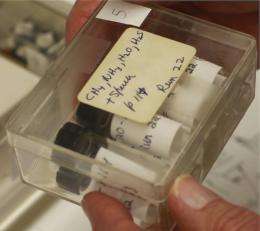
The original box containing archived spark discharge samples prepared by Stanley Miller in 1958. For unknown reasons, Miller never analyzed these even though this is his first experiment using hydrogen sulfide. The label shows Miller’s original writing: p 114 refers to his notebook. Credit: Jeffrey Bada and Robert Benson/Scripps Institution of Oceanography, University of California at San Diego
"This really not only enhances our 2008 study but goes further to show the diversity of compounds that can be produced with a certain gas mixture," Bada said.The Bada lab is gearing up to repeat Miller's classic experiments later this year. With modern equipment including a miniaturized microwave spark apparatus, experiments that took the elder researcher weeks to carry out could be completed in a day, Bada said.
Provided by
University of California - San Diego
-
From lemons to lemonade: Reaction uses carbon dioxide to make carbon-based semiconductor,
32 comments
-
Thioridazine kills cancer stem cells in human while avoiding toxic side-effects of conventional cancer treatments,
3 comments
-
SpaceX private rocket blasts off for space station (Update),
42 comments
-
Climate scientists say they have solved riddle of rising sea,
30 comments
-
Research team claims to have found evidence Lake Cheko is impact crater for Tunguska Event,
18 comments
-
Schwartz reagent-- NMR/MS/IR
15 hours ago
-
Inversion temp
20 hours ago
-
High school chemistry EEI
May 25, 2012
-
oxidation of I- by KMnO4
May 25, 2012
-
Invesion temp
May 25, 2012
-
Hybridization of SnCl3 -
May 25, 2012
- More from Physics Forums - Chemistry
More news stories
From lemons to lemonade: Reaction uses carbon dioxide to make carbon-based semiconductor
(Phys.org) -- A materials scientist at Michigan Technological University has discovered a chemical reaction that not only eats up the greenhouse gas carbon dioxide, it also creates something useful. And, by ...
May 21, 2012 |
4.7 / 5 (88) |
32
|
New CO2-removing catalyst can take the heat
(Phys.org) -- The current method of removing the greenhouse gas carbon dioxide (CO2) from the flues of coal-fired power plants uses so much energy that no one bothers to use it. So says Roger Aines, principal ...
May 24, 2012 |
5 / 5 (7) |
7
|
High-speed method to aid search for solar energy storage catalysts
Eons ago, nature solved the problem of converting solar energy to fuels by inventing the process of photosynthesis.
May 25, 2012 |
5 / 5 (3) |
4
|
Researchers demonstrate possible primitive mechanism of chemical info self-replication
(Phys.org) -- When scientists think about the replication of information in chemistry, they usually have in mind something akin to what happens in living organisms when DNA gets copied: a double-stranded molecule ...
May 25, 2012 |
5 / 5 (4) |
2
|
Castor oil: Action mechanism of one of the oldest drugs known to man elucidated
Castor oil is known primarily as an effective laxative; however, it was also used in ancient times with pregnant women to induce labour. Only now have scientists at the Max Planck Institute for Heart and Lung ...
May 21, 2012 |
3 / 5 (2) |
3
|
Scientist: Evolution debate will soon be history
(AP) -- Richard Leakey predicts skepticism over evolution will soon be history. Not that the avowed atheist has any doubts himself.
Dell tablet leak: 10.1-inch display, two-battery choice
(Phys.org) -- Headline after headline talks about vendors tablets in the wings as likely number-one contenders for the iPad. Such claims have justifiably been taken with a grain of salt, considering ...
SpotterRF debuts Radar Backpack Kit (w/ Video)
(Phys.org) -- SpotterRF has announced a special radar backpack kit designed to enhance situational awareness for soldiers on the ground. The company says its special radar is designed for warfighters as part ...
SpaceX capsule has 'new car' smell, astronauts say (Update)
SpaceX's Dragon cargo vessel smells like a new car, said astronauts at the International Space Station after opening the hatches Saturday following the spacecraft's landmark mission to the orbiting lab.
Thousands of shellfish found dead in Peru
Thousands of crustaceans were found dead off the coast of Lima following the mystery mass death of dolphins and pelicans, the Peruvian Navy said Friday.
Keep food safety in mind this memorial day weekend
(HealthDay) -- Picnics, parades and cookouts are as much a part of Memorial Day weekend as tributes to the United States' war veterans.


Mar 21, 2011
Rank: 1 / 5 (3)
Mar 22, 2011
Rank: 5 / 5 (4)
Mar 22, 2011
Rank: 3.3 / 5 (3)
Mar 22, 2011
Rank: 5 / 5 (1)
You mean clay, not rocks.
Mar 22, 2011
Rank: 1 / 5 (9)
Surely they should mention that unless Miller went out of his way to TRAP his precious amino acids, they would have mixed in again with the primordial soup and been totally destroyed?
So the rather clever experiment demonstrates nothing of a purely random, accidental process out in nature that can produce any of the building blocks of life.
There's simply too much interference by an intelligent outside agent.
So @Whalio, perhaps you should go and put your thinking cap on before becoming too enthused about the Miller experiment.
And the conclusions drawn by the researchers who want life out of nothing is simply laughable.
Mar 22, 2011
Rank: 4.1 / 5 (9)
I'm going to burn a bible today just for you kev. Unless I have something better to do.
Mar 22, 2011
Rank: not rated yet
Even this article itself fails to 'follow up' on its own assertions!
Telling us that the results of analysis are vastly more impressive that Miller's initial announcements is quit menaingless without *some* examples of what is meant!
Physorg is famous for omitting photo's when a photo is the only thing the articl might be about, but now its omitting the very facts which it refers to!
sigh.
Mar 24, 2011
Rank: 5 / 5 (5)
Lie. He carried out the experiments in a closed vessel. Had to so he maintain the gases involved.
No. At least that was disguised as a question.
Who ever claimed the processes were random? They proceed according to physical laws. We even find amino acids in meteorites.
More
Mar 24, 2011
Rank: 5 / 5 (6)
And for our next laugh...
I must perform the Kevin banishing incantation.
When was the Flood Kevin? How come the Egyptians didn't notice drowning since the standard dates for the Flood have it occurring during at the time the Egyptians were building the pyramids?
Goodbye Kevin.
See he is really a Demon and not a human at all. He can be banished. And I don't even have to herd 2000 pigs over a cliff to do it.
Ethelred
Mar 26, 2011
Rank: not rated yet
You're trying to use logic in an argument with a person who has clearly abandoned logic a long time ago. Try using fear; they seem to respond to that.
Mar 27, 2011
Rank: 5 / 5 (1)
In case you had not noticed Kevin is frightened of the question. He runs EVERY time it is asked.
Ethelred