Researchers find new light-sensing mechanism in neurons
Mar 03, 2011
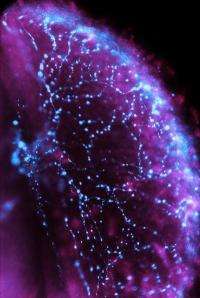
This image shows blue-light sensing arousal neurons. Credit: UCI

A UC Irvine research team led by Todd C. Holmes has discovered a second form of phototransduction light sensing in cells that is derived from vitamin B2. This discovery may reveal new information about cellular processes controlled by light.

For more than 100 years, it had been believed that the phototransduction process was solely based on a chemical derived from vitamin A called retinal. Phototransduction is the conversion of light signals into in photoreceptive and underlies both image-forming and non-image-forming light sensing.

In discovering this new light-sensing phototransduction mechanism, the UCI scientists found that phototransduction can also be mediated by a called cryptochrome, which uses a B2 vitamin chemical derivative for light sensing. Cryptochromes are blue-light photoreceptors found in circadian and arousal neurons that regulate slow biochemical processes, but this is the first time they have been linked to rapid phototransduction.

Their work appears March 3 on online Express site for the journal Science.

"This is totally novel mechanism that does not depend on retinal," said Holmes, a professor of physiology & biophysics. "This discovery opens whole new technology opportunities for adapting light-sensing proteins to drive medically relevant cellular activities."

This basic science breakthrough – "which literally and figuratively came 'out of the blue,'" Holmes said – has implications in the fast-growing field of optogenetics. Optogenetics combines optical and genetic research techniques to probe neural circuits at the high speeds needed to understand brain information processing. In one area, it is being used to understand how treatments such as deep brain massage can aid people with neurodegenerative diseases.

Holmes' team found that cryptochrome mediates phototransduction directly in fruit fly circadian and arousal neurons in response to blue-light wavelengths. The researchers also found that they could genetically express cryptochrome in neurons that are not ordinarily electrically responsive to light to make them responsive.

Explore further: Baby's life saved with groundbreaking 3-D printed device that restored his breathing

Provided by University of California - Irvine

4.8 /5 (6 votes)

Related Stories

More than meets the eye to staying awake, alert

May 13, 2010

Think twice before falling asleep alongside the glare of your computer and TV screens: exposure to dim light from ordinary room lights, computer screens and other electronic devices late at night may be interfering with our ...

Sharp-eyed robins can see magnetic fields

Jul 09, 2010

(PhysOrg.com) -- It has been known for decades that some birds are able to sense the Earth's magnetic field and set their direction as if following a compass heading, which is an extremely useful ability for ...

Recommended for you

Discarded immune cells induce the relocation of stem cells

25 minutes ago

Spanish researchers have discovered that the daily clearance of neutrophils from the body stimulates the release of hematopoietic stem cells from the bone marrow into the bloodstream, according to a report published today ...

Study reveals active site of enzyme linked to stuttering

3 hours ago

(Medical Xpress)—Scientists from the Joint Center for Structural Genomics (JCSG) at SLAC National Accelerator Laboratory have determined the 3-D structure of the chemically active part of an enzyme involved ...

User comments : 0

More news stories

The secret lives, and deaths, of neurons

As the human body fine-tunes its neurological wiring, nerve cells often must fix a faulty connection by amputating an axon—the "business end" of the neuron that sends electrical impulses to tissues or other ...

Breakthrough on Huntington's disease

Researchers at Lund University have succeeded in preventing very early symptoms of Huntington's disease, depression and anxiety, by deactivating the mutated huntingtin protein in the brains of mice.

A hidden population of exotic neutron stars

(Phys.org) —Magnetars – the dense remains of dead stars that erupt sporadically with bursts of high-energy radiation - are some of the most extreme objects known in the Universe. A major campaign using ...

White tiger mystery solved

White tigers today are only seen in zoos, but they belong in nature, say researchers reporting new evidence about what makes those tigers white. Their spectacular white coats are produced by a single change ...

Unspooling DNA from nucleosomal disks

The tight wrapping of genomic DNA around nucleosomes in the cell nucleus makes it unavailable for gene expression. A team of Ludwig-Maximilians-Universitaet (LMU) in Munich now describes a mechanism that allows chromosomal ...