Landsat 7 satellite shows tsunami effects in Sendai, Japan
March 18, 2011 By Mike Taylor and Rob Gutro

Landsat 7 satellite shows tsunami effects in Sendai, Japan

Enlarge

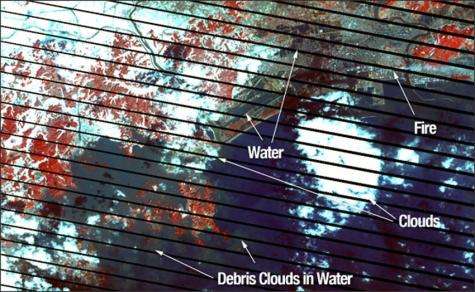
This false color image of Sendai, Japan was captured by the Landsat 7 ETM+ bands 4,3, and 2 on March 12, 2011 and shows inland areas inundated by water from the tsunami, smoke from fires burning, and clouds of debris in the water. Credit: USGS/NASA, Mike Taylor

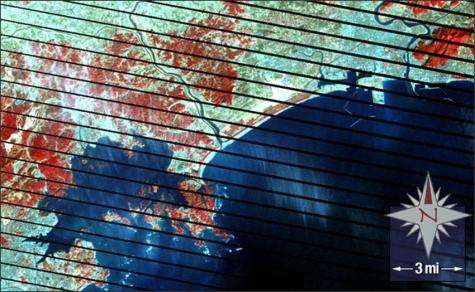
Before and after images from the Landsat 7 satellite show the after effects of the tsunami that followed the 9.0 earthquake off of Japan's east coast last weekend. A side-by-side comparison reveals inland areas inundated by water from the tsunami, smoke from burning fires and clouds of debris in the water.

Images from February 24, 2011 and March 12, 2011 were created using false coloring to make features more prominent. False color Landsat 7 ETM+ bands 4, 3, and 2 were used to create the images. The Enhanced Thematic Mapper Plus (ETM+) instrument is a fixed "whisk-broom," eight-band, multispectral scanning radiometer capable of providing high-resolution imaging information of the Earth's surface.
Landsat 7 satellite shows tsunami effects in Sendai, Japan
Enlarge

This false color image of Sendai, Japan was captured by the Landsat 7 ETM+ bands 4,3, and 2 on February 24, 2011. Credit: USGS/NASA, Mike Taylor

In the images from March 12, you can see water on land especially to the north of Sendai. You can also see water rise and/or inundation on the island in front of the Sendai coast. The clouds are prominent in the imagery but the inland water, debris in the ocean and smoke from the fires are still visible in the March 12 image. The black lines in the image are data band gaps.

The Landsat Program is a series of Earth-observing satellite missions jointly managed by and the U.S. Geological Survey. Since 1972, Landsat satellites have collected information about Earth from space. This science, known as , has matured with the Landsat Program.

Landsat satellites have taken specialized of Earth’s continents and surrounding coastal regions for over three decades, enabling people to study many aspects of our planet and to evaluate the dynamic changes caused by both natural processes and human practices.

More information: For more information about Landsat, visit: http://landsat.gsfc.nasa.gov/ .

Provided by JPL/NASA search and more info website

4.5 /5 (2 votes)  

Rank 4.5 /5 (2 votes)
Relevant PhysicsForums posts

More news stories

SpaceX capsule has 'new car' smell, astronauts say (Update)

SpaceX's Dragon cargo vessel smells like a new car, said astronauts at the International Space Station after opening the hatches Saturday following the spacecraft's landmark mission to the orbiting lab.

Space & Earth / Space Exploration

created 17 hours ago | popularity 4.5 / 5 (20) | comments 0

Astronomers seize last chance in lifetime for Venus Transit

Astronomers are gearing for one the rarest events in the Solar System: an alignment of Earth, Venus and the Sun that will not be seen for another 105 years.

Space & Earth / Astronomy

created 17 hours ago | popularity 5 / 5 (3) | comments 2

Australia hails surprise super-telescope decision

Australia has hailed a surprise decision giving it a role in a radio telescope project aimed at revolutionising astronomy, vowing to draw on its decades of experience in space science.

Space & Earth / Astronomy

created 17 hours ago | popularity 5 / 5 (4) | comments 1

Astronauts enter world's 1st private supply ship

(AP) -- Space station astronauts floated into the Dragon on Saturday, a day after its heralded arrival as the world's first commercial supply ship.

Space & Earth / Space Exploration

created 17 hours ago | popularity 5 / 5 (5) | comments 0

Dragon arrives at space station in historic 1st (Update 2)

The privately bankrolled Dragon capsule made a historic arrival at the International Space Station on Friday, triumphantly captured by astronauts wielding a giant robot arm.

Space & Earth / Space Exploration

created May 25, 2012 | popularity 5 / 5 (10) | comments 19


Scientist: Evolution debate will soon be history

(AP) -- Richard Leakey predicts skepticism over evolution will soon be history. Not that the avowed atheist has any doubts himself.

Dell tablet leak: 10.1-inch display, two-battery choice

(Phys.org) -- Headline after headline talks about vendors’ tablets in the wings as likely number-one contenders for the iPad. Such claims have justifiably been taken with a grain of salt, considering ...

SpotterRF debuts Radar Backpack Kit (w/ Video)

(Phys.org) -- SpotterRF has announced a special radar backpack kit designed to enhance situational awareness for soldiers on the ground. The company says its special radar is designed for warfighters as part ...

Thousands of shellfish found dead in Peru

Thousands of crustaceans were found dead off the coast of Lima following the mystery mass death of dolphins and pelicans, the Peruvian Navy said Friday.

Keep food safety in mind this memorial day weekend

(HealthDay) -- Picnics, parades and cookouts are as much a part of Memorial Day weekend as tributes to the United States' war veterans.

Family history of Alzheimer's affects functional connectivity

(HealthDay) -- Cognitively normal individuals with a family history of late-onset Alzheimer's disease (AD) may display lower resting state functional connectivity in the default mode network (DMN) of the brain, ...