Knee-high fence to halt rampaging Australian toads
Mar 15, 2011
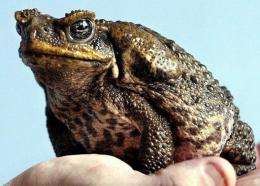
This photo taken in 2005 shows a poisonous cane toad sitting on a keeper's hand at the Taronga Zoo in Sydney. Australia's popular Kimberley wilderness region has resorted to a long knee-high fence to keep out the cane toad, which is rapidly overrunning the tourist attraction.

Australia's popular Kimberley wilderness region has resorted to a long knee-high fence to keep out the poisonous cane toad, which is rapidly overrunning the tourist attraction.

A two-kilometre (1.25 mile) barrier will be erected at Emma Gorge, made from cloth to allow other animals to move through while keeping out the , prolific breeders which secrete a toxin that can kill pets and wildlife.

Stop the Toad Foundation campaign manager Kim Hands said hundreds of thousands of toads had penetrated into the area and were threatening native species.

"Experience in the past has been that it has been really efficient," she said of the fence.

The has spread widely in tropical Australia since being introduced to kill beetles in the 1930s, devouring insects, bird's eggs and such as the quoll, a cat-like marsupial.

But a recent investigation by the University of Melbourne showed that the toad -- up to 25 centimetres (10 inches) long and two kilos (4.4 pounds) in weight -- has an Achilles' heel.

Unlike indigenous amphibians that have adapted to arid conditions, it desperately needs access to nearby standing water to survive.

Placing small fencing around man-made sources such as irrigation ditches and troughs is enough to cause the toad to die of dehydration and stop its advance, said the study.

Explore further: Why we need to put the fish back into fisheries

add to favorites email to friend print save as pdf

Related Stories

Fence tactic thwarts toxic toad

Feb 23, 2011

For three-quarters of a century, the cane toad has rampaged around northeastern Australia, but scientists hope the toxic terror may at last be stopped in its tracks.

Fears Asian bee is Australia's next cane toad

Mar 02, 2011

The aggressive and invasive Asian honey bee could become as bad a pest in Australia as the cane toad, a senator warned Wednesday, adding that the insect could threaten the country's food supply.

Invasion of the cane toads

Feb 27, 2008

Why do some invasive species expand rapidly in a new environment while others do not? Scientists from the United States and Australia are beginning to make headway on this question after analyzing how fast ...

Recommended for you

Why we need to put the fish back into fisheries

5 hours ago

Overfishing has reduced fish populations and biodiversity across much of the world's oceans. In response, fisheries are increasingly reliant on a handful of highly valuable shellfish. However, new research by the University ...

Climate change may have little impact on tropical lizards

May 17, 2013

A new Dartmouth College study finds human-caused climate change may have little impact on many species of tropical lizards, contradicting a host of recent studies that predict their widespread extinction in a rapidly warming ...

Wetlands: value to locals matters most

May 17, 2013

A new way of valuing ecosystem services, incorporating the local perspective, is the driving force behind a project assessing aquatic ecosystems in highland areas of Asia

User comments : 1

Adjust slider to filter visible comments by rank

Display comments: newest first

that_guy
5 / 5 (1) Mar 15, 2011
I'm not gonna lie, at first I thought this article was going to be pretty stupid, and it was gonna be like the great wall of china.

Now that I've read it, i have to say...that's pretty damn clever. May not get rid of all of them, but it sounds like a pretty effective way to control them in dry areas.

More news stories

Mapping a route to stem cell therapies

Monash University researchers are shedding light on the complex processes that underpin the creation and differentiation of stem cells, bringing closer the promise of 'miracle' therapies.

Lovelorn frogs bag closest crooner

What lures a lady frog to her lover? Good looks, the sound of his voice, the size of his pad or none of the above? After weighing up their options, female strawberry poison frogs (Oophaga pumilio) bag th ...

Engineers' nanoantennas improve infrared sensing

(Phys.org) —A team of University of Pennsylvania engineers has used a pattern of nanoantennas to develop a new way of turning infrared light into mechanical action, opening the door to more sensitive infrared ...

Lymphatic fluid takes detour

When tumours metastasise, they can block lymphatic vessels, as researchers from ETH Zurich have discovered using a new method. The lymphatic fluid subsequently has to find a new path through the tissue. Such ...

Tiny ancient bandicoot shines light on future

(Phys.org) —A 20 million-year-old fossil skull identified as a 'pocket-sized' ancestor of the bandicoot will give insights into the future of Australia's modern endangered animals.