Japan quake may have shortened Earth days, moved axis

March 15, 2011 By Alan Buis

Japan quake may have shortened Earth days, moved axis

Enlarge

This view of Earth comes from NASA's Moderate Resolution Imaging Spectroradiometer aboard the Terra satellite. Credit: NASA

(PhysOrg.com) -- The March 11, magnitude 9.0 earthquake in Japan may have shortened the length of each Earth day and shifted its axis. But don't worry-you won't notice the difference.

Using a United States Geological Survey estimate for how the fault responsible for the slipped, research scientist Richard Gross of NASA's Jet Propulsion Laboratory, Pasadena, Calif., applied a complex model to perform a preliminary theoretical calculation of how the earthquake-the fifth largest since 1900-affected Earth's rotation. His calculations indicate that by changing the distribution of Earth's mass, the Japanese earthquake should have caused Earth to rotate a bit faster, shortening the length of the day by about 1.8 microseconds (a microsecond is one millionth of a second).

The calculations also show the Japan should have shifted the position of Earth's figure axis (the axis about which Earth's mass is balanced) by about 17 centimeters (6.5 inches), towards 133 degrees east longitude. Earth's figure axis should not be confused with its north-south axis; they are offset by about 10 meters (about 33 feet). This shift in Earth's figure axis will cause Earth to wobble a bit differently as it rotates, but it will not cause a shift of Earth's axis in space-only external forces such as the of the sun, moon and planets can do that.

Both calculations will likely change as data on the quake are further refined.

In comparison, following last year's magnitude 8.8 earthquake in Chile, Gross estimated the Chile quake should have shortened the length of day by about 1.26 microseconds and shifted Earth's figure axis by about 8 centimeters (3 inches). A similar calculation performed after the 2004 magnitude 9.1 Sumatran earthquake revealed it should have shortened the length of day by 6.8 microseconds and shifted Earth's figure axis by about 7 centimeters, or 2.76 inches. How an individual earthquake affects Earth's rotation depends on its size (magnitude), location and the details of how the fault slipped.
Japan quake may have shortened Earth days, moved axis
Enlarge

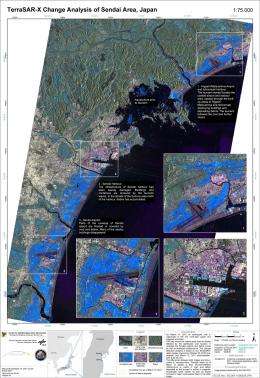
TerraSAR-X Change Analysis of Sendai Area, Japan. Map shows coastal area of Sendai effected by 9,0 magnitude Earthquake that triggered ensuing massivly destructive Tsunami, killings untold thousands and threatens the safety of several Japanese Nuclear reactors. Credit: Deutsches Zentrum fur Luft- und Raumfahrt (DLR) - German Aerospace Center

Gross said that, in theory, anything that redistributes Earth's mass will change Earth's rotation.

"Earth's rotation changes all the time as a result of not only earthquakes, but also the much larger effects of changes in atmospheric winds and oceanic currents," he said. "Over the course of a year, the length of the day increases and decreases by about a millisecond, or about 550 times larger than the change caused by the Japanese earthquake. The position of Earth's figure axis also changes all the time, by about 1 meter (3.3 feet) over the course of a year, or about six times more than the change that should have been caused by the Japan quake."

Gross said that while we can measure the effects of the atmosphere and ocean on Earth's rotation, the effects of earthquakes, at least up until now, have been too small to measure. The computed change in the length of day caused by earthquakes is much smaller than the accuracy with which scientists can currently measure changes in the length of the day. However, since the position of the figure axis can be measured to an accuracy of about 5 centimeters (2 inches), the estimated 17-centimeter shift in the figure axis from the Japan quake may actually be large enough to observe if scientists can adequately remove the larger effects of the atmosphere and ocean from the rotation measurements. He and other scientists will be investigating this as more data become available.

Gross said the changes in Earth's rotation and figure axis caused by earthquakes should not have any impacts on our daily lives. "These changes in Earth's rotation are perfectly natural and happen all the time," he said. "People shouldn't worry about them."

Provided by JPL/NASA search and more info website

Filter


Move the slider to adjust rank threshold, so that you can hide some of the comments.


Display comments: newest first

thesmith
Mar 15, 2011

Rank: not rated yet
I can't believe there are multiple nuclear meltdowns happening, yet this story is posted again. Am I foolish to think that this site should be a main source for rational discussion about Japan right now?

What will be the effect of my moving from LA to Chicago on the earth? What? Nobody cares?
pubwvj
Mar 15, 2011

Rank: 1 / 5 (1)
This was not a 9.0 earthquake. It was a 8.9. There is a huge difference. How about doing some _science_ reporting.
pibaw
Mar 15, 2011

Rank: 5 / 5 (1)
This was not a 9.0 earthquake. It was a 8.9. There is a huge difference. How about doing some _science_ reporting.


Apparently it has just been upgraded to magnitudo 9.0.
wiyosaya
Mar 15, 2011

Rank: 5 / 5 (1)
This was not a 9.0 earthquake. It was a 8.9. There is a huge difference. How about doing some _science_ reporting.


Apparently it has just been upgraded to magnitudo 9.0.

Yes, it has www.usgs.gov/news...rss_home
El_Nose
Mar 15, 2011

Rank: not rated yet
well there you go
omatumr
Mar 15, 2011

Rank: 2 / 5 (4)
As mentioned on BBC, Piers Corbyn has a site that suggests earthquakes may be linked to Earth-Sun Relationships:

bbc.co.uk/blogs/paulhudson/2011/03/is-solar-activity-to-blame-for.shtml

www.weatheraction...&c=5
Ratnak
Mar 16, 2011

Rank: not rated yet
Will the Earth's figure axis move back to its previous position or else?
Rank 3 /5 (2 votes)
Relevant PhysicsForums posts

More news stories

SpaceX capsule has 'new car' smell, astronauts say (Update)

SpaceX's Dragon cargo vessel smells like a new car, said astronauts at the International Space Station after opening the hatches Saturday following the spacecraft's landmark mission to the orbiting lab.

Space & Earth / Space Exploration

created 17 hours ago | popularity 4.5 / 5 (20) | comments 0

Astronomers seize last chance in lifetime for Venus Transit

Astronomers are gearing for one the rarest events in the Solar System: an alignment of Earth, Venus and the Sun that will not be seen for another 105 years.

Space & Earth / Astronomy

created 17 hours ago | popularity 5 / 5 (3) | comments 2

Australia hails surprise super-telescope decision

Australia has hailed a surprise decision giving it a role in a radio telescope project aimed at revolutionising astronomy, vowing to draw on its decades of experience in space science.

Space & Earth / Astronomy

created 17 hours ago | popularity 5 / 5 (4) | comments 1

Astronauts enter world's 1st private supply ship

(AP) -- Space station astronauts floated into the Dragon on Saturday, a day after its heralded arrival as the world's first commercial supply ship.

Space & Earth / Space Exploration

created 17 hours ago | popularity 5 / 5 (5) | comments 0

Dragon arrives at space station in historic 1st (Update 2)

The privately bankrolled Dragon capsule made a historic arrival at the International Space Station on Friday, triumphantly captured by astronauts wielding a giant robot arm.

Space & Earth / Space Exploration

created May 25, 2012 | popularity 5 / 5 (10) | comments 19


Scientist: Evolution debate will soon be history

(AP) -- Richard Leakey predicts skepticism over evolution will soon be history. Not that the avowed atheist has any doubts himself.

Dell tablet leak: 10.1-inch display, two-battery choice

(Phys.org) -- Headline after headline talks about vendors’ tablets in the wings as likely number-one contenders for the iPad. Such claims have justifiably been taken with a grain of salt, considering ...

SpotterRF debuts Radar Backpack Kit (w/ Video)

(Phys.org) -- SpotterRF has announced a special radar backpack kit designed to enhance situational awareness for soldiers on the ground. The company says its special radar is designed for warfighters as part ...

Thousands of shellfish found dead in Peru

Thousands of crustaceans were found dead off the coast of Lima following the mystery mass death of dolphins and pelicans, the Peruvian Navy said Friday.

Keep food safety in mind this memorial day weekend

(HealthDay) -- Picnics, parades and cookouts are as much a part of Memorial Day weekend as tributes to the United States' war veterans.

Family history of Alzheimer's affects functional connectivity

(HealthDay) -- Cognitively normal individuals with a family history of late-onset Alzheimer's disease (AD) may display lower resting state functional connectivity in the default mode network (DMN) of the brain, ...