Risks from radiation low in Japan but panic high
(AP) -- Risks from possible radiation exposure remain greatest for the workers scrambling to cool reactors at a Japanese nuclear power plant. Those who have been evacuated from the site are considered safe, as are the 39 million people who live in the greater Tokyo region.
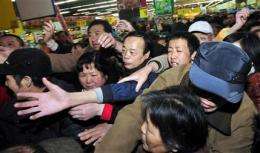
But that hasn't stopped the panic: Supermarkets in Beijing and Shanghai ran out of salt this week, as Chinese stocked up on the mistaken belief that it protects against radiation. Russians rushed to buy seaweed, which contains iodine, and red wine, which Soviet authorities recommended in the wake of the Chernobyl disaster.
There are now two main threats from the Fukushima Dai-ichi plant in northeastern Japan: one from the reactor cores and the other from the spent fuel pools beside them. Both sources have emitted elevated amounts of radiation and if authorities are unable to bring down temperatures, vast amounts of radiation could spew out.
"Spent fuel is a source of radiation in the same way a light bulb is a source of light," said Steve Crossley, an Australia-based radiation physicist. "If you move away from it, there's less and less."
Workers closest to the troubled reactors face the biggest threat as they desperately try to cool down the damaged reactors and add water to the pools. High exposure can cause burns and radiation sickness, which includes nausea, hair loss, vomiting and harm to blood cells.
Thyroid cancer is considered the most serious immediate risk to anyone exposed closest to the plant. But potassium iodide pills can prevent it by blocking radioactive iodine's absorption.
Experts have repeatedly said that people outside of the evacuation radius of 12 miles (20 kilometers) are safe. Japan has additionally recommended those between 12 and 20 miles (20 and 30 kilometers) stay inside, with doors and windows shut.
But foreign governments have sounded more alarm. Washington advised Americans to stay 50 miles (80 kilometers) from the plant, and several European countries have urged their citizens to leave Tokyo, even though at 140 miles (220 kilometers) away, experts said it would not be affected.
"If you released all of the radioactivity from one of these fuel rods ... even if some terrorist gets in and it explodes with dynamite and spreads it out, it's not going to spread in the same way as nuclear fallout from a nuclear bomb," said Gerald Laurence, a radiation safety consultant and associate professor at Adelaide University in Australia.
However, he said, contamination can spread through winds. Concerns about radiation among Americans prompted authorities to deploy more radiation monitors on the West Coast and in Pacific territories, but officials maintain harmful levels won't reach anywhere in the U.S.
Laurence also added that monitoring of soil or plants in areas near the plant could be necessary, and cows might need to be kept from grazing in certain areas to prevent radiation from getting into milk. After the 1986 Chernobyl disaster, which involved a much higher release of radiation, it stayed in soil and got into plants, contaminating milk and meat for decades.
Still John Beddington, Britain's chief scientific officer, stressed that even if the worst-case scenario came to pass in Japan - with nuclear material shooting 1,640 feet (500 meters) into the air, along with strong winds toward Tokyo and rainfall - it would not be as bad as Chernobyl, considered the world's worst nuclear disaster.
"The problems with Chernobyl were people were continuing to drink the water, continuing to eat vegetables and so on and that was where the problems came from. That's not going to be the case here," he told the British Embassy in Tokyo.
Another nightmare scenario - contained in a hypothetical projection in a 2000 study by the U.S. Nuclear Regulatory Commission - also seemed unlikely to come to pass. The study predicted that there could be up to 26,000 cancer deaths over a radius of 500 miles (807 kilometers) in the event of a fire in the zirconium cladding of fuel rods in a spent fuel pool.
There are concerns about the state of the fuel rods in one of the Fukushima plant's pools after a U.S. official said all the water had drained out. But the study's findings were assumed a situation much worse than in Japan, involving more fuel, a bigger reactor and no prior evacuation.
©2010 The Associated Press. All rights reserved. This material may not be published, broadcast, rewritten or redistributed.


