Habitable planets and white dwarfs
March 22, 2011 by Deborah Braconnier
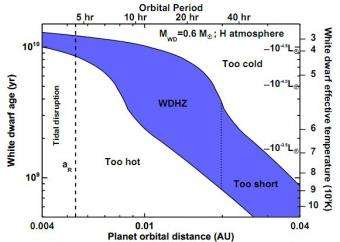
Image credit: Eric Agol, arXiv:1103.2791v1 [astro-ph.EP
(PhysOrg.com) -- The search for habitable planets similar to Earth has routinely focused around active nuclear burning stars. However, in a recently published paper by Eric Agol from the University of Washington, the idea to expand the search to white dwarfs shows promise.
A white dwarf star is similar to the size of Earth and is believed to be in the final stages of a stars evolutionary process. It is no longer supporting nuclear reactions and is essentially only a glowing core. Unlike our sun, a white dwarf is no longer producing reactions, and is in a cooling process. Although cooling, a white dwarfs surface temperature is around 5000K.
According to Agol, the surface temperature of an average white dwarf would be able to provide a habitable zone for planets within an orbit no closer than 0.01 AU. Agol has created a chart illustrating a white dwarf habitable zone, and he defines a continuously habitable zone as one with a range of orbital distances habitable for a minimum duration. This minimum duration could last in excess of 3 billion years.
The one problem with these habitable planets is that they would have a permanent day side and a permanent night side, similar to our moon. This would be caused by the short orbit and the probability of tidal locking.
About five percent of all stars are white dwarfs, and there are at least 15,000 within 300 light-years of earth. Agol proposes that these possible planets could completely eclipse their white dwarf, making it possible to locate them using ground based telescopes. He also proposes that the use of the Large Synoptic Survey Telescope (LSST), currently under construction in Chile, could provide even better options for locating white dwarf habitable planets.
Agol believes that by utilizing a network of ground-based telescopes over a two year period, over half a dozen habitable planets could be located orbiting a white dwarf.
More information: Transit surveys for Earths in the habitable zones of white dwarfs, by Eric Agol, arXiv:1103.2791v1 [astro-ph.EP] http://arxiv.org/abs/1103.2791
via Centauri Dreams
© 2010 PhysOrg.com
-
From lemons to lemonade: Reaction uses carbon dioxide to make carbon-based semiconductor,
32 comments
-
Thioridazine kills cancer stem cells in human while avoiding toxic side-effects of conventional cancer treatments,
3 comments
-
SpaceX private rocket blasts off for space station (Update),
42 comments
-
Climate scientists say they have solved riddle of rising sea,
30 comments
-
Research team claims to have found evidence Lake Cheko is impact crater for Tunguska Event,
18 comments
-
revamping general concept and cosmological principle
May 25, 2012
-
Transiting Exoplanet Light Curve
May 25, 2012
-
Math behind Theoretical Physics
May 24, 2012
-
Do we know whats at the center of galaxies yet?
May 23, 2012
-
Structure of the Milky Way?
May 20, 2012
-
What would it take to terraform Pluto and Charon?
May 19, 2012
- More from Physics Forums - General Astronomy
More news stories
SpaceX capsule has 'new car' smell, astronauts say (Update)
SpaceX's Dragon cargo vessel smells like a new car, said astronauts at the International Space Station after opening the hatches Saturday following the spacecraft's landmark mission to the orbiting lab.
Space & Earth / Space Exploration
15 hours ago |
4.5 / 5 (19) |
0
Astronomers seize last chance in lifetime for Venus Transit
Astronomers are gearing for one the rarest events in the Solar System: an alignment of Earth, Venus and the Sun that will not be seen for another 105 years.
15 hours ago |
5 / 5 (2) |
2
Australia hails surprise super-telescope decision
Australia has hailed a surprise decision giving it a role in a radio telescope project aimed at revolutionising astronomy, vowing to draw on its decades of experience in space science.
15 hours ago |
5 / 5 (3) |
1
Astronauts enter world's 1st private supply ship
(AP) -- Space station astronauts floated into the Dragon on Saturday, a day after its heralded arrival as the world's first commercial supply ship.
Space & Earth / Space Exploration
15 hours ago |
5 / 5 (5) |
0
Dragon arrives at space station in historic 1st (Update 2)
The privately bankrolled Dragon capsule made a historic arrival at the International Space Station on Friday, triumphantly captured by astronauts wielding a giant robot arm.
Space & Earth / Space Exploration
May 25, 2012 |
5 / 5 (10) |
19
Dell tablet leak: 10.1-inch display, two-battery choice
(Phys.org) -- Headline after headline talks about vendors tablets in the wings as likely number-one contenders for the iPad. Such claims have justifiably been taken with a grain of salt, considering ...
Scientist: Evolution debate will soon be history
(AP) -- Richard Leakey predicts skepticism over evolution will soon be history. Not that the avowed atheist has any doubts himself.
SpotterRF debuts Radar Backpack Kit (w/ Video)
(Phys.org) -- SpotterRF has announced a special radar backpack kit designed to enhance situational awareness for soldiers on the ground. The company says its special radar is designed for warfighters as part ...
Thousands of shellfish found dead in Peru
Thousands of crustaceans were found dead off the coast of Lima following the mystery mass death of dolphins and pelicans, the Peruvian Navy said Friday.
Keep food safety in mind this memorial day weekend
(HealthDay) -- Picnics, parades and cookouts are as much a part of Memorial Day weekend as tributes to the United States' war veterans.
Family history of Alzheimer's affects functional connectivity
(HealthDay) -- Cognitively normal individuals with a family history of late-onset Alzheimer's disease (AD) may display lower resting state functional connectivity in the default mode network (DMN) of the brain, ...
Mar 22, 2011
Rank: 5 / 5 (1)
Mar 22, 2011
Rank: 5 / 5 (4)
Otherwise, handy info for planetary engineering with a long, long view...
Mar 22, 2011
Rank: 5 / 5 (4)
The writer has thought is this, of course.
Several ways of forming a planet in the area after white star formation, is given in the Introduction in the article.
Mar 22, 2011
Rank: not rated yet
One is roughly the same size of Earth.
Google neutron star planets, and you should find the info.
While the discovery was quickly buried under more tantalizing discoveries of giant planets orbiting more normal stars, this fact makes this guy's idea extremely plausible, and it's only a lack of imagination and interest among astronomers that has stopped a search like he suggests.
Mar 22, 2011
Rank: not rated yet
Just in case you don't feel like digging through the report.
Mar 23, 2011
Rank: not rated yet
Mar 23, 2011
Rank: 5 / 5 (1)
Unfortunately, after 3 billion years the white dwarf would have cooled significantly. We are looking for a planet that is created towards the inner part of the habitable zone in order for it to remain within the zone for 3 billion years. I suspect this shrinks the possible orbits somewhat.
Mar 23, 2011
Rank: not rated yet
It's not really a lack of imagination, but more a lack of interest, or bang-for-buck that more white dwarfs aren't being targeted. The prospects of finding habitable planets around such bodies is vanishingly poor. You might find an orbiting rock or something, which would be of scientific interest, but not in the way the article alludes - finding a habitable planet with a potential biosphere.
Mar 23, 2011
Rank: 1 / 5 (1)
With no nuclear reaction, there really shouldn't be a solar wind to maintain planetary orbits. The planets should be slowly moving inward towards their star. Granted that we are talking of long spans of time, but as the star cools its habitable zone will also be shrinking.
Mar 23, 2011
Rank: 1 / 5 (1)
How in the HELL are you going to find a "habitable planet" around a star at that close a distance that's gone through its red giant phase.
There isn't going to be ANYTHING there at ALL. Nothing up to about 1 AU out and maybe further...
How can someone so "smart" be so damned stupid...
Mar 23, 2011
Rank: 5 / 5 (4)
Not all that common, one would expect.. But that said, there has been discovered (as previously mentioned) planets around a neutron star, which would seem even less likely.
I'd say your characterisation of this guy as a 'moron' is probably a bit harsh, huh.
Mar 23, 2011
Rank: 5 / 5 (4)
@Steve
I disagree with the assumption that stellar wind is a significant factor of planatary orbits. Indeed my best example of this are the dwarf planets in the Oort cloud and Pluto... if you were right then Pluto should be moving inward ... However the Kepler equations tell us that orbital speed is one of the primary factors along with mass, per the gravity equations. Stellar wind is minimal and is not included in most of the routine equations to predict planetary postion, or rotation.
Mar 23, 2011
Rank: not rated yet
Mar 23, 2011
Rank: 4.2 / 5 (5)
Mar 23, 2011
Rank: 3 / 5 (2)
Why take umbrage when someone says the Earth is flat?
Maybe I shouldn't be so irritated when scientists throw around words carelessly. I guess that it comes from somewhere inside me that when a person in "authority" in scientific circles says "habitable" they ACTUALLY MEAN IT....silly me.
Mar 23, 2011
Rank: 1 / 5 (1)
Mar 23, 2011
Rank: not rated yet
Sure, for the orbits of Pluto or the Oort cloud a solar wind is negligible, but a solar wind, or the lack thereof, should be an orbital factor for planets within a habitable zone.
Mar 23, 2011
Rank: not rated yet
Mar 23, 2011
Rank: not rated yet
You are kidding, right? Please say you are... Can you imagine that environment - working on the surface of a +5,000K degree stellar mass? Just imagine the gravitational forces. It would certainly be a high stress job. Just showing up would be a killer. :)
Mar 24, 2011
Rank: not rated yet
Well.. Because the earth is not flat, obviously. We know it to be fact.
This guy is arguing that the possibility exists of such planets, and of them being relatively easy to detect. Looking at his paper, he makes reasonable points...
I honestly cannot see anything in it to be excited about, in either a positive or negative way...
Mar 24, 2011
Rank: not rated yet
And I fail to see even the possibility of a HABITABLE planet around a white dwarf. Nothing I've read in the article addresses any of the obvious problems with such a theory.