What is good for you is bad for infectious bacteria
March 3, 2011

What is good for you is bad for infectious bacteria

Enlarge

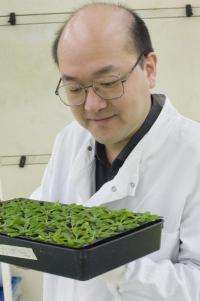
Dr. Jun Fan holds Arabidopsis plants. Credit: John Innes Centre

Plants are able to protect themselves from most bacteria, but some bacteria are able to breach their defences. In research to be published in Science on Friday, scientists have identified the genes used by some strains of the bacterium Pseudomonas to overwhelm defensive natural products produced by plants of the mustard family, or crucifers.

"Microbes only become pathogens when they find a way to infect a host and overwhelm the host defences," said lead author Dr Jun Fan from the John Innes Centre on the Norwich Research Park.

"Our findings answer some important questions about host-pathogen biology."

The scientists have confirmed that the chemicals used by cruciferous plants to defend against bacteria are isothiocyanates, nitrogen and sulphur-containing produced by plants of the mustard family, such as cabbage, broccoli and Brussels sprouts. These potent molecules have antioxidant, anticancer and anti-inflammatory properties in humans.

Isothiocyanates are released by the plant when it is challenged or eaten. They had previously been shown to be active against bacteria but this is the first time their essential role has been successfully tested using real plants. Without this class of compounds, crucifers would be more vulnerable to disease from a much wider variety of bacteria.

Isothiocyanates also provide a chemical barrier to harmful fungi and a toxic defence warning to insects and other herbivores.

The team of scientists from JIC and the University of Edinburgh found that bacterial pathogens carrying the sax genes, thought to be involved in detoxification and removal of isothiocyanates, were able to overcome these defences.

Understanding how some become specialised to overcome will help scientists identify new ways to improve .

"These discoveries have a broader significance for current efforts to increase food security," said co-author Dr Peter Doerner from Edinburgh University.

"They define a strategy for sustainable disease control in agriculture by stimulating the production and variety of natural products in various crop plants."

The research was initiated by former JIC director Professor Chris Lamb and he is an author on the paper.

"Chris supported the research for over a decade up until his death in 2009," said Dr Fan.

"This is a good example of his pursuit of excellence and relevance in scientific research."

Provided by Norwich BioScience Institutes

3.7 /5 (7 votes)  

Rank 3.7 /5 (7 votes)
Relevant PhysicsForums posts

More news stories

Scientist: Evolution debate will soon be history

(AP) -- Richard Leakey predicts skepticism over evolution will soon be history. Not that the avowed atheist has any doubts himself.

Biology / Evolution

created 5 hours ago | popularity 2.8 / 5 (6) | comments 21

Thousands of shellfish found dead in Peru

Thousands of crustaceans were found dead off the coast of Lima following the mystery mass death of dolphins and pelicans, the Peruvian Navy said Friday.

Biology / Ecology

created 15 hours ago | popularity 4.8 / 5 (4) | comments 6

More plant species responding to global warming than previously thought

(Phys.org) -- Far more wild plant species may be responding to global warming than previous large-scale estimates have suggested.

Biology / Ecology

created May 22, 2012 | popularity 4.6 / 5 (14) | comments 18 | with audio podcast

Totally rad: Scientists create rewritable digital data storage in DNA

(Phys.org) -- Scientists from Stanford's Department of Bioengineering have devised a method for repeatedly encoding, storing and erasing digital data within the DNA of living cells.

Biology / Biotechnology

created May 21, 2012 | popularity 4.9 / 5 (17) | comments 11 | with audio podcast

For monogamous sparrows, it doesn't pay to stray (but they do it anyway)

It's quite common for a female song sparrow to stray from her breeding partner and mate with the male next door, but a new study shows that sleeping around can be costly.

Biology / Plants & Animals

created May 22, 2012 | popularity 5 / 5 (1) | comments 7 | with audio podcast


Dell tablet leak: 10.1-inch display, two-battery choice

(Phys.org) -- Headline after headline talks about vendors’ tablets in the wings as likely number-one contenders for the iPad. Such claims have justifiably been taken with a grain of salt, considering ...

SpotterRF debuts Radar Backpack Kit (w/ Video)

(Phys.org) -- SpotterRF has announced a special radar backpack kit designed to enhance situational awareness for soldiers on the ground. The company says its special radar is designed for warfighters as part ...

SpaceX capsule has 'new car' smell, astronauts say (Update)

SpaceX's Dragon cargo vessel smells like a new car, said astronauts at the International Space Station after opening the hatches Saturday following the spacecraft's landmark mission to the orbiting lab.

Astronomers seize last chance in lifetime for Venus Transit

Astronomers are gearing for one the rarest events in the Solar System: an alignment of Earth, Venus and the Sun that will not be seen for another 105 years.

Australia hails surprise super-telescope decision

Australia has hailed a surprise decision giving it a role in a radio telescope project aimed at revolutionising astronomy, vowing to draw on its decades of experience in space science.

Keep food safety in mind this memorial day weekend

(HealthDay) -- Picnics, parades and cookouts are as much a part of Memorial Day weekend as tributes to the United States' war veterans.