Genetic analysis reveals history, evolution of an ancient delicacy -- morels
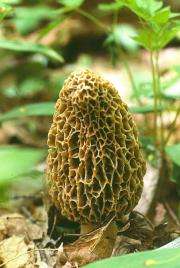
Dinosaurs squashed them with impunity. Thousands of species that lacked culinary appreciation have turned up their noses at them. And a study based on advanced DNA analysis has shown that this shameful indifference went on for 129 million years.
Finally, however, one animal species came along that would learn to appreciate this particular fungus with almost a global reverence – homo sapiens. Thus was born the human affection for the morel – for millions of people around the world, it's what you mean when you say "mushroom hunting."
Spring is coming soon, and with it the timeless quest for morels. For some, it's almost a way of life.
Nancy Weber, a researcher with the College of Forest Ecosystems and Society at Oregon State University, has had a lifelong love affair with the morel.
Her parents took her on her first mushroom hunt in the Michigan woods at the age of six months. Presumably they sat her down in front of a morel, wiped the drool from the corner of her mouth and said, "Now pay attention, Nancy. This is important. This is what you look for."
"Morels probably became so prized because of their distinctive appearance, which almost anyone can learn to recognize," Weber said. "That means you're not apt to pick a poison mushroom. But for a lot of people, mushroom hunting becomes part of your life, stories you tell around a campfire, a favorite picking spot whose location you hide like a great fishing hole."
Weber was part of a research team that has published one of the most detailed genetic analyses ever done on morels, to help identify their ancestry, show how they evolved and what conservation policies may be needed to manage and protect this valuable resource.
Among other things, they concluded that morels have been around for a lot, lot, longer than people have – true morels split off from all other fungal species 129 million years ago, during the beginning of the Cretaceous Period. Back then, mammals were primitive little things, dinosaurs still ruled the world and morels were kind of an afterthought.
Which pretty much proves that dinosaurs had small brains. Or lacked culinary skills.
Since then, morels have evolved into 177 related species, and western North America – particularly the Pacific Northwest – has been an evolutionary hot spot. Despite the varying species, in many ways morels have "remained remarkably static since the Cretaceous," the researchers said. The study was done by scientists from OSU, the U.S. Department of Agriculture, Eastern Illinois University and private industry. It was published in Fungal Genetics and Biology, a professional journal.
"Oddly enough, most animal species aren't particularly attracted to morels," Weber said. "A few slugs and other things will eat them. But humans have probably been eating them for about as long as there have been humans."
The morel, which usually grows a few inches tall but can get larger, is a harbinger of spring and often gives people an excuse to get outdoors after winter is over, Weber said. They can last much of the summer into early fall and provide plenty of opportunity for hiking up and down hills, peeking under leaves, and trying to convince yourself you have a special technique and understanding about how to find this often-elusive mushroom.
"There are things you can know about how to find morels, but on another level they are wherever you find them," Weber said. "When I was a kid, we once drove all over the place, hiked everywhere, came up empty-handed and then went back home, found a bunch of them growing under our apple tree next to the house."
Morels are, in fact, a delicacy, although cooking them doesn't need to be fancy – a few morels sautéed in butter with a little salt and pepper is difficult to improve upon. They are the people's mushroom – clearly more sophisticated than the ubiquitous and bland button mushroom sold in bulk at the grocery store, but not so fancy as the chanterelle prized in French cuisine or the matsutake favored for Japanese dishes.
People who eat morels usually have mud on their boots and aren't afraid to work for their prize.
Getting them can be as simple as a couple hours stomping around in the woods, or traveling hundreds of miles to compete in a mushroom hunting festival. Sometimes you get lucky and come home with a bag full. Often you don't.
"You can grow morels in confinement, but it's pretty tricky and unpredictable, and some people don't think they taste as good," Weber said.
In the Pacific Northwest, finding morels has even evolved into a cottage industry. One species is fairly common after a forest fire, leading to the odd phenomenon of crowds of people sometimes showing up in the spring in an area that burned the previous summer. Dried morels are now sometimes found in supermarkets or available on the Internet.
Based on the new genetic analysis, scientists now know that morels are very old, but not at all the oldest of 1.5 million species of fungi. They are found widely around the world, probably traveled with the continents as they drifted apart, but still look pretty much the same way they did millions of years ago.
There's one big difference now. At least one animal on Earth has finally come to appreciate them.
More information: This blonde morel has been a harbinger of spring for millions of years before humans came around to appreciate them. (Photo by Jim Weber, courtesy of Oregon State University)
Provided by Oregon State University


