Enzyme enhances, erases long-term memories in rats
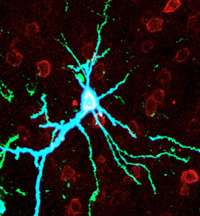
A neuron in a rat brain's cortex over-expressing PKMzeta (blue). Source: Todd Sacktor, M.D., SUNY Downstate Medical Center
(PhysOrg.com) -- Even long after it is formed, a memory in rats can be enhanced or erased by increasing or decreasing the activity of a brain enzyme, say researchers supported, in part, by the National Institutes of Health.
"Our study is the first to demonstrate that, in the context of a functioning brain in a behaving animal, a single molecule, PKMzeta, is both necessary and sufficient for maintaining long-term memory," explained Todd Sacktor, of the SUNY Downstate Medical Center, New York City, a grantee of the NIHs National Institute of Mental Health.
Sacktor, Yadin Dudai, Ph.D., of the Weizmann Institute of Science, Rehovot, Israel, and colleagues, report of their discovery March 4, 2011 in the journal Science.
Unlike other recently discovered approaches to memory enhancement, the PKMzeta mechanism appears to work any time. It is not dependent on exploiting time-limited windows when a memory becomes temporarily fragile and changeable just after learning and upon retrieval which may expire as a memory grows older, says Sacktor.
"This pivotal mechanism could become a target for treatments to help manage debilitating emotional memories in anxiety disorders and for enhancing faltering memories in disorders of aging," said NIMH Director Thomas R. Insel, M.D.
In their earlier studies, Sacktor's team showed that even weeks after rats learned to associate a nauseating sensation with saccharin and shunned the sweet taste, their sweet tooth returned within a couple of hours after rats received a chemical that blocked the enzyme PKMzeta in the brain's outer mantle, or neocortex, where long-term memories are stored.
In the new study, they paired genetic engineering with the same aversive learning model to both confirm the earlier studies and to demonstrate, by increasing PKMzeta, the opposite effect. They harnessed a virus to infect the neocortex with the PKMzeta gene, resulting in overexpression of the enzyme and memory enhancement. Conversely, introducing a mutant inactive form of the enzyme, that replaced the naturally occurring one, erased the memory much as the chemical blocker did.
These effects applied generally to multiple memories stored in the targeted brain area raising questions about how specific memories might be targeted in any future therapeutic application.
The researchers turned up a clue that may hold the beginning of an answer.
"One explanation of the memory enhancement is that PKMzeta might go to some synapses, or connections between brain cells, and not others,"said Sacktor. "Overexpressed PKMzeta may be selectively captured by molecular tags that mark just those brain connections where its needed likely synapses that were holding the memory from the training."
More information:
-- Shema R, Haramati S, Ron S, Hazvi S, Chen A, Sacktor TC, Dudai Y. Enhancement of consolidated long-term memory by overexpression of protein kinase Mzeta in the neocortex. 03/2/2011, Science.
-- How does PKMzeta maintain long-term memory? Sacktor TC. Nat Rev Neurosci. 2011 Jan;12(1):9-15. Epub 2010 Dec 1. Review. PMID:21119699
Provided by National Institutes of Health
-
From lemons to lemonade: Reaction uses carbon dioxide to make carbon-based semiconductor,
32 comments
-
Thioridazine kills cancer stem cells in human while avoiding toxic side-effects of conventional cancer treatments,
3 comments
-
SpaceX private rocket blasts off for space station (Update),
42 comments
-
Climate scientists say they have solved riddle of rising sea,
30 comments
-
Research team claims to have found evidence Lake Cheko is impact crater for Tunguska Event,
18 comments
-
Potential Breakthrough in Seizure Control
19 hours ago
-
Popping/Cracked sternum.
May 25, 2012
-
Which Mental Illness Encompasses This Problem?
May 25, 2012
-
A question about drug tolerance
May 23, 2012
-
Poor nutrition leading to overeating?
May 23, 2012
-
Math and dyslexia?
May 21, 2012
- More from Physics Forums - Medical Sciences
More news stories
Keep food safety in mind this memorial day weekend
(HealthDay) -- Picnics, parades and cookouts are as much a part of Memorial Day weekend as tributes to the United States' war veterans.
5 hours ago |
not rated yet |
0
Family history of Alzheimer's affects functional connectivity
(HealthDay) -- Cognitively normal individuals with a family history of late-onset Alzheimer's disease (AD) may display lower resting state functional connectivity in the default mode network (DMN) of the brain, ...
Medicine & Health / Alzheimer's disease & dementia
14 hours ago |
not rated yet |
0
Transvaginal mesh op restores pelvic organ prolapse at price
(HealthDay) -- Transvaginal mesh (TVM) procedures are effective for anatomical restoration of pelvic organ prolapse (POP), but patients report a worsening of sexual function following surgery, according to ...
14 hours ago |
not rated yet |
0
Travel to high altitudes tied to Crohn's, colitis flare-ups
(HealthDay) -- People with inflammatory bowel disease, which includes Crohn's disease and colitis, may be at increased risk for flare-ups when they fly or travel to high altitudes for skiing or mountain climbing, ...
Medicine & Health / Inflammatory disorders
15 hours ago |
not rated yet |
1
|
Of mice and mental models: Neuroscientific implications of risk-optimized behavior in the mouse
(Medical Xpress) -- Regardless of an organism’s biological complexity, every encephalized animal continuously makes under-informed behavioral choices that can have serious consequences. Despite its ubiquity, ...
Dell tablet leak: 10.1-inch display, two-battery choice
(Phys.org) -- Headline after headline talks about vendors tablets in the wings as likely number-one contenders for the iPad. Such claims have justifiably been taken with a grain of salt, considering ...
Scientist: Evolution debate will soon be history
(AP) -- Richard Leakey predicts skepticism over evolution will soon be history. Not that the avowed atheist has any doubts himself.
SpotterRF debuts Radar Backpack Kit (w/ Video)
(Phys.org) -- SpotterRF has announced a special radar backpack kit designed to enhance situational awareness for soldiers on the ground. The company says its special radar is designed for warfighters as part ...
SpaceX capsule has 'new car' smell, astronauts say (Update)
SpaceX's Dragon cargo vessel smells like a new car, said astronauts at the International Space Station after opening the hatches Saturday following the spacecraft's landmark mission to the orbiting lab.
Thousands of shellfish found dead in Peru
Thousands of crustaceans were found dead off the coast of Lima following the mystery mass death of dolphins and pelicans, the Peruvian Navy said Friday.
Australia hails surprise super-telescope decision
Australia has hailed a surprise decision giving it a role in a radio telescope project aimed at revolutionising astronomy, vowing to draw on its decades of experience in space science.
Mar 04, 2011
Rank: not rated yet