Predicting when, how spins of electrons arrange in one-dimensional multiferroic materials
The properties of a material are greatly affected by the electrical and magnetic structure of its constituent ions and electrons. In a ferromagnet, for example, neighboring electron spins point in the same direction, producing a strong external magnetic field. In an antiferromagnet, however, neighboring spins point in opposite directions, negating its magnetism. This behavior can be exploited in devices ranging from switches to memory and computers.
Multiferroic materials exhibit an even richer physicsand an expanded set of applicationsbecause their magnetic and electrical orderings are linked. However, the magnetic and electrical structuring of multiferroics is not yet completely understood. Now, Shunsuke Furukawa, Masahiro Sato and Shigeki Onoda of the RIKEN Advanced Science Institute, Wako, Japan, have successfully calculated how magnetic ordering arises in one-dimensional multiferroic materialsthe simplest example of these materials.
This simplicity means that one-dimensional multiferroic materials are useful models for understanding multidimensional, or bulk, multiferroic materials. Their one-dimensional chain of spins can not only assume a variety of ferromagnetic and anti-ferromagnetic alignments, but they can also arrange into more complicated patterns, including spirals defined over long portions of the chainreferred to as long-range chiral order (Fig. 1). Understanding these exotic patterns may lead to new foundational science, as well as new applications. In addition, a one-dimensional chain can also exhibit the electrical control of magnetic structure and the response to light that is characteristic of more complex multiferroics.
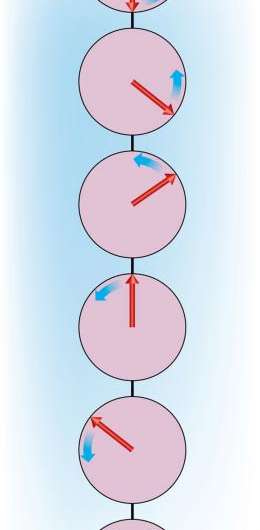
Figure 1: A one-dimensional chain of spins (red arrows), showing a chiral ordering (or spiral), which rotate (blue arrows) in response to incoming light radiation. Credit: 2011 The American Physical Society
Onoda and colleagues focused on describing the magnetic structure in a one-dimensional chain in terms of how strongly neighboring spins were coupled to each other. They began by using a computational technique that uniquely allows for the accurate treatment of an infinitely large collection of spins to construct a phase diagram describing how spin ordering changed as the type of spin-to-spin coupling in the material changed. Most notably, the diagram indicated that ferromagnetic coupling between nearest neighbors was much more likely to cause a long-range chiral order than anti-ferromagnetic coupling.This observation successfully explained the experimentally observed spin ordering of several one-dimensional multiferroic cuprates. In particular, the research team was able to correctly predict that the bulk multiferroic material LiCu2O2, whose unique physics has drawn the attention of physicists for over a decade, exhibits chiral order and has a unique response to light. "These results confirm that one-dimensional multiferroics are an ideal laboratory for studying spin dynamics", says Onoda, and he feels that the calculations will promote studies on new one-dimensional multiferroics and other novel states of matter.
More information: Furukawa, S., et al. Chiral order and electromagnetic dynamics in one-dimensional multiferroic cuprates. Physical Review Letters 105, 257205 (2010). http://prl.aps.org … /i25/e257205
Provided by
RIKEN
-
From lemons to lemonade: Reaction uses carbon dioxide to make carbon-based semiconductor,
32 comments
-
Thioridazine kills cancer stem cells in human while avoiding toxic side-effects of conventional cancer treatments,
3 comments
-
SpaceX private rocket blasts off for space station (Update),
42 comments
-
Climate scientists say they have solved riddle of rising sea,
30 comments
-
Research team claims to have found evidence Lake Cheko is impact crater for Tunguska Event,
18 comments
-
Water Rocket
3 hours ago
-
why do trucks have bigger brakes?
7 hours ago
-
Solar Sail Physics - Do they work on a large scale?
8 hours ago
-
How should I switch an air conditioner off?
8 hours ago
-
Question about current decay in R-L circuit
9 hours ago
-
Elementary time - how does it work?
11 hours ago
- More from Physics Forums - General Physics
More news stories
Landmark calculation clears the way to answering how matter is formed
(Phys.org) -- An international collaboration of scientists, including Thomas Blum, associate professor of physics, is reporting in landmark detail the decay process of a subatomic particle called a kaon ...
May 25, 2012 |
4.4 / 5 (20) |
46
|
Is a classical electrodynamics law incompatible with special relativity?
(Phys.org) -- The laws of classical electromagnetism that were developed in the 19th century are the same laws that scientists use today. They include Maxwell’s four equations along with the Lorentz la ...
Lying in wait for WIMPs: Researchers seek to dramatically increase sensitivity of Large Underground Xenon detector
Although it's invisible, dark matter accounts for at least 80 percent of the matter in the universe. No one knows what it is, but most scientists would bet on weakly interacting massive particles, or WIMPs.
May 23, 2012 |
4 / 5 (7) |
15
|
Hall effect at the speed of light: How can you demonstrate relativistic effects with your mobile phone?
The relativistic Hall effect describing objects rotating at speeds comparable with the speed of light has been reported.
May 21, 2012 |
4.3 / 5 (3) |
8
Cloak of invisibility: Engineers use plasmonics to create an invisible photodetector
A team of engineers at Stanford and the University of Pennsylvania has for the first time used "plasmonic cloaking" to create a device that can see without being seen - an invisible machine that detects light. It is the first ...
May 21, 2012 |
4.8 / 5 (16) |
7
|
Dell tablet leak: 10.1-inch display, two-battery choice
(Phys.org) -- Headline after headline talks about vendors tablets in the wings as likely number-one contenders for the iPad. Such claims have justifiably been taken with a grain of salt, considering ...
Scientist: Evolution debate will soon be history
(AP) -- Richard Leakey predicts skepticism over evolution will soon be history. Not that the avowed atheist has any doubts himself.
SpotterRF debuts Radar Backpack Kit (w/ Video)
(Phys.org) -- SpotterRF has announced a special radar backpack kit designed to enhance situational awareness for soldiers on the ground. The company says its special radar is designed for warfighters as part ...
SpaceX capsule has 'new car' smell, astronauts say (Update)
SpaceX's Dragon cargo vessel smells like a new car, said astronauts at the International Space Station after opening the hatches Saturday following the spacecraft's landmark mission to the orbiting lab.
Thousands of shellfish found dead in Peru
Thousands of crustaceans were found dead off the coast of Lima following the mystery mass death of dolphins and pelicans, the Peruvian Navy said Friday.
Australia hails surprise super-telescope decision
Australia has hailed a surprise decision giving it a role in a radio telescope project aimed at revolutionising astronomy, vowing to draw on its decades of experience in space science.
