Structure of DNA repair complex reveals workings of powerful cell motor
March 27, 2011

Structure of DNA repair complex reveals workings of powerful cell motor

Enlarge

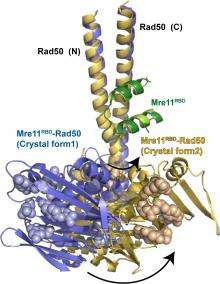
X-ray crystal structures reveal never-before-seen details of where Mre11 interfaces with Rad50. These structures enabled Berkeley Lab scientists to understand key Mre11-Rad50 interactions that are essential for double strand DNA break repair. In this image, two structures of the Mre11-Rad50 complex were solved independently and overlaid, further revealing a flexible hinge in Rad50 near the Mre11 binding site.

(PhysOrg.com) -- Over the last years, two teams of researchers at The Scripps Research Institute have steadily built a model of how a powerful DNA repair complex works. Now, their latest discovery provides revolutionary insights into the way the molecular motor inside the complex functions – findings they say may have implications for treatment of disorders ranging from cancer to cystic fibrosis.

In a paper published in an Advance Online Edition of Nature Structural and Molecular Biology March 27, 2011, the scientists say that the complex's motor molecule, known as Rad50, is a surprisingly flexible protein that can change shape and even rotate depending on the task at hand.

The finding solves the long-standing mystery of how a single protein complex known as MRN (Mre11-Rad50-Nbs1) can repair in a number of different, and tricky, ways that seem impossible for "standard issue" proteins to do, say team leaders Scripps Research Professor John Tainer, Ph.D., and Scripps Research Professor Paul Russell, Ph.D., who also collaborated with members of the Lawrence Berkeley National Laboratory on the study.

They say the finding also provides a critical insight into the ABC-ATPase superfamily of molecular motors, of which Rad50 is a member.

"Rad50 and its brethren proteins in this superfamily are biology's general motors," said Tainer, "and if we know how they work, we might be able to control biological outcomes when we need to."

For example, knowing that Rad50 changes its contour to perform a function suggests it might be possible to therapeutically target unique elements in that specific conformation. "There could be a new generation of drugs that are designed not against an active site, like most drugs now (an approach that can cause side effects, but against the shape the protein needs to be in to work," Tainer said.

Russell added, "Proteins are often viewed as static, but we are showing the moving parts in this complex. They are dynamic. They move about and change shape when engaging with other molecules."

First Responder

The MRN complex is known as a first-responder molecule that rushes in to repair serious double-strand breaks in the DNA helix—an event that normally occurs about 10 times a day per cell due to ultraviolet light and radiation damage, etc. If these breaks are not fixed, dangerous chromosomal rearrangements can occur that lead to cancer. Paradoxically, the complex also mends DNA breaks promoted by chemotherapy, protecting cells against cancer treatment.

When MRN senses a break, it activates an alarm telling the cell to shut down division until repairs are made. Then, it binds to ATP (an energy source) and repairs DNA in three different ways, depending on whether two ends of strands need to be joined together or if DNA sequences need to be replicated. "The same complex has to decide the extent of damage and be able to do multiple things," Tainer said. "The mystery was how it can do it all."

To find out, Tainer, head of a structural biology group, and Russell, who leads a yeast genetics laboratory, began collaborating five years ago. With the additional help of team members at Lawrence Berkeley National Laboratory and its Advanced Light Source beamline, called SIBYLS, the collaboration has produced a series of high-resolution images of the crystal structure of parts of all three proteins (rad50, Mre11, and Nbs1), taken from fission yeast and archaea. The scientists also used the lab's X-ray scattering tool to determine the proteins' overall architecture in solution, which approximates how a protein appears in a natural state.

The scientists say that the parts of the complex, when imagined together as a whole unit, resemble an octopus: the head consists of the repair machinery (the Rad50 motor and the Mre11 protein, which is an enzyme that can break bonds between nucleic acids) and the octopus arms are made up of Nbs1 which can grab the molecules needed to help the machinery mend the strands.

In this study, Tainer and Russell were able to produce crystal and X-ray scattering images of parts of where Rad50 and Mre11 touched each other, and what happened when ATP bound to this complex and what it looked like when it didn't.

In these four new structures, they showed that ATP binding allows Rad50 to drastically change its shape. When not bound to ATP, Rad50 is flexible and floppy, but bound to ATP, Rad50 snaps into a ring that presumably closes around DNA in order to repair it.

"We saw a lot of big movement on a molecular scale," said Tainer. "Rad50 is like a rope that can pull. It appears to be a dynamic system of communicating with other molecules, and so we can now see how flexibly linked proteins can alter their physical states to control outcomes in biology."

"We thought ATP allowed Rad50 to change shape, but now we have proof of it and how it works," Russell said. "This is a key part of the MRN puzzle."

An Engine for Many Vehicles

Rad50 and ATP provide the motor and gas for a number of biological machines that operate across species. These machines are linked to a number of disorders, such as cystic fibrosis, which is caused by a defect in the cystic fibrosis transmembrane conductance regulator (CFTR) gene, which is a member of the ABC ATPase superfamily.

"Our study suggests that ABC ATPase proteins are used so often in biology because they can flexibly hook up to so many different things and produce a specific biological outcome," Tainer said.

Given this new prototypic understanding of these motors, Tainer and Russell envision a future in which therapies might be designed that target Rad50 when it changes into a shape that promotes a disease. For example, chemotherapy could be coupled with an agent that prevents the MRN complex from repairing DNA damage, promoting death of cancer cells.

"There are some potentially very cool applications to these findings that we are only beginning to think about," Russell said.

More information: "ABC ATPase signature helices in Rad50 link nucleotide state to Mre11 interface for DNA repair," Nature Structural and Molecular Biology March 27, 2011.

Provided by The Scripps Research Institute search and more info website

Filter


Move the slider to adjust rank threshold, so that you can hide some of the comments.


Display comments: newest first

Sanescience
Mar 28, 2011

Rank: not rated yet
Mind-blowing amazing how some of this low level molecular stuff works. I sure hope all this understanding soon leads to some applied therapy for keeping people healthy longer so they don't incur the large medical bills that seems to be the trend.
drlong
Mar 28, 2011

Rank: not rated yet
I would like to know how double strand breaks are repaired. Do two identical chromosomes have to line up together, or is this not necessary?
kevinrtrs
Mar 28, 2011

Rank: 1 / 5 (5)
To the evolutionists: The more complex it turns out to be, the more impossible it becomes for life to have started spontaneously from just plain old simple chemical soups.

Repair work is an unimaginably big gulf to cross for evolutionary processes - it requires foresight, design and intent. Those are completely absent from random mutations and natural selection. So just how did the DNA repair information get into place?

We were created. That much is just logically plain and clear. Anything else is having faith in the religion of evolution.
SCVGoodToGo
Mar 28, 2011

Rank: 5 / 5 (3)
To kevinrts: Face. Palm.
Ethelred
Mar 28, 2011

Rank: 5 / 5 (3)
The more complex it turns out to be, the more impossible it becomes for life to have started spontaneously from just plain old simple chemical soups.
This article is about life AFTER it started. Complexity CAN evolve.

But you can't answer a simple question that DOES have a fairly specific answer.

Repair work is an unimaginably big gulf to cross for evolutionary processes -
Your imagination is so stunted it is painful to see.

it requires foresight, design and intent.
No. It requires REDUNDANCY and DNA has redundancy.

Those are completely absent from random mutations and natural selection
Not needed either. You just made that up. A variant of a molecule that can transcribe DNA to RNA should be able to repair DNA. Cytosine to Guanine and Thymine to Adenine. If there is one at one side of the damaged DNA then the other MUST go on the other side. Not all damage is repairable but a very large percentage is.

More
Ethelred
Mar 28, 2011

Rank: 5 / 5 (3)
So just how did the DNA repair information get into place?
By a mutation of another chemical. The information for repair is there in the DNA already to the complementary base pairs.

We were created.
Still looking for evidence. Do you have any? Dr. Behe doesn't and you sure haven't managed any.

hat much is just logically plain and clear.
That much is dependent on continued Aggressive IgnoranceTM on your part.

Anything else is having faith in the religion of evolution.
I thought lying was a no no. I guess its OK in your religion. Evolution is based on evidence and reason. It is not a religion.

And now to banish the Demon Kevin. You can't banish a human with a simple sentence.

When was the Flood Kevin?

Ethelred
Ethelred
Mar 28, 2011

Rank: 5 / 5 (3)
I would like to know how double strand breaks are repaired.
Those are rather a bit trickier than what I wrote in my reply to Kevin which was about simpler damage.

http://en.wikiped...chanisms

Ethelred
Sanescience
Mar 29, 2011

Rank: not rated yet
Wow, well fed troll. You guys should know better. Creationist blindness to the genius that is the billion-billion-billion-plus monkey brigade on typewriters that is the universe will not be assuaged by mere reason.
Ethelred
Mar 29, 2011

Rank: 5 / 5 (2)
Wow, well fed troll.
I don't feed trolls. I chase them or make it clear that they are being idiots.

You want some?

You guys should know better.
I do. I have been slaying trolls for over a decade.

Creationist blindness to the genius that is the billion-billion-billion-plus monkey brigade on typewriters that is the universe will not be assuaged by mere reason.
If that statement was true the Creationist would have a point. Evolution is NOT random. Neither is any of the other ways things self-assemble or sort in the Universe.

Perhaps you should let others handle trolls. At least until you learn how to do it yourself. Something you won't ever do if you think shutting down trolls is somehow feeding them.

Please notice that Kevin almost never replies to me. He runs in most instances as soon as I show. He is in no way an exclusively hit and run poster. But he runs from reason that include questions he dares answer every time.

Ethelred
Rank 5 /5 (2 votes)
Relevant PhysicsForums posts

More news stories

Scientist: Evolution debate will soon be history

(AP) -- Richard Leakey predicts skepticism over evolution will soon be history. Not that the avowed atheist has any doubts himself.

Biology / Evolution

created 4 hours ago | popularity 2.8 / 5 (6) | comments 14

Thousands of shellfish found dead in Peru

Thousands of crustaceans were found dead off the coast of Lima following the mystery mass death of dolphins and pelicans, the Peruvian Navy said Friday.

Biology / Ecology

created 14 hours ago | popularity 4.8 / 5 (4) | comments 5

More plant species responding to global warming than previously thought

(Phys.org) -- Far more wild plant species may be responding to global warming than previous large-scale estimates have suggested.

Biology / Ecology

created May 22, 2012 | popularity 4.6 / 5 (14) | comments 18 | with audio podcast

Totally rad: Scientists create rewritable digital data storage in DNA

(Phys.org) -- Scientists from Stanford's Department of Bioengineering have devised a method for repeatedly encoding, storing and erasing digital data within the DNA of living cells.

Biology / Biotechnology

created May 21, 2012 | popularity 4.9 / 5 (17) | comments 11 | with audio podcast

For monogamous sparrows, it doesn't pay to stray (but they do it anyway)

It's quite common for a female song sparrow to stray from her breeding partner and mate with the male next door, but a new study shows that sleeping around can be costly.

Biology / Plants & Animals

created May 22, 2012 | popularity 5 / 5 (1) | comments 7 | with audio podcast


Dell tablet leak: 10.1-inch display, two-battery choice

(Phys.org) -- Headline after headline talks about vendors’ tablets in the wings as likely number-one contenders for the iPad. Such claims have justifiably been taken with a grain of salt, considering ...

SpotterRF debuts Radar Backpack Kit (w/ Video)

(Phys.org) -- SpotterRF has announced a special radar backpack kit designed to enhance situational awareness for soldiers on the ground. The company says its special radar is designed for warfighters as part ...

SpaceX capsule has 'new car' smell, astronauts say (Update)

SpaceX's Dragon cargo vessel smells like a new car, said astronauts at the International Space Station after opening the hatches Saturday following the spacecraft's landmark mission to the orbiting lab.

Australia hails surprise super-telescope decision

Australia has hailed a surprise decision giving it a role in a radio telescope project aimed at revolutionising astronomy, vowing to draw on its decades of experience in space science.

Keep food safety in mind this memorial day weekend

(HealthDay) -- Picnics, parades and cookouts are as much a part of Memorial Day weekend as tributes to the United States' war veterans.

Astronomers seize last chance in lifetime for Venus Transit

Astronomers are gearing for one the rarest events in the Solar System: an alignment of Earth, Venus and the Sun that will not be seen for another 105 years.