New 3-D microfluidic system offers greater control over production of drug-delivering nanoparticles
March 8, 2011 by Anne Trafton

New 3-D microfluidic system offers greater control over production of drug-delivering nanoparticles

Enlarge

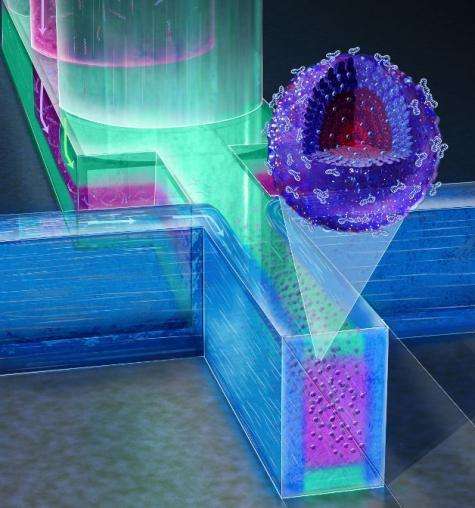
In this artists rendering of the new system, polymers flow through a microfluidic channel as they are formed into spherical nanoparticles. An organic solvent called acetonitrile helps keep the particles away from the walls and prevent clumping. Image: Nicolle Rager Fuller/Sayo-Art

Researchers at MIT and Brigham and Women’s Hospital have developed a new way to produce nanoparticles that can deliver drugs for cancer and other diseases. The new production system offers greater control over the size and composition of the particles, allowing large quantities of homogenous particles to be rapidly produced.

The are formed from a commonly used biodegradable polymer that can carry a large number of drug molecules and release them in a controlled fashion while evading the body’s immune system.

In the new production system, a stream of the polymer flows through a microfluidic channel that focuses it three-dimensionally, isolating it from the channel walls and allowing spherical to form when the contacts water side streams. In traditional two-dimensional systems, polymers often clump along the top and bottom walls, clogging the device. The new system uses streams of an organic solvent called acetonitrile to keep the polymers away from the top and bottom walls and prevent such clumping.

The researchers reported their new system in the Feb. 22 online edition of the journal Advanced Materials. Authors are Minsoung Rhee, postdoctoral associate at MIT and Brigham and Women’s; MIT graduate student Pedro Valencia; MIT senior Maria Rodriguez; Institute Professor Robert Langer; Omid Farokhzad, director of the Laboratory of Nanomedicine and Biomaterials at Brigham and Women’s Hospital; and MIT assistant professor of mechanical engineering Rohit Karnik.

Provided by Massachusetts Institute of Technology search and more info website


Rank not rated yet
Relevant PhysicsForums posts

More news stories

Dopant gives graphene solar cells highest efficiency yet

(Phys.org) -- By taking advantage of graphene’s favorable electrical and optical properties, and then adding an organic dopant, researchers have achieved the highest power conversion efficiency yet for ...

Nanotechnology / Nanophysics

created May 21, 2012 | popularity 5 / 5 (10) | comments 14 | with audio podcast feature

Nanomedicine: Quantum dots appear safe in pioneering study on primates

A pioneering study to gauge the toxicity of quantum dots in primates has found the tiny crystals to be safe over a one-year period, a hopeful outcome for doctors and scientists seeking new ways to battle diseases ...

Nanotechnology / Bio & Medicine

created May 20, 2012 | popularity 4.3 / 5 (3) | comments 8 | with audio podcast

In nanorod crystal growth, nanoparticles seen as artificial atoms

In the growth of crystals, do nanoparticles act as "artificial atoms" forming molecular-type building blocks that can assemble into complex structures? This is the contention of a major but controversial theory ...

Nanotechnology / Nanophysics

created May 24, 2012 | popularity 4.8 / 5 (6) | comments 0 | with audio podcast

First direct observation of oriented attachment in nanocrystal growth

Berkeley Lab researchers have reported the first direct observation of nanoparticles undergoing oriented attachment, the critical step in biomineralization and the growth of nanocrystals. A better understanding ...

Nanotechnology / Nanophysics

created May 24, 2012 | popularity 4.7 / 5 (3) | comments 0 | with audio podcast

Synthetic nano-waste does not disappear

(Phys.org) -- Tiny particles of cerium oxide do not burn or change in the heat of a waste incineration plant. They remain intact on combustion residues or in the incineration system, as a new study by Swiss ...

Nanotechnology / Bio & Medicine

created May 25, 2012 | popularity 5 / 5 (2) | comments 1 | with audio podcast


Dell tablet leak: 10.1-inch display, two-battery choice

(Phys.org) -- Headline after headline talks about vendors’ tablets in the wings as likely number-one contenders for the iPad. Such claims have justifiably been taken with a grain of salt, considering ...

Scientist: Evolution debate will soon be history

(AP) -- Richard Leakey predicts skepticism over evolution will soon be history. Not that the avowed atheist has any doubts himself.

SpotterRF debuts Radar Backpack Kit (w/ Video)

(Phys.org) -- SpotterRF has announced a special radar backpack kit designed to enhance situational awareness for soldiers on the ground. The company says its special radar is designed for warfighters as part ...

SpaceX capsule has 'new car' smell, astronauts say (Update)

SpaceX's Dragon cargo vessel smells like a new car, said astronauts at the International Space Station after opening the hatches Saturday following the spacecraft's landmark mission to the orbiting lab.

Thousands of shellfish found dead in Peru

Thousands of crustaceans were found dead off the coast of Lima following the mystery mass death of dolphins and pelicans, the Peruvian Navy said Friday.

Australia hails surprise super-telescope decision

Australia has hailed a surprise decision giving it a role in a radio telescope project aimed at revolutionising astronomy, vowing to draw on its decades of experience in space science.