3-D printing method advances electrically small antenna design
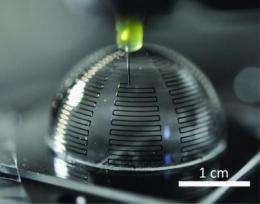
This is an optical image of an antenna during the printing process. Credit: Jennifer A. Lewis
Omnidirectional printing of metallic nanoparticle inks offers an attractive alternative for meeting the demanding form factors of 3-D electrically small antennas. This is the first demonstration of 3-D printed antennas on curvilinear surfaces.
While most electronic components benefit from decreased size, antennas -- whether in a cell phone or on an aircraft -- suffer limitations in gain, efficiency, system range, and bandwidth when their size is reduced below a quarter-wavelength.
"Recent attention has been directed toward producing antennas by screen-printing, inkjet printing, and liquid metal-filled microfluidics in simple motifs, such as dipoles and loops," explained Jennifer T. Bernhard, a professor of electrical and computer engineering at the University of Illinois at Urbana-Champaign. "However, these fabrication techniques are limited in both spatial resolution and dimensionality, yielding planar antennas that occupy a large area relative to the achieved performance."
"Omnidirectional printing of metallic nanoparticle inks offers an attractive alternative for meeting the demanding form factors of 3D electrically small antennas (ESAs)," stated Jennifer A. Lewis, the Hans Thurnauer Professor of Materials Science and Engineering and director of the Frederick Seitz Materials Research Laboratory at Illinois.
"To our knowledge, this is the first demonstration of 3D printed antennas on curvilinear surfaces," Lewis stated. The research findings and fabrication methods developed by Bernhard, Lewis, and their colleagues are featured in the cover article of the March 18 issue of Advanced Materials ("Conformal Printing of Electrically Small Antennas on Three-Dimensional Surfaces").
According to Bernhard, these antennas are electrically small relative to a wavelength (typically a twelfth of a wavelength or less) and exhibit performance metrics that are an order of magnitude better than those realized by monopole antenna designs.
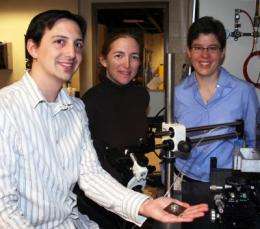
This is postdoctoral researcher Jacob Adams with principle investigators Jennifer Bernhard and Jennifer Lewis. Credit: Rick Kubetz, Engineering Communications Office
"There has been a long-standing problem of minimizing the ratio of energy stored to energy radiatedthe Qof an ESA," Bernhard explained. "By printing directly on the hemispherical substrate, we have a highly versatile single-mode antenna with a Q that very closely approaches the fundamental limit dictated by physics (known as the Chu limit).
Conformal printing allows the antenna's meander lines to be printed on the outside or inside of hemispherical substrates, adding to its flexibility.
"Unlike planar substrates, the surface normal is constantly changing on curvilinear surfaces, which presents added fabrication challenges," Lewis noted. To conformally print features on hemispherical substrates, the silver ink must strongly wet the surface to facilitate patterning even when the deposition nozzle (100 μm diameter) is perpendicular to the printing surface.
To fabricate an antenna that can withstand mechanical handling, for example, the silver nanoparticle ink is printed on the interior surface of glass hemispheres. Other non-spherical ESAs can be designed and printed using a similar approach to enable integration of low Q antennas on, for example, the inside of a cell phone case or the wing of an unmanned aerial vehicle. The antenna's operating frequency is determined primarily by the printed conductor cross-section and the spacing (or pitch) between meander lines within each arm.
According to the researchers, their design can be rapidly adapted to new specifications, including other operating frequencies, device sizes, or encapsulated designs that offer enhanced mechanical robustness.
"This conformal printing technique can be extended other potential applications, including flexible, implantable, and wearable antennas, electronics, and sensors," Lewis said.
Provided by University of Illinois College of Engineering
-
From lemons to lemonade: Reaction uses carbon dioxide to make carbon-based semiconductor,
31 comments
-
Thioridazine kills cancer stem cells in human while avoiding toxic side-effects of conventional cancer treatments,
3 comments
-
SpaceX private rocket blasts off for space station (Update),
42 comments
-
Climate scientists say they have solved riddle of rising sea,
30 comments
-
Research team claims to have found evidence Lake Cheko is impact crater for Tunguska Event,
18 comments
-
Need a rigid insulation material???
1 hour ago
-
magnets or EMF in car bumpers to protect from fender bender
17 hours ago
-
length of wire in a coil of known dimensions?
May 25, 2012
-
India Engineering Powerhouse
May 25, 2012
-
electromagnet core dereference between hard and soft iron
May 25, 2012
-
Measuring water pressure in an open tank
May 24, 2012
- More from Physics Forums - General Engineering
More news stories
SpotterRF debuts Radar Backpack Kit (w/ Video)
(Phys.org) -- SpotterRF has announced a special radar backpack kit designed to enhance situational awareness for soldiers on the ground. The company says its special radar is designed for warfighters as part ...
Probability of contamination from severe nuclear reactor accidents is higher than expected: study
Catastrophic nuclear accidents such as the core meltdowns in Chernobyl and Fukushima are more likely to happen than previously assumed. Based on the operating hours of all civil nuclear reactors and the number ...
Technology / Energy & Green Tech
May 22, 2012 |
3.6 / 5 (21) |
52
|
Delphi gasoline-injection engine technique rivals hybrid's edge
(Phys.org) -- Running a diesel like engine on gasoline is something Delphi is doing in notable fashion. They claim they are on to a promising way to enjoy an engine that gives the vehicle owner high efficiency ...
HyperSolar shows dirty water no barrier to power world
(Phys.org) -- The Santa Barbara, California, company, HyperSolar, is set to transparently share the ups and downs of its research experiences toward the companys ultimate vision, successfully producing ...
Tesla to launch electric sedan in US on June 22
Tesla Motors said Tuesday it would begin deliveries of "the world's first premium electric sedan" on June 22, slightly ahead of schedule.
Technology / Energy & Green Tech
May 22, 2012 |
4.5 / 5 (11) |
18
Dell tablet leak: 10.1-inch display, two-battery choice
(Phys.org) -- Headline after headline talks about vendors tablets in the wings as likely number-one contenders for the iPad. Such claims have justifiably been taken with a grain of salt, considering ...
Scientist: Evolution debate will soon be history
(AP) -- Richard Leakey predicts skepticism over evolution will soon be history. Not that the avowed atheist has any doubts himself.
SpaceX capsule has 'new car' smell, astronauts say (Update)
SpaceX's Dragon cargo vessel smells like a new car, said astronauts at the International Space Station after opening the hatches Saturday following the spacecraft's landmark mission to the orbiting lab.
Thousands of shellfish found dead in Peru
Thousands of crustaceans were found dead off the coast of Lima following the mystery mass death of dolphins and pelicans, the Peruvian Navy said Friday.
Australia hails surprise super-telescope decision
Australia has hailed a surprise decision giving it a role in a radio telescope project aimed at revolutionising astronomy, vowing to draw on its decades of experience in space science.
Keep food safety in mind this memorial day weekend
(HealthDay) -- Picnics, parades and cookouts are as much a part of Memorial Day weekend as tributes to the United States' war veterans.

Mar 16, 2011
Rank: not rated yet
Mar 16, 2011
Rank: not rated yet
Mar 17, 2011
Rank: not rated yet
I'm waiting for somebody to invent a virtual antenna that works better than an antenna array.