What's behind our conflicted feelings on nukes?
March 24, 2011 By SETH BORENSTEIN , AP Science Writer
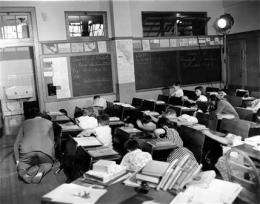
In this Nov. 21, 1951 file picture, sixth grade students crouch under or beside their desks along with their teacher, Vincent M. Bohan, left, as they act out a scene from the Federal Civil Defense administration film "Duck and Cover" at Public School 152 in the Queens borough of New York City. Even before the March 11 earthquake and resulting tsunami that led to the current Japanese nuclear crisis, Americans were bombarded with contradictory images and messages that frighten even when they try to reassure. It started with the awesome and deadly mushroom cloud rising from the atomic bomb, which led to fallout shelters and school duck-and-cover drills. (AP Photo/Dan Grossi, File)
(AP) -- Nuclear radiation, invisible and insidious, gives us the creeps.
Even before the Japanese nuclear crisis, Americans were bombarded with contradictory images and messages that frighten even when they try to reassure. It started with the awesome and deadly mushroom cloud rising from the atomic bomb, which led to fallout shelters and school duck-and-cover drills.
On screen, Bert, the ever-alert turtle of the government civil-defense cartoons, told us all we needed to do was shield our eyes when the bomb exploded and duck under our desks. Jane Fonda in "The China Syndrome" told us to be worried about nuclear power accidents, and just days later, Three Mile Island seemed to prove her right. Now bumbling nuclear plant worker Homer Simpson, Blinky, the radiation-mutated, three-eyed fish, and evil nuclear power plant owner Montgomery Burns make us giggle and wince.
The experts tell us to be logical and not to worry, that nuclear power is safer than most technologies we readily accept. Producing and burning coal, oil and gas kill far more people through accidents and pollution each year.
But our perception of nuclear issues isn't about logic. It's about dread, magnified by arrogance in the nuclear industry, experts in risk and nuclear energy say.
"Whereas science is about analysis, risk resides in most of us as a gut feeling," said University of Oregon psychology professor and risk expert Paul Slovic. "Radiation really creates very strong feelings of fear - not really fear, I would say more anxiety and unease."
Some experts contend that when a disaster has potentially profound repercussions, we should pay attention to emotions as much as logic.
Nuclear energy hits all our hot buttons when we judge how risky something is: It's invisible. It's out of our control. It's manmade, high-tech and hard to understand. It's imposed on us, instead of something we choose. It's associated with major catastrophes, not small problems. And if something goes wrong, it can cause cancer - an illness we fear far more than a bigger killer like heart disease.
Thirty years ago, before the 1986 Chernobyl nuclear disaster, Slovic took four groups of people and asked them to rate 30 risks. Two groups - the League of Women Voters and college students - put nuclear power as the biggest risk, ahead of things that are deadlier, such as cars, handguns and cigarettes. Business club members ranked nuclear power as the eighth risk out of 30. Risk experts put it at 20.
The only fear that Slovic has seen as comparable in his studies to nuclear power is terrorism.
A Pew Research Center poll after the Japanese nuclear crisis found support for increased nuclear power melting down. Last October the American public was evenly split over an expansion of nuclear power; now it's 39 percent in favor and 52 percent opposed.
"Nuclear radiation carries a very powerful stigma. It has automatic negative associations: cancer, bombs, catastrophes," said David Ropeik who teaches risk communications at Harvard University. You can't separate personal feelings from the discussion of actual risks, said Ropeik, author of the book "How Risky Is it, Really?"
But Ropeik, who has consulted for the nuclear industry, said those fears aren't nearly as justified as other public health concerns. He worries that the public will turn to other choices, such as fossil fuels, which are linked to more death and climate change than the nuclear industry is. He cites one government study that says 24,000 Americans die each year from air pollution and another that says fossil fuel power plants are responsible for about one-seventh of that.
At the same time, health researchers have not tied any U.S. deaths to 1979's Three Mile Island accident. United Nations agencies put the death toll from Chernobyl at 4,000 to 9,000, with anti-nuclear groups contending the number is much higher.
Since 2000, more than 1,300 American workers have died in coal, oil and natural gas industry accidents, according to federal records. Radiological accidents have killed no one at U.S. nuclear plants during that time, and nuclear power has one of the lowest industrial accident rates in the country, said Nuclear Energy Institute spokesman Steve Kerekes.
Alan Kolaczkowski, a retired nuclear engineer, consulted with the Nuclear Regulatory Commission on specific probabilities of accidents at nuclear plants. He estimates the risk of a disaster at a given plant at 1 in 100,000 - about the same as your chance of being killed by lightning over your lifetime. For comparison, an American's odds of dying in a car crash are 1 in 88; being shot to death, 1 in 306; and dying from bee stings, 1 in 71,623, according to the National Safety Council. The council couldn't come up with the odds of dying from radiation because it lists zero people dying in the United States from radiation in 2007, the most recent year for which these cause-of-death figures are available.
Ropeik calls this mismatch between statistics and feelings "a classic example of how public policy gets made - not about the numbers alone, but how we feel about them, and it ends up doing us more harm."
Kolaczkowski faulted his own industry.
"Those in the industry believe it is so complex it cannot be explained to the general public, so as a result, the industry has a trust-me attitude and that only goes so far," he said. "We're all afraid of the unknown, the ghosts under the bed."
David Lochbaum of the Union of Concerned Scientists, a group that presses for safer nuclear plants, is a former plant engineer. He likens the public's fears to unjustified worries about shark attacks: The risks and deaths are small, but the attention and fears are big.
"It may be an irrational fear, but I don't think it's one that can be educated away," Lochbaum said.
However, calling these fears irrational isn't justified, said Georgetown University law professor and former Environmental Protection Agency associate administrator Lisa Heinzerling. She said people's concerns have been unjustly trivialized.
People have been trained to think about and prepare for low-probability, catastrophic events like the earthquake and tsunami that caused the Japanese nuclear disaster, Heinzerling said. She pointed to homeowner's insurance. Most people won't have a fire that destroys their home, but "we worry about really big things even if they are improbable because we will be wiped out."
Americans also have long had an ambivalence toward new technology, going back to worries about the introduction of electric lights in homes 130 years ago, said University of Detroit Mercy history professor John Staudenmaier,
"Americans overreact with adulation and awe, then overreact with fear and anxiety," said Staudenmaier, editor emeritus of the academic journal Technology and Culture.
Trying to explain the fears, nuclear industry spokesman Kerekes said, "There's a perception gap that exists." But he adds: "Other industries haven't had to do deal with an animated cartoon series that lasted, what, 25 years?"
That would be "The Simpsons." Producer Al Jean said the show, which has been on the air since 1989, reflects America's real feelings.
"There is something that taps into people's view of big business, and in particular, nuclear power, which is giving profit-minded people complete control over life and death. It is a scary thought, and I think that is a topic for satire," Jean said.
Jean recognizes that nuclear plant workers aren't really like Homer Simpson and radiation doesn't "put a cute third eye on a fish." But he thinks his show is accurate with its portrayal of the greedy, conniving nuclear power plant owner Montgomery Burns: "Mr. Burns may be representative of some people in the nuclear industry - not just nuclear, but all industries - who seem like they're more interested in getting the money rather than doing what's safe. I think that's what resonates in the public."
Yet, Jean takes pride in noting that the Springfield nuclear power plant has never blown up.
The lack of transparency in the nuclear industry- including Tokyo Electric Power Co. - has caused some of the problems, said Baruch Fischhoff, a professor of decision sciences at Carnegie Mellon University. It is a charge Kerekes disputes.
"The nuclear industry has behaved in a way that is untrustworthy, both in the sense of not telling people the truth and not having the competence to manage their own affairs," Fischhoff said. He added that industry is too quick to brush off people's fears: "Telling the public that they are idiots is certainly not a way of making friends."
More information:
Paul Slovic's Decision Research: http://www.decisionresearch.org/
The Nuclear Energy Institute: http://www.nei.org/
The Union of Concerned Scientists: http://www.ucsusa.org/nuclear-power/
©2010 The Associated Press. All rights reserved. This material may not be published, broadcast, rewritten or redistributed.
-
From lemons to lemonade: Reaction uses carbon dioxide to make carbon-based semiconductor,
32 comments
-
Thioridazine kills cancer stem cells in human while avoiding toxic side-effects of conventional cancer treatments,
3 comments
-
SpaceX private rocket blasts off for space station (Update),
42 comments
-
Climate scientists say they have solved riddle of rising sea,
30 comments
-
Research team claims to have found evidence Lake Cheko is impact crater for Tunguska Event,
18 comments
-
Interesting WWII Public INformation Leaflet
May 19, 2012
-
Treaty of the Pyrenees
May 08, 2012
- More from Physics Forums - History & Humanities
More news stories
Social welfare cuts ultimately come with heavy price, researchers say
(Phys.org) -- Slashing government funding for Medicaid, food stamps and other programs that serve the poor while politically popular with some lawmakers and many conservatives may do more harm ...
Other Sciences / Social Sciences
May 24, 2012 |
4.1 / 5 (14) |
123
Ancient Bethlehem seal unearthed in Jerusalem
Israeli archaeologists have discovered a 2,700-year-old seal that bears the inscription "Bethlehem," the Israel Antiquities Authority announced Wednesday, in what experts believe to be the oldest artifact ...
Other Sciences / Archaeology & Fossils
May 23, 2012 |
3.5 / 5 (14) |
23
Oldest Jewish archaeological evidence on the Iberian Peninsula
German archaeologists of the Friedrich Schiller University Jena found one of the oldest archaeological evidence so far of Jewish Culture on the Iberian Peninsula at an excavation site in the south of Portugal, ...
Other Sciences / Archaeology & Fossils
May 25, 2012 |
4.3 / 5 (4) |
12
Dollars and sense: Why are some people morally against tax?
As the U.S. presidential election campaigns heat up, the economic debate is dominated by bailouts, austerity and, inevitably, taxation. Now a new study published in Symbolic Interaction asks why tax is such an important issue ...
Other Sciences / Social Sciences
May 23, 2012 |
3 / 5 (2) |
12
Oldest art even older
New dates from Geißenklösterle Cave in Southwest Germany document the early arrival of modern humans and early appearance of art and music.
Other Sciences / Archaeology & Fossils
May 24, 2012 |
5 / 5 (2) |
6
Scientist: Evolution debate will soon be history
(AP) -- Richard Leakey predicts skepticism over evolution will soon be history. Not that the avowed atheist has any doubts himself.
Dell tablet leak: 10.1-inch display, two-battery choice
(Phys.org) -- Headline after headline talks about vendors tablets in the wings as likely number-one contenders for the iPad. Such claims have justifiably been taken with a grain of salt, considering ...
SpotterRF debuts Radar Backpack Kit (w/ Video)
(Phys.org) -- SpotterRF has announced a special radar backpack kit designed to enhance situational awareness for soldiers on the ground. The company says its special radar is designed for warfighters as part ...
SpaceX capsule has 'new car' smell, astronauts say (Update)
SpaceX's Dragon cargo vessel smells like a new car, said astronauts at the International Space Station after opening the hatches Saturday following the spacecraft's landmark mission to the orbiting lab.
Thousands of shellfish found dead in Peru
Thousands of crustaceans were found dead off the coast of Lima following the mystery mass death of dolphins and pelicans, the Peruvian Navy said Friday.
Keep food safety in mind this memorial day weekend
(HealthDay) -- Picnics, parades and cookouts are as much a part of Memorial Day weekend as tributes to the United States' war veterans.
Mar 24, 2011
Rank: 3.4 / 5 (5)
Where does the fear some from, propaganda. a super large coal plant uses about 1-3 tons of coal per second. .02% of the weight of most coal is uranium and other radio active cemicals. When you do the math, this means a large coal site releases more radio active elements in 1 day, directly into the air we breath, than a nuclear site uses and stores in 2 years. Granted, its not as radio active, but remember, effects of radiation depend of time of exposure, amplitude and type of radiation; we are exposed to fossil fuel byproducts 24 hours day.
Mar 24, 2011
Rank: 3 / 5 (4)
Seriously, the worst case HYPOTHETICAL situation is that the core melts and ends up contaminating the water table. Even though this is not feaesible, we are still rightfully concerned about our water. Yet, at this moment, there are hundreds of fracking operations pooring millions of gallons of fracking fluid directly into the water column. So, we seem to be against cancer caused by radiation but we seem to be ok w/ cancer caused by chemical byproducts.
Mar 24, 2011
Rank: 3 / 5 (4)
http://www.sustai...ainable/
It is important not to make policy decisions regardings our energy mix, based solely on the dangers of one technology without considering the dangers of the alternatives. Especially when we are taking about potential hypothetical damage compared to ongoing existing damage.
We are so scared of radiation poisoning, yet nothing about mercury poisoning, who's legal limits were simply raised when exceeded.
Mar 24, 2011
Rank: 2.6 / 5 (5)
Mar 24, 2011
Rank: 2.3 / 5 (3)
Let the rest of us enjoy smog-free air and not worrying about global warming.
Mar 25, 2011
Rank: 3.8 / 5 (5)
Mar 25, 2011
Rank: 3.3 / 5 (6)
Mar 25, 2011
Rank: 4 / 5 (7)
-Well, lets just hope the rest of the public doesn't make policy decisions based on spelling. We have far more important things to worry about.
Mar 25, 2011
Rank: 1 / 5 (3)
Useful Idiots, and the Union of Concerned Scientists.
Mar 26, 2011
Rank: 2 / 5 (4)
How does letting the unintelligent bottom 25-50% influence such important decisions benefit anyone?
Mar 26, 2011
Rank: 3.2 / 5 (6)
Who defines 'honestly informed'?
Mar 26, 2011
Rank: 2.6 / 5 (5)
Good people ought to be armed as they will, with wits and guns and the truth.
Mar 26, 2011
Rank: 5 / 5 (6)
It's closer to the uninformed 80%. Most informed people are apathetic to voting. It's a very sad turn of events when the extremes of the country war over the middle 90% of the country.
Mar 26, 2011
Rank: 2 / 5 (6)
Mar 26, 2011
Rank: 1.3 / 5 (4)
http://www.comsol...ry/full/
Mar 27, 2011
Rank: 5 / 5 (2)
No one does, the truth is the truth.
It can be clouded by either ignorance, irrational emotion or both.
Mar 27, 2011
Rank: 1.2 / 5 (5)
That's your heuristic.
Mar 28, 2011
Rank: 3 / 5 (4)
-After 5 years, the fuel is 98% less readio active than when it came out.
-Really, I could have swarn there have been massive improvements? But what do I know, I just build fossil and nuclear plants for a living. (not to mention fukushima is 40+ years old)
-and yet, you take hydrolic fracking and carbon sequestration seriously?
-You think this is limited to the nukes? I know for a fact this is far more valid for fossil sites than nukes. Fossil isnt even required to address let alone report employee concerns. View the regultation, nuclear is safer.
Mar 28, 2011
Rank: 3 / 5 (4)
The question isn't, is a nuclear meltdown bad. The question is which is worse, a nuclear meltdown or:
1. global warming
2. mercury in our water/fish
3. polluted dirty cities
4. a massively inflated cancer rate
5. increased asthma
6. fracking fluid in our drinking water
7. coal mine accidents
8. oil spills
9. energy dependance
10. more wars over oil (e.g. libiya, yet nothing for bahrain)
11. Ash spills
12. Poisonous ammonia clouds (worse than radiation cloud, instant death)
13. I can go on.
The point is, compare, don't just point out the problems with a single technology without looking at the problems of the alternatives. When you do this, nuclear wins hands down, every time. Please, show a comparison to the contrary that makes an honest effort to compare.
Mar 28, 2011
Rank: 4.8 / 5 (4)
One is the issue with waste and that it is seemingly dangerous forever and will continue to build up forever. This is currently somewhat of an issue, however the use of reprocessed fuel is becoming more and more common throughout the industry. It will be nice when next generation reactors are built where the spent uranium can be used in a breeder to produce fissile isotopes which can be used to generate more power and reduce the activity of the remaining fuel significantly. I see this as a problem with a solution.
Another big issue is that people are scared of radiation. People just don't know what it is other than that it is bad. Radiation is invisible and can't be seen of felt or tasted and is linked to cancers via evidence from Chernobyl and Hiroshima/Nagasaki fallout. While radiation is dangerous in large doses and should be respected as any hazardous substance, it unfortunate that there has been little education on what it actually is
Mar 28, 2011
Rank: 4.3 / 5 (3)
Finally I think a lot of the fear comes from the fact the nuclear bomb came out before nuclear power and, since they share a name, will be forever linked and will forever make nuclear power seem excessively dangerous.
Mar 28, 2011
Rank: 3 / 5 (4)
-agreed radiation can cause cancer, but there is no conclusive evidence from Chernobyl and many studies have been done by all sides.
-maybe we should start calling bullets, guns, missiles, bombs and similar, fossil weapons.
Other than that, I agree.
-One more point... You'll notice that any argument regarding nuclear power, by default, excludes military nuclear power which isn't even regulted by the NRC and barely regultated by the AIEI. If you have fears about nuclear power, this should be your biggest concern due to lack of any real regulation and shear scale of the military nuclear power. Their accidents are hidden under the vale of national security.
Mar 28, 2011
Rank: 1 / 5 (5)
(continued
Mar 28, 2011
Rank: 1 / 5 (6)
Mar 28, 2011
Rank: 4.2 / 5 (5)
When done properly and exempted from the typical motive of profit, it provides the safest and most abundant source of currently feasible power until we can decouple ourselves from fueled power.
Mar 28, 2011
Rank: 4 / 5 (4)
Also, gunslingor, I'm not explaining why I'M against nuclear. I'm not. I'm just speculating as to why others might be.
The "it's radioactive or it's not" kind of mentality is wrong. You should being aware of what type of radiation is emitted, what the dose rates are, and what those numbers actually mean with respect to storage and shielding. Radioactive milk that's contaminated with I-131 is different than spent fuel is different from a banana (radioactive due to naturally occurring potassium isotopes)
Mar 28, 2011
Rank: 4 / 5 (4)
All of the reactors you're referring to were designed at least 40 years ago. Lessens are learned in the industry and passed on to prevent further/similar mistakes. It's the same in any industry. It could be argued that, with the way nuclear plants share information through organizations such as WANO (World Association of Nuclear Operators) and the IAEA (International Atomic Energy Association) to prevent further accidents.
Mar 28, 2011
Rank: 4 / 5 (4)
Quantify your high doses of radiation please.
Handling nuclear weapons before detonation at most will expose you to alpha radiation from the plutonium/uranium/fissile isotopes at its core (assuming a fission bomb since we're discussing nuclear power which is fission and that's the only thing that would be applicable). Unless you eat them or inhale dust from them, you're not receiving dose from these weapons.
Mar 28, 2011
Rank: 2.3 / 5 (3)
Javinator is correct, radio active is not radio active as most people understand it. TVs, cell phones, etc are radio active devices. 98% less radioactive is slightly more radio active than when the fuel went into the reactor, meaning after 5 years, its normal. Now, normal is still dangerous, just as asbestos, mercury, etc, is dangerous, but your not going to turn into the elephant man if your close to it.
-not considering the other forms means your asking the wrong question. Engineering is about tradeoffs and you cannot make informed decisions until you look at the options and compare.
-Agreed, we commited ourselves to that deal before we left the caves. Metal working is great, but now we have weapons... i.e. trade offs.
Mar 28, 2011
Rank: 2.3 / 5 (3)
-reprocessing will take care of 70 of it.
-the rest can be used in nuclear bombs or depleted uranium bullets, watches, etc....
-A method to obliterate spent fuel in a Tokomak has been tested successfully.
The most important point you need to understand (which will hopefully put you on the side of nuclear) is that with nuclear spent fuel, you have a completely controllable byproduct of the nuclear cycle. With fossil fuels, you have an inherently uncontrollable byproduct that gets pumped into our air and water. If you can get coal to the point where 100% of the byproducts are controllable, I would be more for it. But it is impossible, just try to control the byproducts from a burning cigarette... Clean coal is no sillier than saying clean cigarette. Solid to gas.... gas to solild is not so easy.... problem non-existant with nuclear....
Mar 28, 2011
Rank: 2.3 / 5 (3)
I dont want to get off on a tangent regarding what did and did not happen at Chernobyl, this isn't the most important aspect of the conversation, but there is no conclusive evidence of long term effects. Research the the pregnant wemon living near the site during the daster. Research the rodents and large mamals living around the site today. Research the Chernobyl tourism currently underway. Find a map of hot spots, compare the levels to that of an x-ray. It's all been done, nothing conclusive. When I look at the research, I see only slight indefinite effects. I'm not claiming the accident didn't cause an increase in cancer, but I am 100% claiming the cancer deaths from nuclear are negligable compare to fossil.
Mar 28, 2011
Rank: 2.3 / 5 (4)
So, if you like me are afraid of the massive cancer rates, consider exposer, statistics and genetics. We only have control over exposer, which happens to be way high due to fossil fuels (radactive+combustion byproducts).
Mar 28, 2011
Rank: 1 / 5 (5)
Mar 28, 2011
Rank: 1 / 5 (6)
Mar 28, 2011
Rank: 2.6 / 5 (5)
"Americans living near coal-fired power plants are exposed to higher radiation doses than those living near nuclear power plants that meet government regulations."
http://www.ornl.g...ain.html
Mar 28, 2011
Rank: 4 / 5 (4)
And you haven't provided one that is against it.
Mar 28, 2011
Rank: 3.7 / 5 (3)
Mar 28, 2011
Rank: 4.5 / 5 (4)
Traveling wave reactors run exclusively on spent nuclear fuel, or as you called it 'waste'. New Gen 4 and the propsed gen 5 reactors will enable a human being to be able to weigh their total 'waste' generation in terms of a ball of matter the size of a golf ball. This would be their energy utilization for their entire lifetime. Beyond that, have you even looked at Thorium or Cesium based reactor technology?
Mar 28, 2011
Rank: 1.5 / 5 (4)
Mar 29, 2011
Rank: 3 / 5 (4)
You asked for a factual reason to support nuclear, okay. For one, you have to support some kind of power right? You can't just be against every form of power yet for a functional society right? YOU HAVE TO BE FOR SOMETHING. So, like ryggesogn2 said, people living near coal sites are exposed to more radiation than those living near nuclear sites, especially when you consider they are exposed to it 24 hours a day. So, the biggest fear with nuclear is radiation, we know coal is more dangerous in this regards (plus the combustion byproducts). Isn't this reason enough?
I never claimed nuclear was 100% perfect, but compared to coal, its 10,000% perfect.
You seem to want a perfect source [period]. Well, we will be looking a long time, there are none. So what do you want us to do? If you require proof that nuclear is 100%, you won't find it. Now what? What are you going to support? You can't be against a necessity without being for a replacement. So, what do you support?
Mar 29, 2011
Rank: 1 / 5 (5)
Mar 29, 2011
Rank: 5 / 5 (3)
Mar 29, 2011
Rank: 2.3 / 5 (3)
Mar 29, 2011
Rank: 3 / 5 (2)
I agree, and yet, the side of fossil has never been under this requirement, hence clean coal, hence their support for wind power prior to its viability (and dismissal there after), hence there dismissal of cancer & GW without proof, etc.
Mar 29, 2011
Rank: 3 / 5 (2)
I don't care at all what we use for our power, so long as it doesn't involve burning. We could all go back to living with the animals for all I care, we could go entirely solar if people are willing to spend significantly more... I am. So long as we stop burning. The combustion process produces byproducts that we have zero hope of controlling, zero. So, when I support nuclear, it is because it is the best option for everyone, not necessarily me personnally.
I worked on one power plant that actually used old tires for the fuel. And I thought coal sites were bad, you couldn't imagin the fowl smell around the plant... for 20 miles in any direction.
Stop burning thats all. We cannot get our water or land clean until we clean our air... priorities.
Mar 29, 2011
Rank: 4.7 / 5 (3)
Then counter it by exposing the ridiculousness of the fear itself, not by using it as a direct method of attack upon an industry that is poorly regulated, poorly controlled, and economically motivated to reduce safety and concern in turn for profit and cost benefit analysis.
Mar 29, 2011
Rank: 5 / 5 (2)
Which is why it should never have been brought up. That's like saying something in a courtroom and immediately withdrawing when an objection is made. The jury still heard it.
Regardless, your arguments against the safety of nuclear plants by comparison to Chernobyl, TMI, Fukushima, etc. as well as your claims about the dangers of the radiation from spent fuel led me to believe you were were making a case against nuclear power (although you said you've said now that you haven't stated what you're for or against, only that you're looking for reasons).
Sorry if I took it the wrong way.
Mar 29, 2011
Rank: 5 / 5 (2)
Hydroelectric has numerous environmental consequences to the surrounding ecosystem. Additionally you can only build so many dams.
With current technology, solar just can't produce the amounts of electricity demanded of it. It is still worth pursuing in the mean time until it matures.
Natural gas is a cleaner than coal but still has the CO2 emissions associated with it. Not to mention the risks with leaking.
Wind is very limited depending on location and we are starting to hear of drawbacks to this technology for people near the turbines (i.e noise).
Geothermal and tidal generation need a lot of work before they can contribute significantly to the energy mix.
Nuclear by comparison does not disrupt the people near the plant and produces at a reasonable cost per kW. New technologies are in the works to...
Mar 29, 2011
Rank: 5 / 5 (2)
There is no "one" solution for our energy needs, it needs to come from a mix... at least for now.
Mar 29, 2011
Rank: 3 / 5 (2)
Fictional movies starring Jane Fonda, abysmally irresponsible "reporting" by the main stream media, decades of blatant propaganda by some in the environmental movement...
Mar 29, 2011
Rank: 1 / 5 (4)
My final comment: My challenge to the community of PhysOrg was to come up with a solution to the spent fuel problem without burying it. Only one person came close to an answer. Everyone else is evading addressing this issue and that will not create support for building more nuclear plants in the future. My position: Surprise! I support nuclear power, but we need more candor in the industry and government. This is a profit-making business and they will take every advantage unless the public (govt) forces (regulates) them to act more responsibly (and without public funds for incentives).
Mar 29, 2011
Rank: 2.3 / 5 (3)
this too...
http://en.wikiped...el_cycle
Mar 29, 2011
Rank: 4 / 5 (4)
Your final stance drew great attention to the fact that energy is a for profit business, rife with the problems that come from being a 'for profit business.
Mar 30, 2011
Rank: 2.3 / 5 (3)
-Lol, if you want information regarding every little screw that has ever been out of place at any nuclear site, simply visit the NRC website. In the nuclear industry, if you want to replace a valve, you need hundreds of pages of documentation all of which is archived by the NRC. For fossil, you only need a single piece of paper. Claiming the nuclear industry isn't forthcoming is plan rediculous, all the information regarding ANY little concern raised by ANYONE in the industry is available.
Mar 30, 2011
Rank: 1.5 / 5 (2)
Mar 30, 2011
Rank: 1.5 / 5 (2)
Nuclear waste is not waste. Actually, I think it is fair to say it is more valuable than gold. Granted, with our current infrastruction we can't even reprocess the waste for refueling, but that isn't the fault of the technology. Storage of the waste is an interm process, its temporary. 50-100 years from now, if technology is allowed to naturally progress, there will be no storage. The fuel will immediately be sent for reprocessing, what's left over will go into weapons and consumer products. Uranium, Plutonium, etc are valueable. No other fuel can be recycled.
No other fuel as the value per unit mass. IF someone were against nuclear simply for the waste storage reason, I would simply ask "what about fossil waste storage? There is none. Even the ash pile which contains levels of mercury and arsenic (+10,000 other chemicals) far above the legal limit is just buried without isolation, it does end up in our water. Make informed decisions and do your research."
Mar 30, 2011
Rank: 3 / 5 (2)
We use g4/5 reactors throughout the Navy. Some of the safest power plants we have.
Mar 30, 2011
Rank: 1 / 5 (2)
EXACTLY!!! So why the heck are these anti-nuke nuts only against civilian nuclear power? They are fine with testing atomic bombs which are not only destructive, but far more radio active over the short and long terms. The are fine with the US stock piling 10s of thousands of weapons grade plutonium bombs on nothing more than a warehouse shelf, but god forbid you store spent fuel. They are 100% fine with the zero regulatation associated with military nuclear vessels and storage, but the power industry isn't forthcoming enough. Give me a break.
Mar 31, 2011
Rank: 2.3 / 5 (3)
Them's the breaks. If you believe in global warming which are you more worried about, a few more nuclear weapons out there that people are going to get eventually anyway or boogey man CO2 destroying the planet?