Companion stars could cause unexpected X-rays
Mar 25, 2011 By Jon Voisey, Universe Today
Companion stars could cause unexpected x-rays

Many types of main sequence stars emit in the X-ray portion of the spectra. In massive stars, strong stellar winds ripping through the extended atmosphere of the star create X-ray photons. On lower mass stars, magnetic fields twisting through the photosphere heat it sufficiently to produce X-rays. But between these two mechanisms, in the late B to mid A classes of stars, neither of these mechanisms should be sufficient to produce X-rays. Yet when X-ray telescopes examined these stars, many were found to produce X-rays just the same.

The first exploration into the X-ray emission of this class of stars was the Einstein Observatory, launched in 1978 and deorbited in 1982. While the telescoped confirmed that these B and A stars had significantly less X-ray emission overall, seven of the 35 A type stars still had some emission. Four of these were confirmed as being in binary systems in which the secondary stars could be the source of the emission, leaving three of seven with unaccounted for X-rays.

The German ROSAT satellite found similar results, detecting 232 X-ray stars in this range. Studies explored connections with irregularities in the spectra of these stars and rotational velocities, but found no correlation with either. The suspicion was that these stars simply hid undetected, lower mass companions.

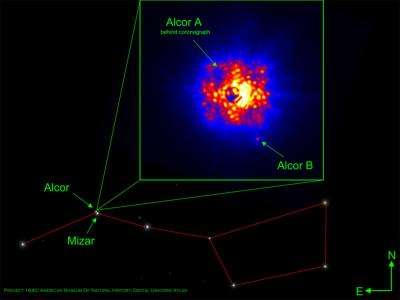
In recent years, some studies have begun exploring this, using telescopes equipped with to search for companions. In some cases, as with Alcor (member of the popular visual binary in the handle of the big dipper), companion stars have been detected, absolving the primary from the expectation of being the cause. However, in other cases, the X-rays still appear to be coming from the primary star when the resolution is sufficient to spatially resolve the system. The conclusion is that either the main star truly is the source, or there are even more elusive, sub-arcsecond binaries skewing the data.

Another new study has taken up the challenge of searching for hidden companions. The new study examined 63 known X-ray stars in the range not predicted to have X-ray emission to search for companions. As a control, they also searched 85 stars without the anomalous emission. This gave a total sample size of 148 target stars. When the images were taken and processed, it uncovered 68 candidate companions to 59 of the total objects. The number of companions was greater than the number of parent stars since some look to exist in trinary star systems or greater.

Comparing the percent of companions around X-ray stars to those that didn’t, 43% of the X-ray stars appeared to have companions, while only 12% of normal stars were discovered to have them. Some of the candidates may be the result of chance alignments and not actual binary systems giving an error of about ±5%.

While this study leaves some cases unresolved, the increased likelihood of X-ray to have companions suggests that the majority of cases are caused by companions. Further studies by X-ray telescopes like Chandra could provide the angular resolution necessary to ensure that the emissions are indeed coming from the partner objects as well as search for companions to even greater resolution.

Explore further: Unusual supernova is doubly unusual for being perfectly normal

add to favorites email to friend print save as pdf

Related Stories

Chandra Lifts the Veil on Milky Way 'Hotspot'

Jan 23, 2008

NASA's Chandra X-ray Observatory is helping to demystify Westerlund 2, a young star cluster with an estimated age of about one- or two-million years. Heavily obscured by dust and gas, Westerlund 2 has been ...

The Polaris Cluster

May 28, 2010

(PhysOrg.com) -- A Cepheid star is one whose mass and age results in physical conditions that generate periodic oscillations in its photosphere. A Cepheid thus varies regularly in brightness, with a period ...

A Black Hole in Medusa's Hair

Mar 11, 2009

This composite image of the Medusa galaxy (also known as NGC 4194) shows X-ray data from NASA's Chandra X-ray Observatory in blue and optical light from the Hubble Space Telescope in orange. Located above ...

Where do supernovae come from?

Sep 17, 2010

(PhysOrg.com) -- Supernovae, the explosive deaths of massive stars, are among the most momentous events in the cosmos because they disburse into space all of the chemical elements that were produced inside ...

X-Ray Emission from Young Stars

Feb 05, 2010

(PhysOrg.com) -- The star TW Hydrae is located about 150 light-years from earth in the direction of the constellation of Hydrae, the Water Snake. This star is relatively young -- at about 10 million years ...

Recommended for you

Three centaurs follow Uranus through the solar system

Jun 18, 2013

Astrophysicists from the Complutense University of Madrid have confirmed that Crantor, a large asteroid with a diameter of 70 km has an orbit similar to that of Uranus and takes the same amount of time to ...

Final curtain for Europe's deep-space telescope

Jun 17, 2013

The deep-space telescope Herschel took its final bow on Monday, climaxing a successful four-year mission to observe the birth of stars and galaxies, the European Space Agency (ESA) said.

Hubble spots a very bright contortionist

Jun 17, 2013

(Phys.org) —The contorted object captured by Hubble in this picture is IRAS 22491-1808, also known as the South America Galaxy. It is an ultra-luminous infrared galaxy (ULIRG) that emits a huge amount of ...

Study explains decades of black hole observations

Jun 14, 2013

(Phys.org) —A new study by astronomers at NASA, Johns Hopkins University and Rochester Institute of Technology confirms long-held suspicions about how stellar-mass black holes produce their highest-energy ...

User comments : 3

Adjust slider to filter visible comments by rank

Display comments: newest first

omatumr
1 / 5 (5) Mar 25, 2011
Companion star hiding in the core?


Neutron stars (pulsars) also emit x-rays and UV radiation.

Perhaps that is where the companion star is hiding.

See: Neutron Repulsion, The APEIRON Journal, in press, 19 pages,
http://arxiv.org/...2.1499v1

With kind regards,
Oliver K. Manuel
yyz
5 / 5 (2) Mar 26, 2011
"Companion star hiding in the core?"

Where does that statement occur in this story? Where is it even implied by Voisey?
omatumr
1 / 5 (2) Mar 26, 2011
"Companion star hiding in the core?"

Where does that statement occur in this story? Where is it even implied by Voisey?


That statement is in my comment, it is not in the story.

If other stars form on the collapsed cores of pre-existing stars, as the Sun did, then radiation from the star will change with time from that of a pulsar to that of an ordinary star.

"Strange xenon, extinct superheavy elements and the solar neutrino puzzle", Science 195, 208-209 (1977):

www.omatumr.com/a...enon.pdf

"Isotopes of tellurium, xenon and krypton in the Allende meteorite retain record of nucleosynthesis", Nature 277, 615-620 (1979):

www.nature.com/na...5a0.html

More news stories

Metamorphosis of moon's water ice explained

Using data gathered by NASA's Lunar Reconnaissance Orbiter (LRO) mission, scientists believe they have solved a mystery from one of the solar system's coldest regions—a permanently shadowed crater on the ...

Looking at sachet water consumption in Ghana

Many of West Africa's largest cities continue to lag in their provision of piped water to residents. Filling the service gap are plastic water sachets, which have become an important source of drinking water ...

The broken symphony of swinging metronomes

An experiment with 30 metronomes reveals chimera states which combine aspects of synchrony and of disorder. Researchers had been looking for such states for ten years.