'A little off the top' helps map cells with submicrometer resolution
March 2, 2011 By Michael E. Newman
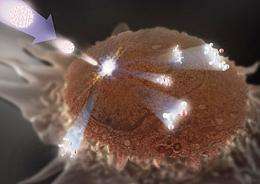
Artist’s illustration showing a HeLa cell with its top already “milled” off being probed by a secondary ion mass spectrometry (SIMS) beam. Molecules from three sections of the cell—the membrane, the cytoplasm and the nucleus—are seen ejecting from the surface in response. The spectra from these molecules are used to map the cell sections from which they originate. Credit: Donald Bliss, National Library of Medicine, National Institutes of Health
To determine if a tissue biopsy reveals the presence of cancer, a histologist often screens for cells with an abnormal appearance or a specific visible trait such as a larger-than-usual nucleus. However, by the time a cancer is physically noticeable, the disease may be in its later stages and more difficult to treat. In an effort to identify the earlier-onset, more subtle chemical changes occurring in a cell heading toward malignancy, researchers at the National Institute of Standards and Technology (NIST) and the National Cancer Institute (NCI) have developed a technique that slices off the top of a cell and makes the structures accessible to spectroscopic examination of their chemical "signature."
Secondary-ion mass spectrometry (SIMS) is a laboratory method developed in the 1960s to define and map the chemicals making up a substance or structure. An ion beam is shot at the surface of a sample, knocking chemical species off the target area that can then be identified by a mass spectrometer. The resulting spectra, in turn, can be used to create a chemical map of the sample.
To date, using SIMS imaging to map mammalian cells has yielded only modest success. To get to the interesting stuff inside the cell, the beam must first blast away the outer cell membrane. Like using a pickax to uncover a fossil, the beam often digs unevenly or too deeply and can damage or destroy the complex molecules and structures inside. The NIST/NCI team tried something more surgical. They first freeze-dried the cell in a manner that prevented its membrane from rupturing and then gently milled the top off the cell with a more powerful, more precisely controlled focused ion beam (FIB) that can skim across the cell at a specified depth. The interior of the cell is left exposed and as close to its natural state as possible for the SIMS beam. "In effect, we get a new, extremely data-rich surface for analysis," says team leader Christopher Szakal.
In a recently published proof-of-concept experiment, the NIST/NCI researchers applied their method to samples from the HeLa immortal human cancer cell line. Specific chemical signals were mapped across the region sliced open by the FIB, yielding images of the cell structures they define at resolutions better than a micrometer (millionth of a meter). For example, spectral maps of phospholipids were used to produce two-dimensional views of cell membranes.
The next step, Szakal says, is to show that the FIB can cleanly slice more than just the top layer off of a cell. "If we can use the FIB-SIMS method to chemically map successive layers of a cell, we'll be able to get three-dimensional images of the cell's components," he explains.
Additionally, the NIST/NCI team is developing mathematical algorithms to enhance and improve the images produced by its new system. The researchers hope that the technique will eventually enable diagnosticians to spot early changes in cell structure that could indicate a move toward abnormality (such as an enlargement of the nuclear membrane) or detect the initial presence of biomarkers, chemical species that can potentially be used to monitor the growth of specific cancers.
More information: C. Szakal, K. Narayan, J. Fu, J. Lefman and S. Subramaniam. Compositional mapping of the surface and interior of mammalian cells at submicrometer resolution. Analytical Chemistry. Vol. 83, Issue 4, pages 12071213. Published online Jan. 26, 2011.
Provided by
National Institute of Standards and Technology
-
From lemons to lemonade: Reaction uses carbon dioxide to make carbon-based semiconductor,
32 comments
-
Thioridazine kills cancer stem cells in human while avoiding toxic side-effects of conventional cancer treatments,
3 comments
-
SpaceX private rocket blasts off for space station (Update),
42 comments
-
Climate scientists say they have solved riddle of rising sea,
30 comments
-
Research team claims to have found evidence Lake Cheko is impact crater for Tunguska Event,
18 comments
-
Schwartz reagent-- NMR/MS/IR
15 hours ago
-
Inversion temp
20 hours ago
-
High school chemistry EEI
May 25, 2012
-
oxidation of I- by KMnO4
May 25, 2012
-
Invesion temp
May 25, 2012
-
Hybridization of SnCl3 -
May 25, 2012
- More from Physics Forums - Chemistry
More news stories
From lemons to lemonade: Reaction uses carbon dioxide to make carbon-based semiconductor
(Phys.org) -- A materials scientist at Michigan Technological University has discovered a chemical reaction that not only eats up the greenhouse gas carbon dioxide, it also creates something useful. And, by ...
May 21, 2012 |
4.7 / 5 (88) |
32
|
New CO2-removing catalyst can take the heat
(Phys.org) -- The current method of removing the greenhouse gas carbon dioxide (CO2) from the flues of coal-fired power plants uses so much energy that no one bothers to use it. So says Roger Aines, principal ...
May 24, 2012 |
5 / 5 (7) |
7
|
High-speed method to aid search for solar energy storage catalysts
Eons ago, nature solved the problem of converting solar energy to fuels by inventing the process of photosynthesis.
May 25, 2012 |
5 / 5 (3) |
4
|
Researchers demonstrate possible primitive mechanism of chemical info self-replication
(Phys.org) -- When scientists think about the replication of information in chemistry, they usually have in mind something akin to what happens in living organisms when DNA gets copied: a double-stranded molecule ...
May 25, 2012 |
5 / 5 (4) |
2
|
Castor oil: Action mechanism of one of the oldest drugs known to man elucidated
Castor oil is known primarily as an effective laxative; however, it was also used in ancient times with pregnant women to induce labour. Only now have scientists at the Max Planck Institute for Heart and Lung ...
May 21, 2012 |
3 / 5 (2) |
3
|
Dell tablet leak: 10.1-inch display, two-battery choice
(Phys.org) -- Headline after headline talks about vendors tablets in the wings as likely number-one contenders for the iPad. Such claims have justifiably been taken with a grain of salt, considering ...
Scientist: Evolution debate will soon be history
(AP) -- Richard Leakey predicts skepticism over evolution will soon be history. Not that the avowed atheist has any doubts himself.
SpotterRF debuts Radar Backpack Kit (w/ Video)
(Phys.org) -- SpotterRF has announced a special radar backpack kit designed to enhance situational awareness for soldiers on the ground. The company says its special radar is designed for warfighters as part ...
SpaceX capsule has 'new car' smell, astronauts say (Update)
SpaceX's Dragon cargo vessel smells like a new car, said astronauts at the International Space Station after opening the hatches Saturday following the spacecraft's landmark mission to the orbiting lab.
Thousands of shellfish found dead in Peru
Thousands of crustaceans were found dead off the coast of Lima following the mystery mass death of dolphins and pelicans, the Peruvian Navy said Friday.
Keep food safety in mind this memorial day weekend
(HealthDay) -- Picnics, parades and cookouts are as much a part of Memorial Day weekend as tributes to the United States' war veterans.