Brookhaven lab's new light source halfway there
March 22, 2011 By Mona S. Rowe
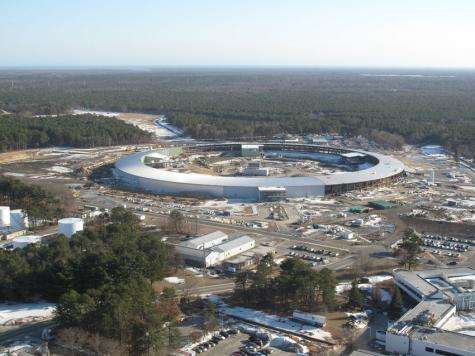
NSLS-II construction site
(PhysOrg.com) -- The U.S. Department of Energys Brookhaven National Laboratory is now halfway toward completing construction of the National Synchrotron Light Source II (NSLS-II), a powerful x-ray microscope nearly half a mile in circumference. Construction started in 2009 on the $912-million facility.
Ready for research in 2015, NSLS-II will be one of the worlds most advanced light sources, providing sophisticated new tools for science that will enhance national and energy security and help drive abundant, safe and clean energy technologies.
The 50-percent mark is a major construction milestone, said Steve Dierker, Associate Laboratory Director for Photon Sciences and NSLS-II Project Director. It means that half of the planned work on the project is finished. With this achievement coming in March 2011, the NSLS-II project is well ahead of schedule.
In 2009, the project received $150 million from the American Recovery and Reinvestment Act, money that came ahead of the baseline schedule and allowed construction to advance more quickly than originally planned.
During its construction and operation, NSLS-II is expected to create more than 1,250 construction jobs and 450 scientific, engineering and support jobs, plus additional jobs at U.S. material suppliers and service providers. Several dozen contractors, mostly based on Long Island, are currently working on the project.
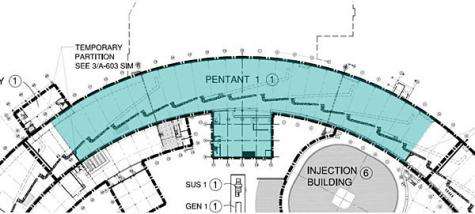
Close-up of first fifth of ring building (shown in light blue), now ready for beneficial occupancy
Conventional construction in the project is divided into two major segments. Torcon serves as the prime contractor for the ring building, which will house the electron accelerator and beamlines that are the heart of NSLS-II. Laboratory-office buildings, which E.W. Howell is constructing, will be attached around the exterior of the ring building.The circular ring building, encompassing 400,000 square feet, consists of seven sections. Construction is now substantially complete on the first ring section of 70,000 square feet, enabling Brookhaven Lab to take beneficial occupancy of the first fifth of the ring. Beneficial occupancy allows the NSLS-II project team to begin installing accelerator components and beamlines for experiments.
Taking beneficial occupancy of a portion of the ring building is a second major milestone, according to Dierker. Up until now, all activity in the ring building has involved conventional construction, including site preparation; concrete work; structural steel; mechanical, electrical and plumbing systems; and the building enclosure roof and walls.
Beneficial occupancy enables us to begin installing the first of 826 high-precision magnets destined for the main accelerator ring, said Dierker. The first, fully equipped magnet girder, 14 feet long and holding multiple magnets, will be placed in the ring building in March. This is a third significant milestone for the NSLS-II project.
In brief, NSLS-II will work by shooting electrons through the center of each magnet, where powerful magnetic fields will contain and steer the particles in a nearly circular path. Light emitted by electrons traveling around the ring will be shunted to beamlines, a collection of scientific instruments used to do experiments.
NSLS-II will enable scientists to focus on some of the nations most important scientific challenges at the nanoscale level, including clean, affordable energy; molecular electronics; and high-temperature superconductors. NSLS-II will also be used to study the smallest crystals in structural biology.
Provided by
Brookhaven National Laboratory
-
From lemons to lemonade: Reaction uses carbon dioxide to make carbon-based semiconductor,
32 comments
-
Thioridazine kills cancer stem cells in human while avoiding toxic side-effects of conventional cancer treatments,
3 comments
-
SpaceX private rocket blasts off for space station (Update),
42 comments
-
Climate scientists say they have solved riddle of rising sea,
30 comments
-
Research team claims to have found evidence Lake Cheko is impact crater for Tunguska Event,
18 comments
-
Question about induced E field.
1 hour ago
-
Charging a capacitor in a tesla coil
1 hour ago
-
Water Rocket
4 hours ago
-
why do trucks have bigger brakes?
9 hours ago
-
Solar Sail Physics - Do they work on a large scale?
10 hours ago
-
How should I switch an air conditioner off?
10 hours ago
- More from Physics Forums - General Physics
More news stories
Landmark calculation clears the way to answering how matter is formed
(Phys.org) -- An international collaboration of scientists, including Thomas Blum, associate professor of physics, is reporting in landmark detail the decay process of a subatomic particle called a kaon ...
May 25, 2012 |
4.4 / 5 (20) |
47
|
Is a classical electrodynamics law incompatible with special relativity?
(Phys.org) -- The laws of classical electromagnetism that were developed in the 19th century are the same laws that scientists use today. They include Maxwell’s four equations along with the Lorentz la ...
Lying in wait for WIMPs: Researchers seek to dramatically increase sensitivity of Large Underground Xenon detector
Although it's invisible, dark matter accounts for at least 80 percent of the matter in the universe. No one knows what it is, but most scientists would bet on weakly interacting massive particles, or WIMPs.
May 23, 2012 |
4 / 5 (7) |
15
|
Hall effect at the speed of light: How can you demonstrate relativistic effects with your mobile phone?
The relativistic Hall effect describing objects rotating at speeds comparable with the speed of light has been reported.
May 21, 2012 |
4.3 / 5 (3) |
8
Cloak of invisibility: Engineers use plasmonics to create an invisible photodetector
A team of engineers at Stanford and the University of Pennsylvania has for the first time used "plasmonic cloaking" to create a device that can see without being seen - an invisible machine that detects light. It is the first ...
May 21, 2012 |
4.8 / 5 (16) |
7
|
Dell tablet leak: 10.1-inch display, two-battery choice
(Phys.org) -- Headline after headline talks about vendors tablets in the wings as likely number-one contenders for the iPad. Such claims have justifiably been taken with a grain of salt, considering ...
Scientist: Evolution debate will soon be history
(AP) -- Richard Leakey predicts skepticism over evolution will soon be history. Not that the avowed atheist has any doubts himself.
SpotterRF debuts Radar Backpack Kit (w/ Video)
(Phys.org) -- SpotterRF has announced a special radar backpack kit designed to enhance situational awareness for soldiers on the ground. The company says its special radar is designed for warfighters as part ...
SpaceX capsule has 'new car' smell, astronauts say (Update)
SpaceX's Dragon cargo vessel smells like a new car, said astronauts at the International Space Station after opening the hatches Saturday following the spacecraft's landmark mission to the orbiting lab.
Thousands of shellfish found dead in Peru
Thousands of crustaceans were found dead off the coast of Lima following the mystery mass death of dolphins and pelicans, the Peruvian Navy said Friday.
Keep food safety in mind this memorial day weekend
(HealthDay) -- Picnics, parades and cookouts are as much a part of Memorial Day weekend as tributes to the United States' war veterans.

Mar 22, 2011
Rank: 1 / 5 (1)
Now that's what I like to read!!!