Beetle explorers name new species for Roosevelt
March 22, 2011 By Carol Hughes
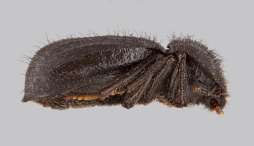
Lateral view of a new species of a rugged, and hairy, darkling beetle - Stenomorpha roosevelti - named in honor of Theodore Roosevelt on the 100th anniversary of a speech he gave at Tempe Normal School, now Arizona State University, on March 20, 1911. The new species of beetle, covered in thick dark hair with golden setal pads on tarsal segments of legs, was discovered in the protected area of Cuatro Ciénegas, a biodiversity-rich oasis in Coahuila, Mexico. It was discovered and named by Aaron Smith, a postdoctoral research associate at ASU; Kelly Miller, an assistant professor and curator of arthropods for the Museum of Southwestern Biology at the University of New Mexico; and Quentin Wheeler, a professor and founding director of the International Institute for Species Exploration at Arizona State University. Credit: Rebecca Dornburg / International Institute for Species Exploration, Arizona State University
(PhysOrg.com) -- A new species of a rugged darkling beetle that thrives in an arid region of the Chihuahuan Desert is being named in honor of Theodore Roosevelt on the 100th anniversary of a speech he gave at Tempe Normal School, now Arizona State University. The speech, delivered March 20, 1911, focused on the role of government, the importance of an educated citizenry, and the far-sighted wisdom of the Territory of Arizona.
The new species of beetle, Stenomorpha roosevelti, covered in thick dark hair with golden setal pads on tarsal segments of legs, was discovered in the protected area of Cuatro Ciénegas, a biodiversity-rich oasis in Coahuila, Mexico. It was discovered and named by Aaron Smith, an authority on darkling beetles and a postdoctoral research associate at ASU; Kelly Miller, an assistant professor and curator of arthropods for the Museum of Southwestern Biology at the University of New Mexico; and Quentin Wheeler, a professor and founding director of the International Institute for Species Exploration at ASU.
We wanted to do something distinct and long lasting to mark Roosevelts impact on Arizona and conservation as we ramp up to the state centennial next year, said Wheeler, an ASU vice president and dean of the College of Liberal Arts and Sciences.
According to Douglas Brinkleys book, The Wilderness Warrior: Theodore Roosevelt and the Crusade for America, it was Roosevelts executive orders that saved such natural treasures as Devils Tower, the Petrified Forest, and Arizonas Grand Canyon.
Naming a new species for President Roosevelt honors his achievements as a pioneering conservationist, naturalist and explorer, and helps us bring attention to biodiversity and the field of taxonomy. The ruggedness of this darkling beetle reflects many of the hardy and resilient characteristics of President Roosevelt, said Wheeler.
Roosevelt has had a number of species and subspecies named in his honor, including an elk, shrew, mollusk, worm and ant, according to Wheeler. To this list of honors we are pleased to add this rugged and dashing new species of beetle.
The announcement of the new species named for Roosevelt was made March 21 during a commemoration ceremony at ASUs Old Main, the site of the former presidents speech 100 years ago. Roosevelt was in Arizona at the time to dedicate a new dam on the Salt River that was named in his honor.
Roosevelt is not the first US president to have a beetle named by Wheeler and Miller. The pair of entomologists has named new species in honor of former President George W. Bush, former Vice President Dick Cheney, and former Secretary of Defense Donald Rumsfeld (Agathidium bushi, A. cheneyi and A. rumsfeldi). They also named beetles for the late rock n' roll legend Roy Orbison and his widow Barbara (Orectochilus orbisonorum); for fictional "Star Wars" character Darth Vader (Agathidium vaderi); and for Stephen Colbert, the satirical host and executive producer of Comedy Centrals The Colbert Report (Agaporomorphus colberti).
Provided by
Arizona State University
-
From lemons to lemonade: Reaction uses carbon dioxide to make carbon-based semiconductor,
30 comments
-
Thioridazine kills cancer stem cells in human while avoiding toxic side-effects of conventional cancer treatments,
3 comments
-
SpaceX private rocket blasts off for space station (Update),
42 comments
-
Climate scientists say they have solved riddle of rising sea,
30 comments
-
Research team claims to have found evidence Lake Cheko is impact crater for Tunguska Event,
18 comments
-
What would stain as translucent on light-coloured fabric?
3 hours ago
-
How do I identify different bacteria on culture plates?
13 hours ago
-
Why Do Dogs do Strange things...
May 25, 2012
-
What does exophillic and endophillic mean in terms of mosquito and their control?
May 24, 2012
-
Semen stains glows under black lights (uv light)?
May 23, 2012
-
Question on Human Chromosome 2
May 23, 2012
- More from Physics Forums - Biology
More news stories
Scientist: Evolution debate will soon be history
(AP) -- Richard Leakey predicts skepticism over evolution will soon be history. Not that the avowed atheist has any doubts himself.
2 hours ago |
3.5 / 5 (4) |
3
Thousands of shellfish found dead in Peru
Thousands of crustaceans were found dead off the coast of Lima following the mystery mass death of dolphins and pelicans, the Peruvian Navy said Friday.
12 hours ago |
4.8 / 5 (4) |
5
More plant species responding to global warming than previously thought
(Phys.org) -- Far more wild plant species may be responding to global warming than previous large-scale estimates have suggested.
May 22, 2012 |
4.6 / 5 (14) |
18
|
Totally rad: Scientists create rewritable digital data storage in DNA
(Phys.org) -- Scientists from Stanford's Department of Bioengineering have devised a method for repeatedly encoding, storing and erasing digital data within the DNA of living cells.
May 21, 2012 |
4.9 / 5 (17) |
11
|
For monogamous sparrows, it doesn't pay to stray (but they do it anyway)
It's quite common for a female song sparrow to stray from her breeding partner and mate with the male next door, but a new study shows that sleeping around can be costly.
May 22, 2012 |
5 / 5 (1) |
7
|
Dell tablet leak: 10.1-inch display, two-battery choice
(Phys.org) -- Headline after headline talks about vendors tablets in the wings as likely number-one contenders for the iPad. Such claims have justifiably been taken with a grain of salt, considering ...
SpaceX capsule has 'new car' smell, astronauts say (Update)
SpaceX's Dragon cargo vessel smells like a new car, said astronauts at the International Space Station after opening the hatches Saturday following the spacecraft's landmark mission to the orbiting lab.
SpotterRF debuts Radar Backpack Kit (w/ Video)
(Phys.org) -- SpotterRF has announced a special radar backpack kit designed to enhance situational awareness for soldiers on the ground. The company says its special radar is designed for warfighters as part ...
Keep food safety in mind this memorial day weekend
(HealthDay) -- Picnics, parades and cookouts are as much a part of Memorial Day weekend as tributes to the United States' war veterans.
Australia hails surprise super-telescope decision
Australia has hailed a surprise decision giving it a role in a radio telescope project aimed at revolutionising astronomy, vowing to draw on its decades of experience in space science.
Astronomers seize last chance in lifetime for Venus Transit
Astronomers are gearing for one the rarest events in the Solar System: an alignment of Earth, Venus and the Sun that will not be seen for another 105 years.