Baby stars born to 'napping' parents
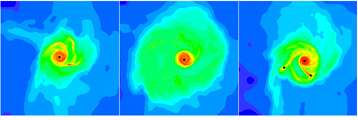
(PhysOrg.com) -- Cardiff University astronomers believe that a young star's long "napping" could trigger the formation of a second generation of smaller stars and planets orbiting around it.
It has long been suspected that the build up of material onto young stars is not continuous but happens in episodic events, resulting in short outbursts of energy from these stars.
However, this has been largely ignored in models of star formation.
Now, by developing advanced computer models to simulate the behaviour of young stars, Cardiff University Astrophysicists Dr Dimitris Stamatellos and Professor Anthony Whitworth, along with Dr David Hubber from the University of Sheffield, have offered a new insight in star formation.
While stars are young they are surrounded by discs of gas and dust, and grow by accreting material from these discs. The discs may break-up to give birth to smaller stars, planets and brown dwarfs - objects larger than planets but not large enough to burn hydrogen like our Sun.
This video is not supported by your browser at this time.
A star acquires much of its mass by accreting material from a disc. Accretion is probably not continuous but episodic. We have developed a method to include the effects of episodic accretion in simulations of star formation. Episodic accretion results in bursts of radiative feedback, during which a protostar is very luminous, and its surrounding disc is heated and stabilised. These bursts typically last only a few hundred years. In contrast, the lulls between bursts may last a few thousand years; during these lulls the luminosity of the protostar is very low, and its disc cools and fragments. Thus, episodic accretion enables the formation of low-mass stars, brown dwarfs and planetary-mass objects by disc fragmentation. If episodic accretion is a common phenomenon among young protostars, then the frequency and duration of accretion bursts may be critical in determining the low-mass end of the stellar initial mass function.
"We know that young stars spend most of their early lives sleeping," said Dr Dimitris Stamatellos. "After they have their lunch, a large chunk of dust and gas from their discs, they take a nap that lasts for a few thousand years. During this nap their brightness is very low."As they sleep, their discs grow in mass, but they remain relatively cool, despite the presence of stars right at their centres. Eventually, these discs become unstable and fragment to form low-mass stars and substellar objects, like brown dwarfs and planets."
To date, research has suggested that the radiation from the parent star could heat and stabilize the disc, suppressing its breaking up.
However, the researchers discovered that there is ample time in between outbursts to allow the disc to break up and give birth to a new generation of low-mass stars, brown dwarfs, and planets.
The new theory provides an explanation for the formation and the properties of stars with masses below a fifth of that of our Sun, which are estimated to constitute more than 60% of all stars in our Galaxy.
"Our findings suggest that disc fragmentation is possible in nature," says Dr Stamatellos.
"It is important now to investigate whether this is the dominant mechanism for the formation of low-mass stars and brown dwarfs," he adds.
More information: The research was published in the Astrophysical Journal.
Provided by
Cardiff University
-
From lemons to lemonade: Reaction uses carbon dioxide to make carbon-based semiconductor,
30 comments
-
Thioridazine kills cancer stem cells in human while avoiding toxic side-effects of conventional cancer treatments,
3 comments
-
SpaceX private rocket blasts off for space station (Update),
42 comments
-
Climate scientists say they have solved riddle of rising sea,
30 comments
-
Research team claims to have found evidence Lake Cheko is impact crater for Tunguska Event,
18 comments
-
revamping general concept and cosmological principle
May 25, 2012
-
Transiting Exoplanet Light Curve
May 25, 2012
-
Math behind Theoretical Physics
May 24, 2012
-
Do we know whats at the center of galaxies yet?
May 23, 2012
-
Structure of the Milky Way?
May 20, 2012
-
What would it take to terraform Pluto and Charon?
May 19, 2012
- More from Physics Forums - General Astronomy
More news stories
SpaceX capsule has 'new car' smell, astronauts say (Update)
SpaceX's Dragon cargo vessel smells like a new car, said astronauts at the International Space Station after opening the hatches Saturday following the spacecraft's landmark mission to the orbiting lab.
Space & Earth / Space Exploration
12 hours ago |
4.6 / 5 (16) |
0
Australia hails surprise super-telescope decision
Australia has hailed a surprise decision giving it a role in a radio telescope project aimed at revolutionising astronomy, vowing to draw on its decades of experience in space science.
12 hours ago |
5 / 5 (2) |
0
Astronomers seize last chance in lifetime for Venus Transit
Astronomers are gearing for one the rarest events in the Solar System: an alignment of Earth, Venus and the Sun that will not be seen for another 105 years.
12 hours ago |
5 / 5 (1) |
0
Astronauts enter world's 1st private supply ship
(AP) -- Space station astronauts floated into the Dragon on Saturday, a day after its heralded arrival as the world's first commercial supply ship.
Space & Earth / Space Exploration
12 hours ago |
5 / 5 (5) |
0
Dragon arrives at space station in historic 1st (Update 2)
The privately bankrolled Dragon capsule made a historic arrival at the International Space Station on Friday, triumphantly captured by astronauts wielding a giant robot arm.
Space & Earth / Space Exploration
May 25, 2012 |
5 / 5 (10) |
19
Dell tablet leak: 10.1-inch display, two-battery choice
(Phys.org) -- Headline after headline talks about vendors tablets in the wings as likely number-one contenders for the iPad. Such claims have justifiably been taken with a grain of salt, considering ...
Scientist: Evolution debate will soon be history
(AP) -- Richard Leakey predicts skepticism over evolution will soon be history. Not that the avowed atheist has any doubts himself.
Keep food safety in mind this memorial day weekend
(HealthDay) -- Picnics, parades and cookouts are as much a part of Memorial Day weekend as tributes to the United States' war veterans.
SpotterRF debuts Radar Backpack Kit (w/ Video)
(Phys.org) -- SpotterRF has announced a special radar backpack kit designed to enhance situational awareness for soldiers on the ground. The company says its special radar is designed for warfighters as part ...
Thousands of shellfish found dead in Peru
Thousands of crustaceans were found dead off the coast of Lima following the mystery mass death of dolphins and pelicans, the Peruvian Navy said Friday.
Family history of Alzheimer's affects functional connectivity
(HealthDay) -- Cognitively normal individuals with a family history of late-onset Alzheimer's disease (AD) may display lower resting state functional connectivity in the default mode network (DMN) of the brain, ...
Mar 09, 2011
Rank: 1 / 5 (4)
Our research also suggests that fragmentation precedes the formation of a new star on the fragment [1].
We conclude that the initial fragmentation is powered by neutron repulsion, and that neutron repulsion also causes neutron-emission and neutron-decay into a photosphere, the glowing globe of hydrogen that hides the stars compact source of energy.
1. "Neutron Repulsion," The APEIRON Journal in press (2011), 19 pages
http://arxiv.org/...2.1499v1
With kind regards,
Oliver K. Manuel