Arachnophobes beware: Hubble snaps close-up of the Tarantula (w/ Video)
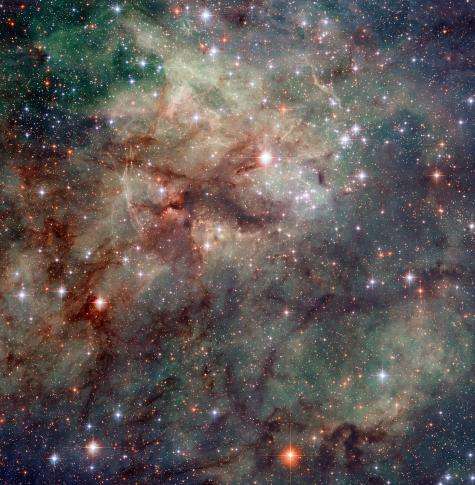
Hubble has taken this stunning close-up shot of part of the Tarantula Nebula. This star-forming region of ionised hydrogen gas is in the Large Magellanic Cloud, a small galaxy which neighbors the Milky Way. It is home to many extreme conditions including supernova remnants and the heaviest star ever found. The Tarantula Nebula is the most luminous nebula of its type in the local universe. Credit: NASA, ESA
(PhysOrg.com) -- The wispy arms of the Tarantula Nebula were originally thought to resemble spindly spider legs, giving the nebula its unusual name. The part of the nebula visible in this image from Hubble's Advanced Camera for Surveys is criss-crossed with tendrils of dust and gas churned up by recent supernovae. These supernova remnants include NGC 2060, visible above and to the left of the centre of this image, which contains the brightest known pulsar.
The tarantula's bite goes beyond NGC 2060. Near the edge of the nebula, outside the frame, below and to the right, lie the remains of supernova SN 1987a, the closest supernova to Earth to be observed since the invention of telescopes in the 17th century. Hubble and other telescopes have been returning to spy on this stellar explosion regularly since it blew up in 1987, and each subsequent visit shows an expanding shockwave lighting up the gas around the star, creating a pearl necklace of glowing pockets of gas around the remains of the star. SN 1987a is visible in wide field images of the nebula, such as that taken by the MPG/ESO 2.2-metre telescope.
Together with dying stars, the Tarantula Nebula is packed with young stars which have recently formed from the nebula's supply of hydrogen gas. These toddler-stars shine forth with intense ultraviolet light that ionises the gas, making it light up red. The light is so intense that although around 170 000 light-years distant, and outside the Milky Way, the Tarantula Nebula is nevertheless visible without a telescope on a dark night to Earth-bound observers. This nebula might be far away, but it is the most luminous example of its type that astronomers have observed in the local Universe.
This video is not supported by your browser at this time.
The Hubblecast's Joe Liske (Dr J) takes us on a tour of the Tarantula Nebula. Bright star forming gas clouds, super star clusters and supernova remnants are just some of the sights in this dramatic region of the night sky. Credit: ESA/Hubble
A compact and extremely bright star cluster called RMC 136 lies above and to the left of this field of view, providing much of the radiation that powers the multi-coloured glow. Until recently, astronomers debated whether the source of the intense light was a tightly bound cluster of stars, or perhaps an unknown type of super-star thousands of times bigger than the Sun. It is only in the last 20 years, with the fine detail revealed by Hubble and the latest generation of ground-based telescopes, that astronomers have been able to conclusively prove that it is, indeed, a star cluster.But even if the Tarantula Nebula doesn't contain this hypothetical super-star, it still hosts some extreme phenomena, making it a popular target for telescopes. Within the bright star cluster lies star RMC 136a1, which was recently found to be the heaviest ever discovered, at around 300 times the mass of the Sun at its birth. This heavyweight is challenging astronomers' theories of star formation, smashing through the upper limit they thought existed on star mass.
Provided by
ESA/Hubble Information Centre
-
From lemons to lemonade: Reaction uses carbon dioxide to make carbon-based semiconductor,
30 comments
-
Thioridazine kills cancer stem cells in human while avoiding toxic side-effects of conventional cancer treatments,
3 comments
-
SpaceX private rocket blasts off for space station (Update),
42 comments
-
Climate scientists say they have solved riddle of rising sea,
30 comments
-
Research team claims to have found evidence Lake Cheko is impact crater for Tunguska Event,
18 comments
-
revamping general concept and cosmological principle
May 25, 2012
-
Transiting Exoplanet Light Curve
May 25, 2012
-
Math behind Theoretical Physics
May 24, 2012
-
Do we know whats at the center of galaxies yet?
May 23, 2012
-
Structure of the Milky Way?
May 20, 2012
-
What would it take to terraform Pluto and Charon?
May 19, 2012
- More from Physics Forums - General Astronomy
More news stories
SpaceX capsule has 'new car' smell, astronauts say (Update)
SpaceX's Dragon cargo vessel smells like a new car, said astronauts at the International Space Station after opening the hatches Saturday following the spacecraft's landmark mission to the orbiting lab.
Space & Earth / Space Exploration
12 hours ago |
4.6 / 5 (16) |
0
Australia hails surprise super-telescope decision
Australia has hailed a surprise decision giving it a role in a radio telescope project aimed at revolutionising astronomy, vowing to draw on its decades of experience in space science.
12 hours ago |
5 / 5 (2) |
0
Astronomers seize last chance in lifetime for Venus Transit
Astronomers are gearing for one the rarest events in the Solar System: an alignment of Earth, Venus and the Sun that will not be seen for another 105 years.
12 hours ago |
5 / 5 (1) |
0
Astronauts enter world's 1st private supply ship
(AP) -- Space station astronauts floated into the Dragon on Saturday, a day after its heralded arrival as the world's first commercial supply ship.
Space & Earth / Space Exploration
12 hours ago |
5 / 5 (5) |
0
Dragon arrives at space station in historic 1st (Update 2)
The privately bankrolled Dragon capsule made a historic arrival at the International Space Station on Friday, triumphantly captured by astronauts wielding a giant robot arm.
Space & Earth / Space Exploration
May 25, 2012 |
5 / 5 (10) |
19
Dell tablet leak: 10.1-inch display, two-battery choice
(Phys.org) -- Headline after headline talks about vendors tablets in the wings as likely number-one contenders for the iPad. Such claims have justifiably been taken with a grain of salt, considering ...
Scientist: Evolution debate will soon be history
(AP) -- Richard Leakey predicts skepticism over evolution will soon be history. Not that the avowed atheist has any doubts himself.
Keep food safety in mind this memorial day weekend
(HealthDay) -- Picnics, parades and cookouts are as much a part of Memorial Day weekend as tributes to the United States' war veterans.
SpotterRF debuts Radar Backpack Kit (w/ Video)
(Phys.org) -- SpotterRF has announced a special radar backpack kit designed to enhance situational awareness for soldiers on the ground. The company says its special radar is designed for warfighters as part ...
Thousands of shellfish found dead in Peru
Thousands of crustaceans were found dead off the coast of Lima following the mystery mass death of dolphins and pelicans, the Peruvian Navy said Friday.
Family history of Alzheimer's affects functional connectivity
(HealthDay) -- Cognitively normal individuals with a family history of late-onset Alzheimer's disease (AD) may display lower resting state functional connectivity in the default mode network (DMN) of the brain, ...
Mar 15, 2011
Rank: 5 / 5 (4)
Mar 15, 2011
Rank: not rated yet
http://www.spacet...ic1105a/
Mar 15, 2011
Rank: not rated yet
but every reference to a pearl necklace in an article make me giggle