Identifying 'anonymous' email authors
March 8, 2011

Identifying 'anonymous' email authors

Enlarge

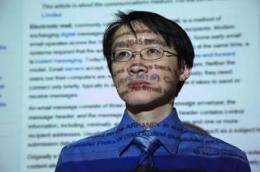
Benjamin Fung, a professor of Information Systems Engineering at Concordia University, has developed an effective new technique to determine the authorship of anonymous emails. Credit: Concordia University

A team of researchers from Concordia University has developed an effective new technique to determine the authorship of anonymous emails. Tests showed their method has a high level of accuracy – and unlike many other methods of ascertaining authorship, it can provide presentable evidence in courts of law. Findings on the new technique are published in the journal Digital Investigation.

"In the past few years, we've seen an alarming increase in the number of cybercrimes involving anonymous emails," says study co-author Benjamin Fung, a professor of Information Systems Engineering at Concordia University and an expert in data mining – extracting useful, previously unknown knowledge from a large volume of raw data. "These emails can transmit threats or child pornography, facilitate communications between criminals or carry viruses."

While police can often use the IP address to locate the house or apartment where an originated, they may find many people at that address. They need a reliable, effective way to determine which of several suspects has written the emails under investigation.

Fung and his colleagues developed a novel method of authorship attribution to meet this need, based on techniques used in speech recognition and data mining. Their approach relies on the identification of frequent patterns – unique combinations of features that recur in a suspect's emails.

To determine whether a suspect has authored the target email, they first identify the patterns found in emails written by the subject. Then, they filter out any of these patterns which are also found in the emails of other suspects.

The remaining frequent patterns are unique to the author of the emails being analyzed. They constitute the suspect's 'write-print,' a distinctive identifier like a fingerprint. "Let's say the anonymous email contains typos or grammatical mistakes, or is written entirely in lowercase letters," says Fung. "We use those special characteristics to create a write-print. Using this method, we can even determine with a high degree of who wrote a given email, and infer the gender, nationality and education level of the author."

To test the accuracy of their technique, Fung and his colleagues examined the Enron Email Dataset, a collection which contains over 200,000 real-life emails from 158 employees of the Enron Corporation. Using a sample of 10 emails written by each of 10 subjects – 100 emails in all – they were able to identify authorship with an accuracy of 80 percent to 90 percent.

"Our technique was designed to provide credible evidence that can be presented in a court of law," says Fung. "For evidence to be admissible, investigators need to explain how they have reached their conclusions. Our method allows them to do this."

The new authorship identification technique was developed in collaboration with Mourad Debbabi, a Concordia expert in cyber forensics, and PhD student Farkhund Iqbal. "Our different backgrounds allowed us to apply data mining techniques to real-life problems in cyber forensics," says Fung. "This is an excellent illustration of how effective interdisciplinary research can be."

More information: Cited research: http://www.dfrws.o … 42-iqbal.pdf

Provided by Concordia University

3.4 /5 (12 votes)  

Filter


Move the slider to adjust rank threshold, so that you can hide some of the comments.


Display comments: newest first

wealthychef
Mar 08, 2011

Rank: 4.4 / 5 (5)
80 to 90 percent accuracy and this is going to be used in a court of law? I can just hear a good defense lawyer shredding this to pieces. Also, these things seem pretty easy to fake.
elginz
Mar 08, 2011

Rank: 3.7 / 5 (3)
1. COmpose an email
2. Run it through a translator
3. Translate back to English
4. Send email
that_guy
Mar 08, 2011

Rank: 5 / 5 (3)
80 to 90 percent accuracy and this is going to be used in a court of law? I can just hear a good defense lawyer shredding this to pieces. Also, these things seem pretty easy to fake.

It's not enough for a conviction, but it's good enough to catch a warrant in conjunction with the ip. it would be part of a case. It would be stupid and abusive to try to convict someone on one piece of evidence.

If someone sees a blue pickup truck leaving the site of a crime, do they ignore that piece of evidence because there is a small individual chance of that being the perpetrator's case, or do they use that in conjunction with the tire tracks, the shoe tracks, the hole in his story, etc?

This is similar to handwriting analysis, and that is admissible in court with even lower efficacy/reliability.
Newbeak
Mar 08, 2011

Rank: 2 / 5 (2)
Send your email through a proxy server..
Skeptic_Heretic
Mar 08, 2011

Rank: 5 / 5 (2)
Send your email through a proxy server..

Still traceable for the most part, depends on the proxy. Very few lvl 5 proxies aren't watched on both ends.
Froob
Mar 09, 2011

Rank: 5 / 5 (1)
Emails tend to be relatively short, especially those trying to do spam selling, therefore the statistical basis of any technique based on the content of such emails, is suspect.
frajo
Mar 09, 2011

Rank: 5 / 5 (2)
I'm underwhelmed. Text pattern analysis is very interesting but older than the internet.

[1] IP numbers can be faked. In order to find the true sender you'd have to trace back the whole chain of mail servers some of which could be compromised.
[2] Threats and CP? Rubbish. I never read or open spam. (Yes - no Microsoft inside.)
[3] To be precise text analyses need huge bodies of texts. Not one-liners like "buy cheap viagra www.cheap-viagra.bum.
[4] I'd really like to put those spamming bastards and their sponsors into jail. But this method won't help me.
J-n
Mar 09, 2011

Rank: not rated yet
This, unfortunately, has nothing to do with spammers. They know who sends out the spam, they know from where, and they turn a blind eye because it would mean getting involved internationally, and someone somewhere down the line would loose money.

The biggest problem with this idea in my mind is that it will instill into people that this form of identification is plausible and as good as fingerprints. Fingerprints are very difficult to change, and changing them will usually not get them confused with someonelse's. Changing your speech (text) patterns you could impersonate someone, or completely change your "identity" in the eyes of this system.

While it wouldn't be the only thing used to convict someone of a crime, it's a heck of a good way to get a warrant to search their computer for whatever crimes they "might" be committing.
Rank 3.4 /5 (12 votes)
Relevant PhysicsForums posts
  • Ideas to mitigate risk of 911 calls being misdirected
    createdMay 24, 2012
  • Live scribe pen?
    createdMay 10, 2012
  • Shallow water flow simulation
    createdMay 07, 2012
  • Tablet for taking notes?
    createdMay 05, 2012
  • Best fit tablet for me?
    createdMay 05, 2012
  • Measure of Informaton
    createdMay 04, 2012
  • More from Physics Forums - Computing & Technology

More news stories

SpotterRF debuts Radar Backpack Kit (w/ Video)

(Phys.org) -- SpotterRF has announced a special radar backpack kit designed to enhance situational awareness for soldiers on the ground. The company says its special radar is designed for warfighters as part ...

Technology / Hi Tech & Innovation

created 12 hours ago | popularity 5 / 5 (3) | comments 10 | with audio podcast report

Probability of contamination from severe nuclear reactor accidents is higher than expected: study

Catastrophic nuclear accidents such as the core meltdowns in Chernobyl and Fukushima are more likely to happen than previously assumed. Based on the operating hours of all civil nuclear reactors and the number ...

Technology / Energy & Green Tech

created May 22, 2012 | popularity 3.7 / 5 (20) | comments 50 | with audio podcast

Delphi gasoline-injection engine technique rivals hybrid's edge

(Phys.org) -- Running a diesel like engine on gasoline is something Delphi is doing in notable fashion. They claim they are on to a promising way to enjoy an engine that gives the vehicle owner high efficiency ...

Technology / Energy & Green Tech

created May 21, 2012 | popularity 4.7 / 5 (18) | comments 37 | with audio podcast report

HyperSolar shows dirty water no barrier to power world

(Phys.org) -- The Santa Barbara, California, company, HyperSolar, is set to transparently share the ups and downs of its research experiences toward the company’s ultimate vision, successfully producing ...

Technology / Energy & Green Tech

created May 24, 2012 | popularity 4.8 / 5 (14) | comments 17 | with audio podcast report

Tesla to launch electric sedan in US on June 22

Tesla Motors said Tuesday it would begin deliveries of "the world's first premium electric sedan" on June 22, slightly ahead of schedule.

Technology / Energy & Green Tech

created May 22, 2012 | popularity 4.5 / 5 (11) | comments 18


Dell tablet leak: 10.1-inch display, two-battery choice

(Phys.org) -- Headline after headline talks about vendors’ tablets in the wings as likely number-one contenders for the iPad. Such claims have justifiably been taken with a grain of salt, considering ...

Scientist: Evolution debate will soon be history

(AP) -- Richard Leakey predicts skepticism over evolution will soon be history. Not that the avowed atheist has any doubts himself.

Keep food safety in mind this memorial day weekend

(HealthDay) -- Picnics, parades and cookouts are as much a part of Memorial Day weekend as tributes to the United States' war veterans.

SpaceX capsule has 'new car' smell, astronauts say (Update)

SpaceX's Dragon cargo vessel smells like a new car, said astronauts at the International Space Station after opening the hatches Saturday following the spacecraft's landmark mission to the orbiting lab.

Australia hails surprise super-telescope decision

Australia has hailed a surprise decision giving it a role in a radio telescope project aimed at revolutionising astronomy, vowing to draw on its decades of experience in space science.

Thousands of shellfish found dead in Peru

Thousands of crustaceans were found dead off the coast of Lima following the mystery mass death of dolphins and pelicans, the Peruvian Navy said Friday.