UN alarmed at huge deline in bee numbers
March 10, 2011

Much of the decline ranging up to 85 percent in some areas is taking place in the industralised northern hemisphere

Enlarge

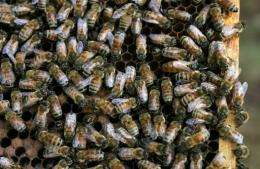
The UN expressed alarm at a huge decline in bee colonies under a multiple onslaught of pests and pollution, urging an international effort to save the pollinators that are vital for food crops.

The UN on Thursday expressed alarm at a huge decline in bee colonies under a multiple onslaught of pests and pollution, urging an international effort to save the pollinators that are vital for food crops.

Much of the decline, ranging up to 85 percent in some areas, is taking place in the industralised northern hemisphere due to more than a dozen factors, according to a report by the UN's environmental agency.

They include pesticides, , a lethal parasite that only affects bee species in the northern hemisphere, mismanagement of the countryside, the loss of and a decline in in Europe.

"The way humanity manages or mismanages its nature-based assets, including , will in part define our collective future in the 21st century," said UNEP executive director Achim Steiner.

"The fact is that of the 100 crop species that provide 90 percent of the world's food, over 70 are pollinated by bees," he added.

colony declines in recent years have reached 10 to 30 percent in Europe, 30 percent in the United States, up to 85 percent in Middle East, said scientist Peter Neumann, one of the authors of the first ever UN report on the issue.

But in South America, Africa and Australia there were no reports of high losses.

"It is a very complex issue. There are a lot of interactive factors and one country alone is not able to solve the problem, that's for sure. We need to have an international network, global approaches," added Neumann of the Swiss government's Bee Research Centre.

Some of the mechanisms behind the four decades old trend, which appears to have intensified in the late 1990s, are not understood. UNEP warned that the broad issue of countryside management and conservation was involved.

"The will get the headlines in this story," UNEP spokesman Nick Nuttall told journalists.

"But in a sense they are an indicator of the wider changes that are happening in the countryside but also urban environments, in terms of whether nature can continue to provide the services as it has been doing for thousands or millions of years in the face of acute environmental change," he added.

(c) 2011 AFP

Filter


Move the slider to adjust rank threshold, so that you can hide some of the comments.


Display comments: newest first

Doug_Huffman
Mar 10, 2011

Rank: 1 / 5 (1)
Perhaps the UN-united-nations have come to grips with their Global Warming error, as this obvious correlation was not mentioned.
Alphakronik
Mar 10, 2011

Rank: not rated yet
Or maybe they should work on making their sick bees better again.

UK Researchers announced what was killing them last year.

Failed article has failed.
J-n
Mar 10, 2011

Rank: 5 / 5 (1)
From what i've been made aware, we still do not know the cause of CCD (colony collapse disorder). If you have some additional information that i've missed please let me know :)

In the MANY years that scientists and bee keepers have known this problem exists, there are may possible reasons that have been floated for the reason as to this happening.

Climate change has not been suggested by anyone as the small temperature changes right now would not cause CCD in the way we are seeing it.

The fact that some people see the need to inject their opinions on Global Warming into every conversation just proves to me that they are unsure about their own opinions on the matter and hope for others to agree with them to validate their opinions.

astro_optics
Mar 10, 2011

Rank: not rated yet
Is it coincidental that the introduction of lot of GM crops and also introduction of new/cheaper pesticides from China might have something to do with it...
Djincss
Mar 12, 2011

Rank: 5 / 5 (2)
It started to appear here in the Balkans too, and we dont have GM.
Skeptic_Heretic
Mar 12, 2011

Rank: 5 / 5 (1)
Or maybe they should work on making their sick bees better again.
UK Researchers announced what was killing them last year.

Failed article has failed.

And you have failed to tell us what these UK researchers found as the cause. Have a link to the research? Only thing I found was a piece in the Guardian speaking of the impacts of industrialization of the pollination industry becomming a breeding ground for the various diseases, parasite, and fungi that are responsible for CCD.
Rank 5 /5 (2 votes)
Relevant PhysicsForums posts

More news stories

Scientist: Evolution debate will soon be history

(AP) -- Richard Leakey predicts skepticism over evolution will soon be history. Not that the avowed atheist has any doubts himself.

Biology / Evolution

created 2 hours ago | popularity 3.5 / 5 (4) | comments 3

Thousands of shellfish found dead in Peru

Thousands of crustaceans were found dead off the coast of Lima following the mystery mass death of dolphins and pelicans, the Peruvian Navy said Friday.

Biology / Ecology

created 12 hours ago | popularity 4.8 / 5 (4) | comments 5

More plant species responding to global warming than previously thought

(Phys.org) -- Far more wild plant species may be responding to global warming than previous large-scale estimates have suggested.

Biology / Ecology

created May 22, 2012 | popularity 4.6 / 5 (14) | comments 18 | with audio podcast

Totally rad: Scientists create rewritable digital data storage in DNA

(Phys.org) -- Scientists from Stanford's Department of Bioengineering have devised a method for repeatedly encoding, storing and erasing digital data within the DNA of living cells.

Biology / Biotechnology

created May 21, 2012 | popularity 4.9 / 5 (17) | comments 11 | with audio podcast

For monogamous sparrows, it doesn't pay to stray (but they do it anyway)

It's quite common for a female song sparrow to stray from her breeding partner and mate with the male next door, but a new study shows that sleeping around can be costly.

Biology / Plants & Animals

created May 22, 2012 | popularity 5 / 5 (1) | comments 7 | with audio podcast


Dell tablet leak: 10.1-inch display, two-battery choice

(Phys.org) -- Headline after headline talks about vendors’ tablets in the wings as likely number-one contenders for the iPad. Such claims have justifiably been taken with a grain of salt, considering ...

Keep food safety in mind this memorial day weekend

(HealthDay) -- Picnics, parades and cookouts are as much a part of Memorial Day weekend as tributes to the United States' war veterans.

SpaceX capsule has 'new car' smell, astronauts say (Update)

SpaceX's Dragon cargo vessel smells like a new car, said astronauts at the International Space Station after opening the hatches Saturday following the spacecraft's landmark mission to the orbiting lab.

SpotterRF debuts Radar Backpack Kit (w/ Video)

(Phys.org) -- SpotterRF has announced a special radar backpack kit designed to enhance situational awareness for soldiers on the ground. The company says its special radar is designed for warfighters as part ...

Australia hails surprise super-telescope decision

Australia has hailed a surprise decision giving it a role in a radio telescope project aimed at revolutionising astronomy, vowing to draw on its decades of experience in space science.

Astronomers seize last chance in lifetime for Venus Transit

Astronomers are gearing for one the rarest events in the Solar System: an alignment of Earth, Venus and the Sun that will not be seen for another 105 years.