New Volvo pedestrian detection system brakes for you
February 25, 2011 by Lin Edwards
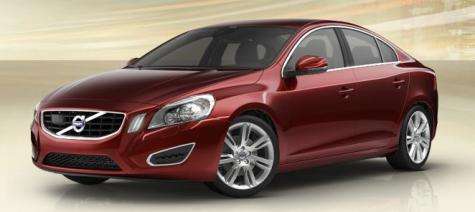
The Volvo S60 sedan.
(PhysOrg.com) -- Swedish vehicle manufacturer Volvos goal is that by 2020 nobody should be killed or seriously injured in a new Volvo and their cars should not seriously injure or kill other road users or pedestrians. To help achieve this aim the company has developed a detection system for cars that can detect pedestrians, predict when they might move in front of the vehicle and automatically apply the brakes if the driver does not.
The Collision Warning with Full Auto Brake and Pedestrian Detection system fitted in the 2011 model S60 was first announced early last year. It uses a computer fed by information from a wide-angle radar system that detects objects and monitors their speed and distance from the car, and from a camera fitted near the rear view mirror. Using this information the computer identifies the objects and determines if they are on a collision path.
If a collision is imminent the car gives the driver an audible and visual warning and brakes hard if the driver does not react quickly enough. At speeds under 35 km/h a collision is prevented, while at higher speeds it may not be possible to avoid a collision but the impact and subsequent injuries are reduced.
This video is not supported by your browser at this time.
The system has been successfully tested with a dummy, but is not completely foolproof because in one trial the dummy was hit even when the car was traveling below 35 km/h. This could have been because crowds gathered on either side of the track confused the system, which worked perfectly when the crowds moved back.
Other computer systems in the Volvo S60 include an alarm triggered by random or uncontrolled weaving of the car to wake the tired or distracted driver and warning lights on the outside mirrors to warn drivers of vehicles they cannot see. Another system monitors lane dividers and warns the driver if they cross the dividers without first using a turning indicator. The headlamps are also under computer control and move to follow the curve of the road.
Volvos pedestrian detection system is not the first, since Mercedes-Benz and BMW have already introduced pedestrian detection in night vision displays, but Volvo is the first system to couple a detection system with automatic braking.
This video is not supported by your browser at this time.
More information: Volvo website
© 2010 PhysOrg.com
-
From lemons to lemonade: Reaction uses carbon dioxide to make carbon-based semiconductor,
30 comments
-
Thioridazine kills cancer stem cells in human while avoiding toxic side-effects of conventional cancer treatments,
3 comments
-
SpaceX private rocket blasts off for space station (Update),
42 comments
-
Climate scientists say they have solved riddle of rising sea,
30 comments
-
Research team claims to have found evidence Lake Cheko is impact crater for Tunguska Event,
18 comments
-
magnets or EMF in car bumpers to protect from fender bender
16 hours ago
-
length of wire in a coil of known dimensions?
May 25, 2012
-
India Engineering Powerhouse
May 25, 2012
-
electromagnet core dereference between hard and soft iron
May 25, 2012
-
Measuring water pressure in an open tank
May 24, 2012
-
Question from a non-engineer: Pulley Systems
May 24, 2012
- More from Physics Forums - General Engineering
More news stories
SpotterRF debuts Radar Backpack Kit (w/ Video)
(Phys.org) -- SpotterRF has announced a special radar backpack kit designed to enhance situational awareness for soldiers on the ground. The company says its special radar is designed for warfighters as part ...
Probability of contamination from severe nuclear reactor accidents is higher than expected: study
Catastrophic nuclear accidents such as the core meltdowns in Chernobyl and Fukushima are more likely to happen than previously assumed. Based on the operating hours of all civil nuclear reactors and the number ...
Technology / Energy & Green Tech
May 22, 2012 |
3.7 / 5 (20) |
52
|
Delphi gasoline-injection engine technique rivals hybrid's edge
(Phys.org) -- Running a diesel like engine on gasoline is something Delphi is doing in notable fashion. They claim they are on to a promising way to enjoy an engine that gives the vehicle owner high efficiency ...
HyperSolar shows dirty water no barrier to power world
(Phys.org) -- The Santa Barbara, California, company, HyperSolar, is set to transparently share the ups and downs of its research experiences toward the companys ultimate vision, successfully producing ...
Tesla to launch electric sedan in US on June 22
Tesla Motors said Tuesday it would begin deliveries of "the world's first premium electric sedan" on June 22, slightly ahead of schedule.
Technology / Energy & Green Tech
May 22, 2012 |
4.5 / 5 (11) |
18
Dell tablet leak: 10.1-inch display, two-battery choice
(Phys.org) -- Headline after headline talks about vendors tablets in the wings as likely number-one contenders for the iPad. Such claims have justifiably been taken with a grain of salt, considering ...
Scientist: Evolution debate will soon be history
(AP) -- Richard Leakey predicts skepticism over evolution will soon be history. Not that the avowed atheist has any doubts himself.
SpaceX capsule has 'new car' smell, astronauts say (Update)
SpaceX's Dragon cargo vessel smells like a new car, said astronauts at the International Space Station after opening the hatches Saturday following the spacecraft's landmark mission to the orbiting lab.
Keep food safety in mind this memorial day weekend
(HealthDay) -- Picnics, parades and cookouts are as much a part of Memorial Day weekend as tributes to the United States' war veterans.
Thousands of shellfish found dead in Peru
Thousands of crustaceans were found dead off the coast of Lima following the mystery mass death of dolphins and pelicans, the Peruvian Navy said Friday.
Australia hails surprise super-telescope decision
Australia has hailed a surprise decision giving it a role in a radio telescope project aimed at revolutionising astronomy, vowing to draw on its decades of experience in space science.
Feb 25, 2011
Rank: not rated yet
Feb 25, 2011
Rank: not rated yet
Feb 25, 2011
Rank: 5 / 5 (1)
Which, of course, some environment people will find welcome.
Feb 25, 2011
Rank: not rated yet
Possibly, we'll have to increase the fine for causing such a system to engage. As in the video, someone could be drinking a hot beverage and spill it all over when the brakes are engaged. I'd have the camera system record a few hours of video so that any idiot who runs into the path of your car can be fined by police who will have surveillance evidence. For all the problems though, this type of thing will greatly reduce deaths and is necessary.
Feb 25, 2011
Rank: 5 / 5 (1)
For example, the obvious case is if the control system has bugs or fails for whatever reason, it could lead to unexpected sudden braking and possibly a chain of rear-end collisions.
Another issue is judgment calls. In some situations it might be safer to swerve to avoid a collision rather than brake.
Also behaviorally, people could get used to the car doing the braking for them or even seek out dangerous braking situations just to see the system work!
Feb 26, 2011
Rank: not rated yet
Feb 26, 2011
Rank: not rated yet
Feb 26, 2011
Rank: 1 / 5 (1)
I'm sure the Trial Lawyers Ass is already on it, with study groups on how to pick sympathetic juries, and has hired "scientists" to do "studies" that "prove" Volvo is killing babies with this system, even before anyone has had so much as a look at it yet.