Virus-mimicking nanoparticles can stimulate long lasting immunity
Emory postdoctoral fellow Sudhir Pai Kasturi, PhD, created tiny particles studded with molecules thatturn on Toll‑like receptors. He worked with colleague Niren Murthy, PhD, associate professor in the Wallace H. Coulter Department of Biomedical Engineering at Georgia Tech and Emory University.
Vaccine scientists say their "Holy Grail" is to stimulate immunity that lasts for a lifetime. Live viral vaccines such as the smallpox or yellow fever vaccines provide immune protection that lasts several decades, but despite their success, scientists have remained in the dark as to how they induce such long lasting immunity.
Scientists at the Emory Vaccine Center have designed tiny nanoparticles that resemble viruses in size and immunological composition and that induce lifelong immunity in mice. They designed the particles to mimic the immune‑stimulating effects of one of the most successful vaccines ever developed – the yellow fever vaccine. The particles, made of biodegradable polymers, have components that activate two different parts of the innate immune system and can be used interchangeablywith material from many different bacteria or viruses.
The results are described in this week’s issue of Nature.
“These results address a long‑standing puzzle in vaccinology: how do successful vaccines induce longlasting immunity?” says senior author Bali Pulendran, PhD, Charles Howard Candler professor of pathology and laboratory medicine at Emory University School of Medicine and a researcher at Yerkes National Primate Research Center.
“These particles could provide an instant way to stretch scarce supplies when access to viral material is limited, such as pandemic flu or during an emerging infection. In addition, there are many diseases, such as HIV, malaria, tuberculosis and dengue, that still lack effective vaccines, where we anticipate that this type of immunity enhancer could play a role.”
One injection of the live viral yellow fever vaccine, developed in the 1930s by Nobel Prize winner Max Theiler, can protect against disease‑causing forms of the virus for decades. Pulendran and his colleagues have been investigating how humans respond to the yellow fever vaccine, in the hopes of imitating it.
Several years ago, they established that the yellow fever vaccine stimulated multiple Toll‑like receptors (TLRs) in the innate immune system. TLRs are present in insects as well as mammals, birds and fish. They are molecules expressed by cells that can sense bits of viruses, bacteria and parasites and can activate the immune system. Pulendran’s group demonstrated that the immune system sensed the yellow fever vaccine via multiple TLRs, and that this was required for the immunity induced by the vaccine.
“TLRs are like the sixth sense in our bodies, because they have an exquisite capacity to sense viruses and bacteria, and convey this information to stimulate the immune response,” Pulendran says. “We found that to get the best immune response, you need to hit more than one kind of Toll‑like receptor. Our aim was to create a synthetic particle that accomplishes this task.”
Emory postdoctoral fellow Sudhir Pai Kasturi, PhD, created tiny particles studded with molecules thatturn on Toll‑like receptors. He worked with colleague Niren Murthy, PhD, associate professor in the Wallace H. Coulter Department of Biomedical Engineering at Georgia Tech and Emory University.
“We are very excited about building on this platform to design improved vaccines for existing and emerging infectious diseases” says Kasturi, the primary author working in Pulendran’s lab at the Emory Vaccine Center. One of the particles’ components is MPL (monophosphoryl lipid A), a component of bacterial cell walls, and the other is imiquimod, a chemical that mimics the effects of viral RNA. The particles are made of PLGA—poly(lactic acid)‑co‑(glycolic acid)—a synthetic polymer used for biodegradable grafts and sutures.
All three components are FDA‑approved for human use individually. For several decades, the only FDA‑approved vaccine additive was alum, until a cervical cancer vaccine containing MPL was approved in 2009. Because of immune system differences between mice and monkeys, the scientists replaced imiquimod with the related chemical resiquimod for monkey experiments.
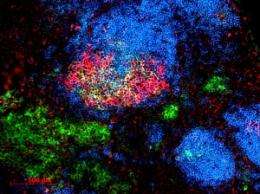
In mice, the particles can stimulate production of antibodies to proteins from flu virus or anthrax bacteria several orders of magnitude more effectively than alum, the authors found. In addition, the immune cells persist in lymph nodes for at least 18months, almost the lifetime of a mouse. In experiments with monkeys, nanoparticles with viral protein could induce robust responses greater than five times the response induced by a dose of the same viral protein given by itself, without the nanoparticles.
More information: S.P. Kasturi et al. Programming the magnitude and persistence of antibody responses with innateimmunity. Nature (2011). doi:10.1038/nature09737
Provided by Emory University


