Violent storms on alien planets
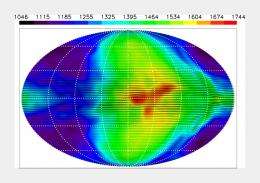
Hundreds of planets have now been detected outside our solar system. So far, very little is known about the physical conditions on these fascinating objects. Kevin Heng from the Institute for Astronomy at ETH Zurich is attempting to close this gap with sophisticated model stimulations.
In 1992, American scientists discovered the first planets outside our solar system – a scientific sensation at the time. Well over 500 objects have now been confirmed by astronomers as exoplanets. There are also several hundred other objects identified as possible exoplanets by the Kepler space telescope, according to a recent NASA statement. With this abundance of newly discovered planets, the question as to the exact structure of these objects and the conditions prevailing on them naturally arises. This is a field of research still in its infancy and shrouded in speculation, since the information that can be derived directly from measurements is severely limited. For example, astronomers can only indirectly infer whether a particular exoplanet has a solid core and how thick its atmosphere is.
The main problem when studying exoplanets is that they emit only very little light compared to the star around which they orbit. The low intensity of light makes it exceedingly difficult to carry out spectral analyses that yield information about the chemical structure of the object. Nevertheless, a few things can now be said about these exoplanets, as Kevin Heng, Zwicky Fellow at the Institute for Astronomy at ETH Zurich, showed in an article published recently in the scientific journal Monthly Notices of the Royal Astronomical Society.
Temperature shift
Based on observations up to now, Kevin Heng used simulation models to reconstruct the climatic conditions that might prevail on various exoplanets. For example he calculated that violent winds – with speeds of several kilometres per second – are present on one of the biggest of the exoplanets discovered so far.
This exoplanet studied by Heng orbits relatively close to its star. Experts call such objects “hot Jupiters”. Astronomers conclude by theoretical inference that the orientation of such planets relative to their star is fixed, i.e. the light from their star always illuminates them on the same side – similar to the way the same side of the Moon always faces towards the Earth. Thus, hot Jupiters are expected to have permanent day and night sides.
In the case of a hot Jupiter, one expects to measure the highest temperature when the illuminated face of the planet is fully visible. However, measurements by other groups show that the maximum temperature is shifted with respect to the point where starlight is at its most intense. Kevin Heng can now explain this surprising finding with his models: “The shift occurs because strong winds in the exoplanet’s atmosphere carry part of the heat from the day side to the night side. The exoplanet is basically trying to reduce the temperature difference between its day and night sides.”
Solid concordance between the models
Kevin Heng bases his statements on three-dimensional model simulations, which he runs on the Brutus computing cluster at ETH Zurich. He explains that, “We are in a difficult situation. We cannot use direct measurements to verify the calculations we make, nor do we know per se whether our modelling strategies are correct at all.” To gain slightly more certainty at least with regard to the models, he compared two models based on different methods of solution. Both are able to replicate the conditions in the Earth’s atmosphere correctly, and produce very similar results for the exoplanets that were studied. Kevin Heng explains that, “The aim of this comparison was to create a standard against which other models can be validated.”
There is now also concrete evidence that Kevin Heng’s calculations may be correct at least in their order of magnitude: based on frequency shifts in the absorption lines associated with an exoplanet, another group of researchers has also concluded that winds with a speed of two kilometres per second exist on this planet. This represents a high level of concordance, considering how little tangible knowledge exists about exoplanets.
More information: Heng K, et al. Atmospheric circulation of tidally-locked exoplanets: a suite of benchmark tests for dynamical solvers. Mon. Not. R. Astron. Soc., in press (2011) arxiv.org/abs/1010.1257
Provided by ETH Zurich


