Unearthing ancient secrets of daily life in Roman city
Feb 15, 2011

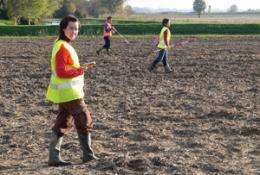
The Department of Ancient History’s Dr. Arianna Traviglia will be part of a groundbreaking cooperative archeological project in which she will be exploring what life was like for the more than 100,000 people who would have lived outside the city walls.

At its height Aquilea was home to 100,000 people, but the city walls could not accommodate a population of that size.

"Most of the population would have lived outside the city walls, and that’s my project," says Traviglia. "We don’t know pretty much anything about what was outside the city: where the people were living, where the nice villas were, where the fancy, rich Romans were living and so on."

New technologies will also make long distance collaboration easier. "My research assistant is in Italy. We share data on the internet every day. If I have specific ideas I can send her to check and she can send me the data."

She is also hopeful that modern survey techniques, such as hyperspectral data imaging and laser scanners, will reveal far more about the city than traditional archaeological practices would normally uncover.

"Hyperspectral data looks like a picture but in each pixel is recorded in the electromagnetic spectrum in a range the human eye can’t see," she explains. "For example, I can detect the difference in vegetation growth, which is a sign that there could be archaeological structures underneath."

Traviglia hopes that this agreement will help to establish further agreements and broaden the opportunites for foreign study in this field. Her department is investing in a new Archaeological Fieldwork Lab to bring the most up-to-date technologies to the classroom. "The most important thing for us is to be able to train students to use it."

Explore further: King Richard III found in 'untidy lozenge-shaped grave'

Provided by Macquarie University

4 /5 (2 votes)
add to favorites email to friend print save as pdf

Related Stories

Ancient Phoenician city not destroyed

Mar 14, 2006

The ancient Phoenician city Motya, believed destroyed by ancient Greeks, has been found to have been inhabited long after that supposed event.

Living in densely populated areas linked to lower body mass

Feb 20, 2007

New York City dwellers who reside in densely populated, pedestrian-friendly areas have significantly lower body mass index levels compared to other New Yorkers, according to a new study by the Mailman School of Public Health. ...

Uncovering Nottingham's hidden medieval sandstone caves

May 13, 2010

The very latest laser technology combined with old fashioned pedal power is being used to provide a unique insight into the layout of Nottingham's sandstone caves — where the city's renowned medieval ale was brewed and, ...

Recommended for you

The ascent of man: Why our early ancestors took to two feet

13 hours ago

A new study by archaeologists at the University of York challenges evolutionary theories behind the development of our earliest ancestors from tree dwelling quadrupeds to upright bipeds capable of walking and scrambling.

Submerged structure stumps Israeli archaeologists

May 23, 2013

The massive circular structure appears to be an archaeologists dream: a recently discovered antiquity that could reveal secrets of ancient life in the Middle East and is just waiting to be excavated.

User comments : 0

More news stories

Challenging the public's view of gender and science

According to She Figures 2012, which analyses gender equality in research, in 2010 women accounted for only 10 % of university rectors in Europe and 15.5 % were heads of institutions of the higher education ...

Galaxies fed by funnels of fuel

(Phys.org) —Computer simulations of galaxies growing over billions of years have revealed a likely scenario for how they feed: a cosmic version of swirly straws.

Google eyes emerging markets networks

Google has become deeply involved in a series of projects to build and operate wireless networks in emerging markets including sub-Saharan Africa and Southeast Asia, a report said Friday.