Ultrathin coating generates current more efficiently from nanowire
Electrical energy can be generated from a temperature difference in a circuit with suitable materials. In simulations, ETH Zurich scientists show which materials are most likely to succeed in a thermoelectric process.
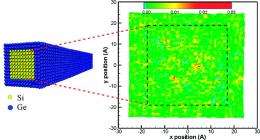
The nanowires look like long french fries: elongated rectangular cuboids more than 300 silicon unit cells long and with a cross-section 9 unit cells wide and 9 high. The wires are tiny, only 160 nanometres long and about five nanometres in equivalent diameter – 10,000 times thinner than a hair. The nanowires are coated with an atomically-thin layer of germanium, the thickness of the layer being only one to two unit cells of the semiconductor material.
A silicon-germanium nanowire with this construction is – or rather would be – a worthy candidate for use in thermoelectricity. The only problem is that, up to now, the tiny semiconductor wire in this form exists only in the computer of Ming Hu, a post-doctoral scientist in the group of Dimos Poulikakos, Professor of Thermodynamics at the Institute of Energy Technology. Professor K. Giapis of the California Institute of Technology, USA, who spent his Sabbatical leave with the Poulikakos group at ETH Zurich also collaborated in performing the research that led to the development of this wire.
More effective nanowires
Thermoelectricity exploits the fact that temperature and electricity can be under certain conditions inter-convertible. Due to the so-called Seebeck effect, a small electrical voltage occurs in a circuit when a temperature difference is present between the contact points of two different kinds of electrical conductors in the circuit. However, not all conducting or semiconducting materials are suitable for thermoelectricity generation. To exhibit high conversion coefficients rendering a material viable to realistic applications the material thermal conductivity must be as small as possible, whereas its electrical conductivity must be large. Dimos Poulikakos says, “Such materials are practically non-existent in nature.”
Therefore, the goal of the research project was to design a suitable material that had these properties. Silicon abandons in nature and could be especially suitable in this respect. Although the thermal conductivity of bulk silicon is high, this thermal conductivity deteriorates as soon as the semiconductor is converted into a wire-like nanostructure. The ETH Zurich professor warns however, that “even pure silicon nanowires are not good enough for efficient energy conversion.”
Germanium layer further reduces thermal conductivity
Through computer simulations, Hu Ming has now discovered how the problem might be solved. He showed that silicon nanowires conduct heat even more poorly if they are coated with an atomically thin layer of germanium, another semiconductor. The thermal conductivity decreases by 75 percent compared to pure silicon nano-wires, and does so at room temperature. On the other hand, when Hu added more layers of germanium in his model, the thermal conductivity increased again.
The researchers showed that the reason for the dramatic reduction in the thermal conductivity of germanium-coated silicon nanowires lies in the altered vibration modes of the phonons that transport heat through the crystal lattice. The wavelengths of the particles were shortened and compressed at the interfacial layer between the silicon and the germanium, which blocked the heat transport to a very large degree.
Therefore, the researchers conclude that thin silicon nanowires should be coated with one or two layers of germanium to enable a significant step toward achieving viable thermoelectric processes.
From the computer to the laboratory
The Si/Ge nanowires still exist only in Ming Hu’s computer. However, the plan is to manufacture them soon in Poulikakos’ laboratory for real experiments. Thermoelectric methods could make an important contribution to alternative energy production in the future. For example, the ETH Zurich professor can envisage that, with the aid of suitable installations, they could be used to exploit the waste heat from machines or buildings to generate electricity, which can be stored or fed into the grid. Based on the present state of knowledge, one could imagine devices that supply electricity to individual houses or portable equipment. Thermoelectric modules, e.g. as big as a kitchen table, could also act as solar panels to generate electrical energy from solar energy. However, these are initial thought experiments at the moment. Poulikakos warns that, “Such practical applications are still a rather long way into the future”
More information: Hu M, et al. Significant Reduction of Thermal Conductivity in Si/Ge Core-Shell Nanowires. Nano Lett. 2011, 11, 618–623. doi: 10.1021/nl103718a
Provided by ETH Zurich


