Stellar discovery excites students
February 3, 2011 By Sue Ann Heatherly

Stellar discovery excites students

Enlarge

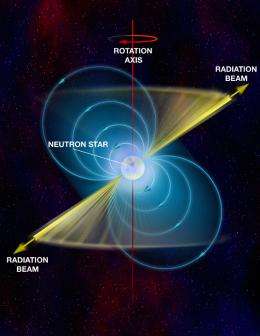
Basics of a Pulsar. Credit: Bill Saxton, NRAO/AUI/NSF

In the constellation of Ophiuchus, above the disk of our Milky Way Galaxy, there lurks a stellar corpse spinning 30 times per second -- an exotic star known as a radio pulsar. This object was unknown until it was discovered last week by three high school students. These students are part of the Pulsar Search Collaboratory (PSC) project, run by the National Radio Astronomy Observatory (NRAO) in Green Bank, WV, and West Virginia University (WVU).

The , which may be a rare kind of neutron star called a recycled pulsar, was discovered independently by Virginia students Alexander Snider and Casey Thompson, on January 20, and a day later by Kentucky student Hannah Mabry. "Every day, I told myself, 'I have to find a pulsar. I better find a pulsar before this class ends,'" said Mabry.

When she actually made the discovery, she could barely contain her excitement. "I started screaming and jumping up and down."

Thompson was similarly expressive. "After three years of searching, I hadn't found a single thing," he said, "but when I did, I threw my hands up in the air and said, 'Yes!'."

Snider said, "It actually feels really neat to be the first person to ever see something like that. It's an uplifting feeling."

As part of the PSC, the students analyze real data from NRAO's Robert C. Byrd Green Bank Telescope (GBT) to find pulsars. The students' teachers -- Debra Edwards of Sherando High School, Leah Lorton of James River High School, and Jennifer Carter of Rowan County Senior High School -- all introduced the PSC in their classes, and interested students formed teams to continue the work.

Even before the discovery, Mabry simply enjoyed the search. "It just feels like you're actually doing something," she said. "It's a good feeling."

Once the pulsar candidate was reported to NRAO, Project Director Rachel Rosen took a look and agreed with the young scientists. A followup observing session was scheduled on the GBT. Snider and Mabry traveled to West Virginia to assist in the follow-up observations, and Thompson joined online.

"Observing with the students is very exciting. It gives the students a chance to learn about radio telescopes and pulsar observing in a very hands-on way, and it is extra fun when we find a pulsar," said Rosen.

Snider, on the other hand, said, "I got very, very nervous. I expected when I went there that I would just be watching other people do things, and then I actually go to sit down at the controls. I definitely didn't want to mess something up."

Everything went well, and the observations confirmed that the students had found an exotic pulsar. "I learned more in the two hours in the control room than I would have in school the whole day," Mabry said.

Pulsars are spinning that sling lighthouse beams of radio waves or light around as they spin. A neutron star is what is left after a massive star explodes at the end of its normal life. With no nuclear fuel left to produce energy to offset the stellar remnant's weight, its material is compressed to extreme densities. The pressure squeezes together most of its protons and electrons to form neutrons; hence, the name neutron star. One tablespoon of material from a pulsar would weigh 10 million tons -- as much as a supertanker.

The object that the students discovered is in a special class of pulsar that spins very fast - in this case, about 30 times per second, comparable to the speed of a kitchen blender.

"The big question we need to answer first is whether this is a young pulsar or a recycled pulsar," said Maura McLaughlin, an astronomer at WVU. "A pulsar spinning that fast is very interesting as it could be newly born or it could be a very old, recycled pulsar."

A recycled pulsar is one that was once in a binary system. Material from the companion star is deposited onto the pulsar, causing it to speed up, or be recycled. Mystery remains, however, about whether this pulsar has ever had a companion star.

If it did, "it may be that this pulsar had a massive companion that exploded in a supernova, disrupting its orbit," McLaughlin said. Astronomers and students will work together in the coming months to find answers to these questions.

The PSC is a joint project of the and West Virginia University, funded by a grant from the National Science Foundation. The PSC, led by NRAO Education Officer Sue Ann Heatherly and Project Director Rachel Rosen, includes training for teachers and student leaders, and provides parcels of data from the GBT to student teams. The project involves teachers and students in helping astronomers analyze data from the GBT, a giant, 17-million-pound telescope.

Some 300 hours of observing data were reserved for analysis by student teams. Thompson, Snider, and Mabry have been working with about 170 other students across the country. The responsibility for the work, and for the discoveries, is theirs. They are trained by astronomers and by their teachers to distinguish between pulsars and noise. The students' collective judgment sifts the pulsars from the noise.

All three students had analyzed thousands of data plots before coming upon this one. Casey Thompson, who has been with the PSC for three years, has analyzed more than 30,000 plots.

"Sometimes I just stop and think about the fact that I'm looking at data from space," Thompson said. "It's really special to me."

In addition to this discovery, two other astronomical objects have been discovered by students. In 2009, Shay Bloxton of Summersville, WV, discovered a pulsar that spins once every four seconds, and Lucas Bolyard of Clarksburg, WV, discovered a rapidly rotating radio transient, which astronomers believe is a pulsar that emits radio waves in bursts.

Those involved in the PSC hope that being a part of astronomy will give students an appreciation for science. Maybe the project will even produce some of the next generation of astronomers. Snider, surely, has been inspired.

"The PSC changed my career path," confessed Thompson. "I'm going to study astrophysics."

Snider is pleased with the idea of contributing to scientific knowledge. "I hope that astronomers at Green Bank and around the world can learn something from the discovery," he said.

Mabry is simply awed. "We've actually been able to experience something," she said.

Provided by National Radio Astronomy Observatory search and more info website

Filter


Move the slider to adjust rank threshold, so that you can hide some of the comments.


Display comments: newest first

Quantum_Conundrum
Feb 03, 2011

Rank: 1 / 5 (14)
A neutron star is what is left after a massive star explodes at the end of its normal life. With no nuclear fuel left to produce energy to offset the stellar remnant's weight, its material is compressed to extreme densities. The pressure squeezes together most of its protons and electrons to form neutrons; hence, the name neutron star. One tablespoon of material from a pulsar would weigh 10 million tons -- as much as a supertanker.


Except when you do the math, this theory doesn't work, because the amount of energy needed to explode the star is more than any normal fusion process or electron capture process can make. Only an anti-matter annihilation can release enough energy to cause a supernova.

the neutron star is NOT a by-product of the explosion. The Neutron star's gravity causes the explosion by starting a chain reaction by colliding protons to make ANTI-neutrons, which then decay into anti-protons and positrons, which annihilate.
Quantum_Conundrum
Feb 03, 2011

Rank: 1.3 / 5 (13)
Normal fusion doesn't make enough power to do much more than burp the gases off the surface of a star, even if all the matter fused instantaneously.

When the core collapses, the remaining "ordinary matter" above it falls into the void and is smashed onto the surface of the neutron star as the remaining protos in the hydrogen and helium "outer layers" of the star collide with one another, making anti-neutrons. This causes a stellar mass anti-matter annihilation in a shell of collapsing matter immediately surrounding the neutron star, which in turn blows off the outer 1/3 to 1/2 of the star, leaving behind about 1/3 to 1/4 of the original mass as the Neutron star which started it all...

If you do not believe this, integrate the gravitational acceleration formula and plug in a stellar mass or two for the big "M", and neutron star radii for "r". No matter how much you try or lie, you cannot overcome that much gravitation through a fusion-based explosion.
TopherTO
Feb 03, 2011

Rank: 5 / 5 (8)
QC you found another issue with their math?

Everytime I read an article on PhysOrg you are ranting about numbers not adding up. I guess there is a massive conspiracy to spread cosmological lies...

Or we are in need of a global recall on faulty calculators.
omatumr
Feb 03, 2011

Rank: 1.1 / 5 (8)
Congratulations!

Keep looking! You may find proto-planetary debris orbiting that pulsar.

At least, that seems to be how planets formed here in the solar system ["Nuclear Systematics: Part IV. Neutron-capture cross sections and solar abundance", Journal of Radioanalytical and Nuclear Chemistry, vol. 266, No. 2 (2005) 159–163].

With kind regards,
Oliver K. Manuel
Nik_2213
Feb 03, 2011

Rank: 3.5 / 5 (2)
Uh, perhaps the collapse / accretion is not spherically symmetric ?? Stars do rotate and, IIRC, most stars rotate much faster than our Sun...
Kumelys
Feb 03, 2011

Rank: 4.8 / 5 (8)
QC your math is 'stellar' in some aspects. Fusion has so little to do with super novas... There are not only fusion caused repulsion and gravitation in star, there is also hydrostatic pressure, convection currents and many other interesting things going in there. I would advice you to read some serious books on subject (serious, I mean, let's say textbooks for astronomy undergraduates or something, start with Carroll 'Fundamental Astrophysics', great start) and brag that their math is wrong and only you are right after that.
technicalengeneering
Feb 04, 2011

Rank: 4.5 / 5 (8)
@ QC

ANTI-NEUTRONS.... Now where doesn't that add up?
omatumr
Feb 04, 2011

Rank: 1 / 5 (6)
No matter how much you try or lie, you cannot overcome that much gravitation through a fusion-based explosion.


Neutron repulsion is the key.

youtube.com/watch?v=sXNyLYSiPO0

With kind regards,
Oliver K. Manuel
Quantum_Conundrum
Feb 04, 2011

Rank: 1 / 5 (3)
@ QC

ANTI-NEUTRONS.... Now where doesn't that add up?


Google it, moron. You know nothing.

A = GM/r^2

The acceleration gravity on the "surface" of the "core" of a 1M star is around 6.67km/s.

In a 10M Star, the acceleration due to gravity on the surface of the core as it collapses to a neutron star is in the trillions m/s^2.

Absolutely nothing other than anti-matter annihilation can even remotely break even with this, nevermind overcome it.

You can compute the amount of "work" required to explode the shell of matter away from the neutron star at Ve, by integrating the above from A to B where A is radius of the neutron star, and B is radius of the shell at any given time. This is the average of the graviataional acceleration along a curve at escape velocity. If you then multiply this number by the mass displaced and the distance displaced, you get "work".

By E = MC^2 you find it takes about 1/3rd of the initial mass of the star being annihilated to do this.
Quantum_Conundrum
Feb 04, 2011

Rank: 1 / 5 (3)
Since I know you're too lazy.

Anti-neutron:

wikipedia.org/wiki/Antineutron

You can also check the main Physforums site where I proved this is what happened to the "missing mass" in the Crab Nebula using this logic. I calculated to within less than 25% margin of error that the mass energy of this "missing mass" is EXACTLY the amount of energy needed to cause the observed explosion, and this conversion of mass to kinetic energy could only have been accomplished through anti-matter annihilation.

Additionally, in the calculation, I even neglected the fact that the cloud continues to expand with speed greater than escape velocity, so by the time you factor that "excess" energy above the curve, I'm positive all of the missing mass will be there in the form of the kinetic energy.
Quantum_Conundrum
Feb 04, 2011

Rank: 1 / 5 (3)
The acceleration due to gravity on the surface of the Crab Pulsar is between:

947,664,071,429m/s^2 and 1.35 TRILLION m/s^2.

This means that just to break even to explode away, you'd need a FORCE of around 1 trillion Newtons per kilogram mass in the shell that exploded away. In order to obtain escape velocity you need to EXCEED this force for an amount of time sufficient to obtain escape velocity.

By the way, escape velocity of the crab pulsar is 0.648c...

This exceeds the maximum theoretical velocity of an ideal fusion rocket in assymptotically flat space- time.

Translation:

Not a chance in HELL of a fusion explosion or anything else other than anti-matter annihilation overcoming the gravitational acceleration by enough to achieve escape velocity...it simply isn't possible...

Since we can clearly see the nebula exists and expands greater than Ve, then "something" overcame this.

Only the complete conversion of the "missing mass" to kinetic energy can do this.
Thrasymachus
Feb 04, 2011

Rank: 4 / 5 (4)
QC, you're fudging your math too much there. You're assuming the smallest possible radius for any neutron star and the largest possible mass. Neutronium is compressible, which means its density is not a constant, and you can't calculate the gravitational binding energy from it alone. In fact, it only requires about 18% of our sun's mass being converted to energy. Given that we're starting with stars several times more massive than our sun, converting that much mass into energy through fusion alone is more than feasible.
Skeptic_Heretic
Feb 04, 2011

Rank: 5 / 5 (1)
QC, I have two problems here.

First, the gravitational acceleration is ever increasing in intensity. Your energy figures of off by an exponential degree because of this.

Second, once neutronium forms the energy in the reaction increases as the matter is squashed so fast that a lot of the various nuclear binding energies are released creating exactly what you're demanding above, fusion explosions.
Quantum_Conundrum
Feb 04, 2011

Rank: 1 / 5 (3)
QC, I have two problems here.

First, the gravitational acceleration is ever increasing in intensity. Your energy figures of off by an exponential degree because of this.


For the purpose of that calculation, it evens out, because outer shells of the expanding nebula are influenced by the gravity of the inner shells.

Second, once neutronium...


fusion explosions are not enough. You missed the point.

Fusion explosions only convert at most a few percent of the rest mass to energy. For example, the first phase of the proton-proton chain only converts 0.7% of rest mass to other forms of energy.

So if the entire 11M mass had fused instanly from hydrogen to helium, it would only be 1.378E46 joules.

This would be enough energy in flat space time to move the ~5M cloud to it's current velocity, but not in the presence of gravity.
Skeptic_Heretic
Feb 05, 2011

Rank: not rated yet
fusion explosions are not enough. You missed the point.

Fusion explosions only convert at most a few percent of the rest mass to energy. For example, the first phase of the proton-proton chain only converts 0.7% of rest mass to other forms of energy.

So if the entire 11M mass had fused instanly from hydrogen to helium, it would only be 1.378E46 joules.
No, I think you're missing the point. We're not fusing from H2 to He. We're fusing from H2 to Neutronium. The majority of the rest mass is preserved but you're releasing (potentially) ALL the nuclear binding energy.
Quantum_Conundrum
Feb 05, 2011

Rank: 1 / 5 (1)
Only about 2M got made into neutronium.

The 5M cloud is still ordinary matter: Hydrogen,helium, oxygen, calcium, carbon, lithiusm, etc, with traces of heavy metals.
Resonance
Feb 05, 2011

Rank: 3 / 5 (2)
QC and omatumr are really the same person...
Rank 5 /5 (4 votes)
Relevant PhysicsForums posts
  • revamping general concept and cosmological principle
    createdMay 25, 2012
  • Transiting Exoplanet Light Curve
    createdMay 25, 2012
  • Math behind Theoretical Physics
    createdMay 24, 2012
  • Do we know whats at the center of galaxies yet?
    createdMay 23, 2012
  • Structure of the Milky Way?
    createdMay 20, 2012
  • What would it take to terraform Pluto and Charon?
    createdMay 19, 2012
  • More from Physics Forums - General Astronomy

More news stories

SpaceX capsule has 'new car' smell, astronauts say (Update)

SpaceX's Dragon cargo vessel smells like a new car, said astronauts at the International Space Station after opening the hatches Saturday following the spacecraft's landmark mission to the orbiting lab.

Space & Earth / Space Exploration

created 13 hours ago | popularity 4.6 / 5 (18) | comments 0

Australia hails surprise super-telescope decision

Australia has hailed a surprise decision giving it a role in a radio telescope project aimed at revolutionising astronomy, vowing to draw on its decades of experience in space science.

Space & Earth / Astronomy

created 13 hours ago | popularity 5 / 5 (3) | comments 0

Astronomers seize last chance in lifetime for Venus Transit

Astronomers are gearing for one the rarest events in the Solar System: an alignment of Earth, Venus and the Sun that will not be seen for another 105 years.

Space & Earth / Astronomy

created 13 hours ago | popularity 5 / 5 (1) | comments 0

Astronauts enter world's 1st private supply ship

(AP) -- Space station astronauts floated into the Dragon on Saturday, a day after its heralded arrival as the world's first commercial supply ship.

Space & Earth / Space Exploration

created 13 hours ago | popularity 5 / 5 (5) | comments 0

Dragon arrives at space station in historic 1st (Update 2)

The privately bankrolled Dragon capsule made a historic arrival at the International Space Station on Friday, triumphantly captured by astronauts wielding a giant robot arm.

Space & Earth / Space Exploration

created May 25, 2012 | popularity 5 / 5 (10) | comments 19


Dell tablet leak: 10.1-inch display, two-battery choice

(Phys.org) -- Headline after headline talks about vendors’ tablets in the wings as likely number-one contenders for the iPad. Such claims have justifiably been taken with a grain of salt, considering ...

Scientist: Evolution debate will soon be history

(AP) -- Richard Leakey predicts skepticism over evolution will soon be history. Not that the avowed atheist has any doubts himself.

SpotterRF debuts Radar Backpack Kit (w/ Video)

(Phys.org) -- SpotterRF has announced a special radar backpack kit designed to enhance situational awareness for soldiers on the ground. The company says its special radar is designed for warfighters as part ...

Keep food safety in mind this memorial day weekend

(HealthDay) -- Picnics, parades and cookouts are as much a part of Memorial Day weekend as tributes to the United States' war veterans.

Thousands of shellfish found dead in Peru

Thousands of crustaceans were found dead off the coast of Lima following the mystery mass death of dolphins and pelicans, the Peruvian Navy said Friday.

Family history of Alzheimer's affects functional connectivity

(HealthDay) -- Cognitively normal individuals with a family history of late-onset Alzheimer's disease (AD) may display lower resting state functional connectivity in the default mode network (DMN) of the brain, ...